
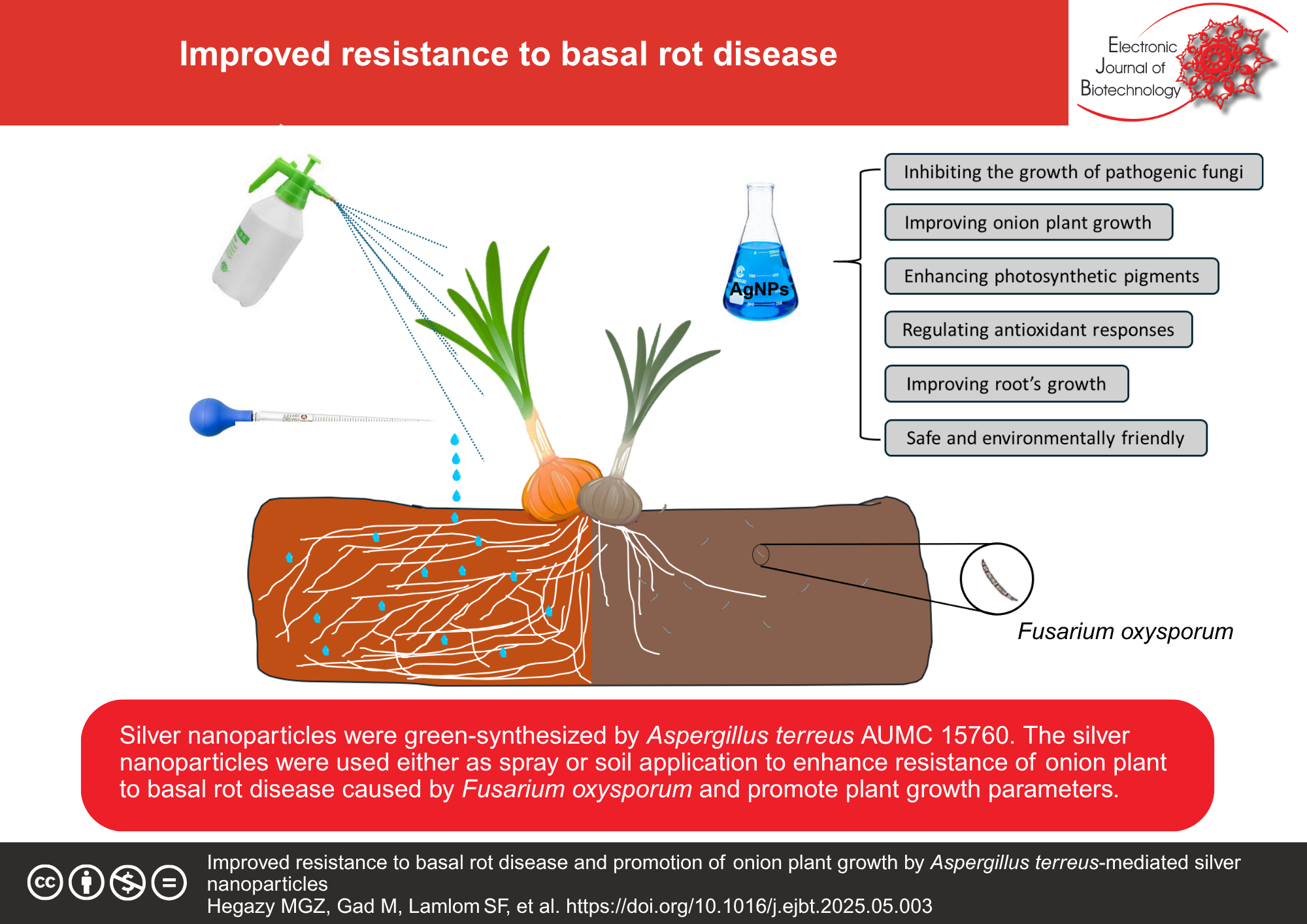
Graphical abstract
Keywords
How to Cite
Abstract
Background: Onions, a vital agricultural crop rich in carbohydrates and essential minerals, face severe threats from Fusarium oxysporum, the causative agent of basal rot disease. This study assessed the effectiveness of extracellular, green-synthesized silver nanoparticles (AgNPs), produced by Aspergillus terreus AUMC 15760, in managing basal rot disease caused by F. oxysporum AUMC 15798.
Results: AgNPs ranging from 12.1 to 28.7 nm were incorporated into PDA media at concentrations of 50, 100, 150, and 200 ppm, achieving fungal growth inhibition rates of 24.88%, 40.77%, 54.44%, and 69.33%, respectively. A greenhouse experiment was carried out using onion seedlings, with a randomized complete block design (RCBD) to compare eight different treatments: 100 ppm AgNPs (spray), 50 ppm AgNPs (spray), 100 ppm AgNPs (soil application), 50 ppm AgNPs (soil application), Dovex spray (50%), Dovex soil application (50%), a negative control, and a positive control. Greenhouse results showed a significant reduction in disease severity, with Dovex lowering it to 20%. AgNPs at 50 ppm reduced severity to 57.77% (soil) and 35.55% (spray), while 100 ppm further decreased it to 31.1% (soil) and 22.2% (spray). The application of 100 ppm AgNPs improved plant growth parameters. It also enhanced chlorophyll a, chlorophyll b, and carotenoid levels. The greatest reductions in phenolic (0.34 mg/g) and anthocyanin contents (0.48 mg/g), as well as peroxidase (0.44 µmol/min) and catalase activities (0.19 µmol/min), were recorded in plants treated with 100 ppm AgNPs (spray).
Conclusions: AgNPs effectively control basal rot disease, boost plant growth, and regulate antioxidant activity.
References
. Chakraborty AJ, Uddin TM, Zidan BRM, et al. Allium cepa: A treasure of bioactive phytochemicals with prospective health benefits. Evidence-Based Complementary and Alternative Medicine 2022;2022(1):4586318. https://doi.org/10.1155/2022/4586318 PMid: 35087593
. Sami R, Elhakem A, Alharbi M, et al. Nutritional values of onion bulbs with some essential structural parameters for packaging process. Applied Sciences 2021;11(5):2317. https://doi.org/10.3390/app11052317
. Sharma S, Mandal S, Cramer CS. Recent advances in understanding and controlling Fusarium diseases of alliums. Horticulturae 2024;10(5):527. https://doi.org/10.3390/horticulturae10050527
. Edel-Hermann V, Lecomte C. Current status of Fusarium oxysporum formae speciales and races. Phytopathology 2019;109(4):512-30. https://doi.org/10.1094/PHYTO-08-18-0320-RVW PMid: 30461350
. Rongai D, Pulcini P, Pesce B, et al. Antifungal activity of some botanical extracts on Fusarium oxysporum. Open Life Sciences 2015;10(1):409-16. https://doi.org/10.1515/biol-2015-0040
. Nosrati H, Aramideh Khouy R, Nosrati A, et al. Nanocomposite scaffolds for accelerating chronic wound healing by enhancing angiogenesis. Journal of Nanobiotechnology 2021;19:1. https://doi.org/10.1186/s12951-020-00755-7 PMid: 33397416
. Thiruvengadam M, Rajakumar G, Chung I-M. Nanotechnology: current uses and future applications in the food industry. 3 Biotech. 2018;8:1-13. https://doi.org/10.1007/s13205-018-1104-7 PMid: 29354385
. Saxena J, Sharma MM, Gupta S, et al. Emerging role of fungi in nanoparticle synthesis and their applications. World J Pharm Sci. 2014;3(9):1586-613.
. Elgorban AM, El-Samawaty AE-RM, Yassin MA, et al. Antifungal silver nanoparticles: synthesis, characterization and biological evaluation. Biotechnology & Biotechnological Equipmen. 2016;30(1):56-62. https://doi.org/10.1080/13102818.2015.1106339
. Elblbesy MA-A, Madbouly AK, Hamdan TA-A. Bio-synthesis of magnetite nanoparticles by bacteria. Am J Nano Res Appl. 2014;2(5):98-103.
. Yassin MA, Elgorban AM, El-Samawaty AE-RM, et al. Biosynthesis of silver nanoparticles using Penicillium verrucosum and analysis of their antifungal activity. Saudi Journal of Biological Sciences. 2021;28(4):2123-7. https://doi.org/10.1016/j.sjbs.2021.01.063 PMid: 33911928
. Siddiqi KS, Husen A. Fabrication of metal nanoparticles from fungi and metal salts: scope and application. Nanoscale Research Letters. 2016;11:98. https://doi.org/10.1186/s11671-016-1311-2 PMid: 26909778
. Malik MA, Wani AH, Bhat MY, et al. Fungal-mediated synthesis of silver nanoparticles: a novel strategy for plant disease management. Frontiers in Microbiology. 2024;15:1399331. https://doi.org/10.3389/fmicb.2024.1399331 PMid: 39006753
. Anjum S, Vyas A, Sofi T. Fungi?mediated synthesis of nanoparticles: characterization process and agricultural applications. Journal of the Science of Food and Agriculture. 2023;103(10):4727-41. https://doi.org/10.1002/jsfa.12496 PMid: 36781932
. Tariq M, Mohammad KN, Ahmed B, et al. Biological synthesis of silver nanoparticles and prospects in plant disease management. Molecules. 2022;27(15):4754. https://doi.org/10.3390/molecules27154754 PMid: 35897928
. Buggana A, Bandari K, Golla N, et al. Leaf-mediated green synthesis of silver nanoparticles from Azadirachta indica and Ficus religiosa: characterization and bioactive properties. Egyptian Journal of Agricultural Research. 2024;102(3):392-406. https://doi.org/10.21608/ejar.2024.285666.1541
. Nasr A, Yousef AF, Hegazy MGA, et al. Biosynthesized silver nanoparticles mitigate charcoal rot and root-knot nematode disease complex in faba bean. Physiological and Molecular Plant Pathology. 2025;136:102610. https://doi.org/10.1016/j.pmpp.2025.102610
. Francis S, Joseph S, Koshy EP, et al. Microwave assisted green synthesis of silver nanoparticles using leaf extract of Elephantopus scaber and its environmental and biological applications. Artificial cells, nanomedicine, and biotechnology. 2018;46(4):795-804. https://doi.org/10.1080/21691401.2017.1345921 PMid: 28681662
. Siddiqi KS, Husen A, Rao RA. A review on biosynthesis of silver nanoparticles and their biocidal properties. Journal of Nanobiotechnology. 2018;16:14. https://doi.org/10.1186/s12951-018-0334-5 PMid: 29452593
. Zhao X, Zhou L, Riaz Rajoka MS, et al. Fungal silver nanoparticles: synthesis, application and challenges. Critical Reviews in Biotechnology. 2018;38(6):817-35. https://doi.org/10.1080/07388551.2017.1414141 PMid: 29254388
. Hegazy MG, Ahmed A-RM, Yousef AF, et al. Effectiveness of some plant extracts in biocontrol of induced onion basal rot disease in greenhouse conditions. AMB Express. 2024;14(1):72. https://doi.org/10.1186/s13568-024-01721-4 PMid: 38874641
. Ramadan AM, Shehata RM, El-Sheikh HH, et al. Exploitation of sugarcane bagasse and environmentally sustainable production, purification, characterization, and application of lovastatin by Aspergillus terreus AUMC 15760 under solid-state conditions. Molecules. 2023;28(10):4048. https://doi.org/10.3390/molecules28104048 PMid: 37241788
. Smith D, Onions AH. The preservation and maintenance of living fungi. Wallingford, UK: CAB international; 1994. https://doi.org/10.1079/9780851989020.0000
. Al-Bedak OA, Sayed RM, Hassan SH. A new low-cost method for long-term preservation of filamentous fungi. Biocatalysis and Agricultural Biotechnology. 2019;22:101417. https://doi.org/10.1016/j.bcab.2019.101417
. Hamad M. Biosynthesis of silver nanoparticles by fungi and their antibacterial activity. International Journal of Environmental Science and Technology. 2019;16:1015-24. https://doi.org/10.1007/s13762-018-1814-8
. Banala RR, Nagati VB, Karnati PR. Green synthesis and characterization of Carica papaya leaf extract coated silver nanoparticles through X-ray diffraction, electron microscopy and evaluation of bactericidal properties. Saudi Journal of Biological Sciences. 2015;22(5):637-44. https://doi.org/10.1016/j.sjbs.2015.01.007 PMid: 26288570
. Macías Sánchez KL, González Martínez HDR, Carrera Cerritos R, et al. In vitro evaluation of the antifungal effect of AgNPs on Fusarium oxysporum f. sp. lycopersici. Nanomaterials. 2023;13(7):1274. https://doi.org/10.3390/nano13071274 PMid: 37049367
. Abd-Elaziz MA, Aly MME-S, Mohamed A-EA. Biological control of some garlic diseases using antagonistic fungi and bacteria. Journal of Phytopathology and Disease Management. 2021;8(1):46-63.
. Hussein RR, Aly MME-S, Mohamed A-EA. Effect of some biofertilizers and biofungicides applications on control onion root-rot disease. Journal of Phytopathology and Disease Management. 2021;8(1):15-28.
. Shieh G, Jan SL. The effectiveness of randomized complete block design. Statistica Neerlandica. 2004;58(1):111-24. https://doi.org/10.1046/j.0039-0402.2003.00109.x
. AlAita A, Talebi H. Exact neutrosophic analysis of missing value in augmented randomized complete block design. Complex & Intelligent Systems. 2024;10(1):509-23. https://doi.org/10.1007/s40747-023-01182-5
. El-Naggar A, El-Sheikh Aly M, El-Emary F, et al. Disease management of rose powdery mildew using some fungicides and biofungicides. Archives of Agriculture Sciences Journal. 2023;6(2):44-57. https://doi.org/10.21608/aasj.2023.304185
. Ahmed HA, Hassan MA, Hussein MA, et al. Efficiency of bio-agents and green-synthesized silver nanoparticles in controlling purple blotch disease caused by Alternaria porri in onion plants. Notulae Scientia Biologicae. 2024;16(2):11854. https://doi.org/10.55779/nsb16211854
. Abdel Latef AAH, Abu Alhmad MF, Kordrostami M, et al. Inoculation with Azospirillum lipoferum or Azotobacter chroococcum reinforces maize growth by improving physiological activities under saline conditions. Journal of Plant Growth Regulation. 2020;39(3):1293-306. https://doi.org/10.1007/s00344-020-10065-9
. Oloumi H, Soltaninejad R, Baghizadeh A. The comparative effects of nano and bulk size particles of CuO and ZnO on glycyrrhizin and phenolic compounds contents in Glycyrrhiza glabra L. seedlings. Indian Journal of Plant Physiology. 2015;20:157-61. https://doi.org/10.1007/s40502-015-0143-x
. Kadhum MA, Hadwan MH. A precise and simple method for measuring catalase activity in biological samples. Chemical Papers. 2021;75:1669-78. https://doi.org/10.1007/s11696-020-01401-0
. Alici EH, Arabaci G. Determination of SOD, POD, PPO and cat enzyme activities in Rumex obtusifolius L. Annual Research & Review in Biology. 2016;11(3):1-7. https://doi.org/10.9734/ARRB/2016/29809
. Bradford MM. A rapid and sensitive method for the quantitation of microgram quantities of protein utilizing the principle of protein-dye binding. Analytical Biochemistry. 1976;72(1):248-54. https://doi.org/10.1016/0003-2697(76)90527-3 PMid: 942051
. Brantmeier C. Statistical procedures for research on L2 reading comprehension: An examination of ANOVA and Regression Models. Reading in a Foreign Language. 2004;16(2):51-69.
. Tallarida RJ, Murray RB, Tallarida RJ, et al. Duncan multiple range test: Springer, New York, NY; 1987. 125-7 p. https://doi.org/10.1007/978-1-4612-4974-0_38
. El-Debaiky SA, El-Sayed AF. Morphological and molecular identification of endophytic fungi from roots of tomato and evaluation of their antioxidant and cytotoxic activities. Egyptian Journal of Botany. 2023;63(3):981-1003. https://doi.org/10.21608/ejbo.2023.201958.2291
. Zhu Y, Lujan P, Wedegaertner T, et al. First report of Fusarium oxysporum f. sp. vasinfectum race 4 causing Fusarium wilt of cotton in New Mexico, USA. Plant Disease. 2020;104(2):588. https://doi.org/10.1094/PDIS-06-19-1170-PDN
. Ploetz RC. Fusarium wilt of banana. Phytopathology. 2015;105(12):1512-21. https://doi.org/10.1094/PHYTO-04-15-0101-RVW PMid: 26057187
. Chen Y, Lin Y, Chung W. Fusarium wilt of basil caused by Fusarium oxysporum f. sp. basilici in Taiwan. Plant Med. 2017;59(1-2):1-5.
. Salim HA, Salman IS, Jasim BN. IPM approach for the management of wilt disease caused by Fusarium oxysporum f. sp. lycopersici on tomato (Lycopersicon esculentum). Journal of Experimental Biology and Agricultural Sciences. 2016;4:742-7. https://doi.org/10.18006/2016.4(VIS).742.747
. Basco M, Bisen K, Keswani C, et al. Biological management of Fusarium wilt of tomato using biofortified vermicompost. Mycosphere. 2017;8(3):467-83. https://doi.org/10.5943/mycosphere/8/3/8
. Guerrero M, Martínez M, León M, et al. First report of Fusarium wilt of lettuce caused by Fusarium oxysporum f. sp. lactucae race 1 in Spain. Plant Disease. 2020;104(6):1858. https://doi.org/10.1094/PDIS-10-19-2143-PDN
. Rolim J, Savian L, Walker C, et al. First report of Fusarium wilt caused by Fusarium oxysporum on Pecan in Brazil. Plant Disease. 2020;104(6):1870. https://doi.org/10.1094/PDIS-09-19-1956-PDN
. Mohamed RA, Al-Bedak OA, Hassan SH. First record in Upper Egypt of vascular wilt on pomegranate caused by Fusarium oxysporum, its molecular identification and artificial pathogenicity. Journal of Plant Diseases and Protection. 2021;128:311-6. https://doi.org/10.1007/s41348-020-00385-z
. Al-Huqail AA, Hatata MM, Al-Huqail AA, et al. Preparation, characterization of silver phyto nanoparticles and their impact on growth potential of Lupinus termis L. seedlings. Saudi Journal of Biological Sciences. 2018;25(2):313-9. https://doi.org/10.1016/j.sjbs.2017.08.013 PMid: 29472784
. Janaki AC, Sailatha E, Gunasekaran S. Synthesis, characteristics and antimicrobial activity of ZnO nanoparticles. Spectrochimica Acta Part A: Molecular and Biomolecular Spectroscopy. 2015;144:17-22. https://doi.org/10.1016/j.saa.2015.02.041 PMid: 25748589
. Shaikh S, Nazam N, Rizvi SMD, et al. Mechanistic insights into the antimicrobial actions of metallic nanoparticles and their implications for multidrug resistance. International Journal of Molecular Sciences. 2019;20(10):2468. https://doi.org/10.3390/ijms20102468 PMid: 31109079
. Jo Y-K, Kim BH, Jung G. Antifungal activity of silver ions and nanoparticles on phytopathogenic fungi. Plant Disease. 2009;93(10):1037-43. https://doi.org/10.1094/PDIS-93-10-1037 PMid: 30754381
. Kim SW, Jung JH, Lamsal K, et al. Antifungal effects of silver nanoparticles (AgNPs) against various plant pathogenic fungi. Mycobiology. 2012;40(1):53-8. https://doi.org/10.5941/MYCO.2012.40.1.053 PMid: 22783135
. Mishra S, Singh BR, Naqvi AH, et al. Potential of biosynthesized silver nanoparticles using Stenotrophomonas sp. BHU-S7 (MTCC 5978) for management of soil-borne and foliar phytopathogens. Scientific Reports. 2017;7(1):45154. https://doi.org/10.1038/srep45154 PMid: 28345581
. Ferreira FV, Herrmann?Andrade AM, Calabrese CD, et al. Effectiveness of Trichoderma strains isolated from the rhizosphere of citrus tree to control Alternaria alternata, Colletotrichum gloeosporioides and Penicillium digitatum A21 resistant to pyrimethanil in post?harvest oranges (Citrus sinensis L. (Osbeck)). Journal of Applied Microbiology. 2020;129(3):712-27. https://doi.org/10.1111/jam.14657 PMid: 32249987
. Gomaa A, Mahdy A, Fawzy R, et al. Control of tomato fusarium wilt caused by Fusarium oxysporum f. sp. lycopersici by grafting and silver nanoparticles under greenhouse conditions. Benha Journal of Applied Sciences. 2022;7(5):37-50. https://doi.org/10.21608/bjas.2022.244584
. Hwang ET, Lee JH, Chae YJ, et al. Analysis of the toxic mode of action of silver nanoparticles using stress?specific bioluminescent bacteria. Small. 2008;4(6):746-50. https://doi.org/10.1002/smll.200700954 PMid: 18528852
. Prabhu S, Poulose EK. Silver nanoparticles: mechanism of antimicrobial action, synthesis, medical applications, and toxicity effects. International Nano Letters. 2012;2:32. https://doi.org/10.1186/2228-5326-2-32
. Sondi I, Salopek-Sondi B. Silver nanoparticles as antimicrobial agent: a case study on E. coli as a model for Gram-negative bacteria. Journal of Colloid and Interface Science. 2004;275(1):177-82. https://doi.org/10.1016/j.jcis.2004.02.012 PMid: 15158396
. Danilczuk M, Lund A, Sadlo J, et al. Conduction electron spin resonance of small silver particles. Spectrochimica Acta Part A: Molecular and Biomolecular Spectroscopy. 2006;63(1):189-91. https://doi.org/10.1016/j.saa.2005.05.002 PMid: 15978868
. Kim JS, Kuk E, Yu KN, et al. Antimicrobial effects of silver nanoparticles. Nanomedicine: Nanotechnology, Biology and Medicine. 2007;3(1):95-101. https://doi.org/10.1016/j.nano.2006.12.001 PMid: 17379174
. Feng QL, Wu J, Chen G-Q, et al. A mechanistic study of the antibacterial effect of silver ions on Escherichia coli and Staphylococcus aureus. Journal of Biomedical Materials Research. 2000;52(4):662-8. https://doi.org/10.1002/1097-4636(20001215)52:4<662::AID-JBM10>3.0.CO;2-3 PMid: 11033548
. Matsumura Y, Yoshikata K, Kunisaki S-i, et al. Mode of bactericidal action of silver zeolite and its comparison with that of silver nitrate. Applied and environmental microbiology. 2003;69(7):4278-81. https://doi.org/10.1128/AEM.69.7.4278-4281.2003 PMid: 12839814
. Morones JR, Elechiguerra JL, Camacho A, et al. The bactericidal effect of silver nanoparticles. Nanotechnology. 2005;16(10):2346. https://doi.org/10.1088/0957-4484/16/10/059 PMid: 20818017
. Hatchett DW, White HS. Electrochemistry of sulfur adlayers on the low-index faces of silver. The Journal of Physical Chemistry. 1996;100(23):9854-9. https://doi.org/10.1021/jp953757z
. Mashwani Z-u-R, Khan T, Khan MA, et al. Synthesis in plants and plant extracts of silver nanoparticles with potent antimicrobial properties: current status and future prospects. Applied microbiology and biotechnology. 2015;99:9923-34. https://doi.org/10.1007/s00253-015-6987-1 PMid: 26392135
. Mohanta YK, Biswas K, Jena SK, et al. Anti-biofilm and antibacterial activities of silver nanoparticles synthesized by the reducing activity of phytoconstituents present in the Indian medicinal plants. Frontiers in Microbiology. 2020;11:1143. https://doi.org/10.3389/fmicb.2020.01143 PMid: 32655511
. Sadak MS. Impact of silver nanoparticles on plant growth, some biochemical aspects, and yield of fenugreek plant (Trigonella foenum-graecum). Bulletin of the National Research Centre. 2019;43(1):1-6. https://doi.org/10.1186/s42269-019-0077-y
. Krishnaraj C, Jagan E, Ramachandran R, et al. Effect of biologically synthesized silver nanoparticles on Bacopa monnieri (Linn.) Wettst. plant growth metabolism. Process biochemistry. 2012;47(4):651-8. https://doi.org/10.1016/j.procbio.2012.01.006
. Oh M-M, Trick HN, Rajashekar C. Secondary metabolism and antioxidants are involved in environmental adaptation and stress tolerance in lettuce. Journal of plant physiology. 2009;166(2):180-91. https://doi.org/10.1016/j.jplph.2008.04.015 PMid: 18562042
. Abd-Ellatif S, Ibrahim AA, Safhi FA, et al. Green synthesized of Thymus vulgaris chitosan nanoparticles induce relative WRKY-genes expression in Solanum lycopersicum against Fusarium solani, the causal agent of root rot disease. Plants. 2022;11(22):3129. https://doi.org/10.3390/plants11223129 PMid: 36432858

This work is licensed under a Creative Commons Attribution-ShareAlike 4.0 International License.
Copyright (c) 2025 Electronic Journal of Biotechnology