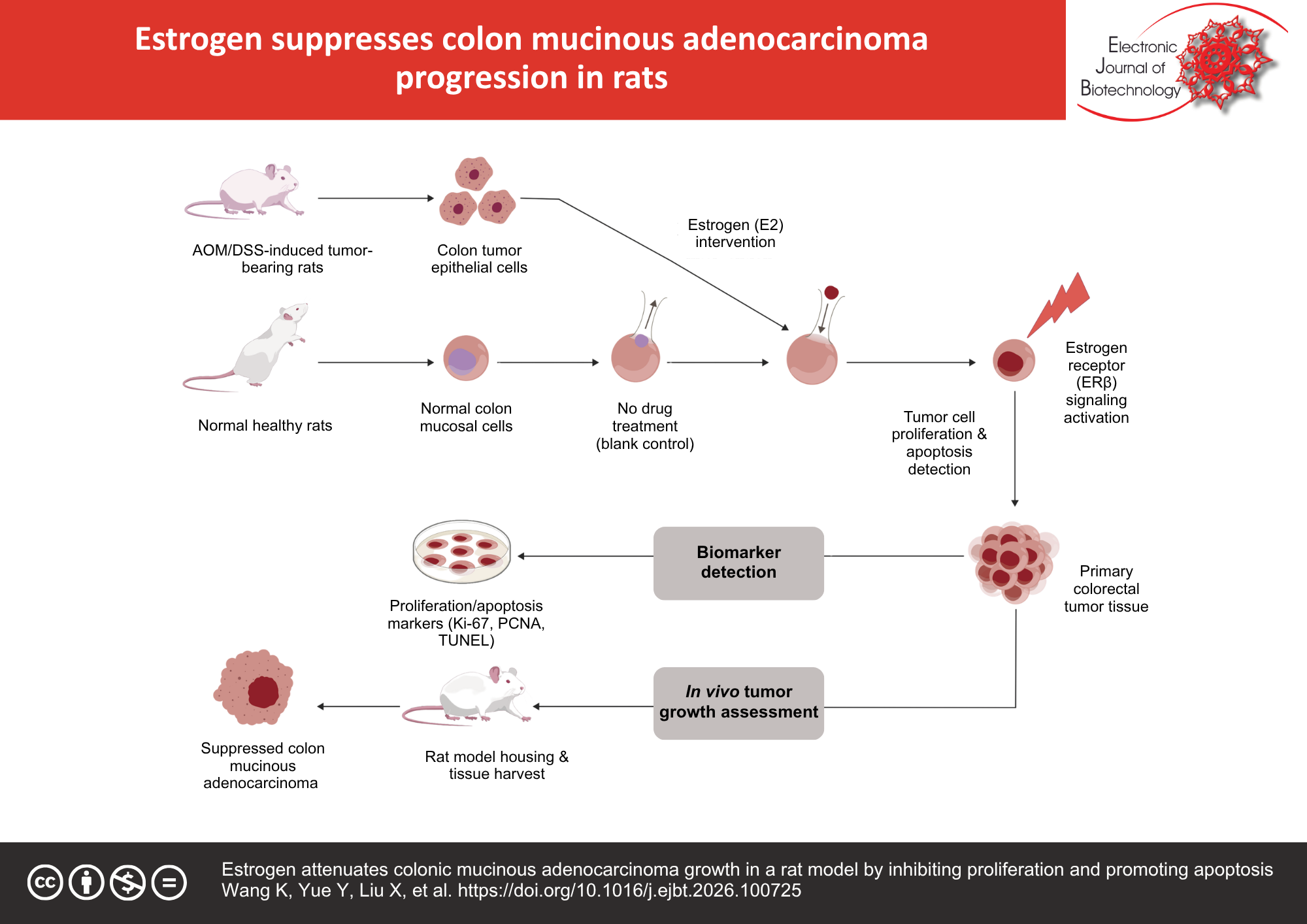
Graphical abstract
Keywords
Categories
How to Cite
Abstract
Background: Colonic mucinous adenocarcinoma is a highly aggressive subtype of colon cancer. Epidemiological evidence has linked estrogen exposure to certain gastrointestinal malignancies, yet its pathophysiological role in the pathogenesis of colonic mucinous adenocarcinoma remains unclear. This study aimed to investigate the effect of estrogen on tumor growth in a rat model of colonic mucinous adenocarcinoma and its association with intestinal mucosal epithelial proliferation-related factors and apoptosis.
Results: Compared with the normal control group, the model control group showed significantly increased tumor proliferative activity and elevated intestinal epithelial apoptosis. After estrogen intervention, tumor volume and proliferative activity were inhibited, the expressions of Ki-67 and proliferating cell nuclear antigen were downregulated, and the apoptosis rate of intestinal epithelial cells decreased; an estrogen antagonist could enhance some of the above effects.
Conclusions: Estrogen can slow the growth of colonic mucinous adenocarcinoma by inhibiting intestinal mucosal epithelial proliferation, exhibiting potential anti-tumor effects. Its mechanism may be related to regulating the proliferation-apoptosis balance of intestinal mucosal epithelium, providing experimental evidence for colon cancer therapy research.
References
Hu FJ, Li YJ, Zhang L, et al. Single-cell profiling reveals differences between human classical adenocarcinoma and mucinous adenocarcinoma. Communications Biology 2023;6(1):85. https://doi.org/10.1038/s42003-023-04441-w PMid 36690709
Reynolds IS, O’Connell E, Fichtner M, et al. Mucinous adenocarcinoma is a pharmacogenomically distinct subtype of colorectal cancer. The Pharmacogenomics Journal 2020:20(3):24-532. https://doi.org/10.1038/s41397-019-0137-6 PMid 31819162
Zou RQ, Hu HJ, Liu F, et al. Comparison of clinicopathological characteristics of mucinous adenocarcinoma and conventional adenocarcinoma of and gallbladder. Asian Journal of Surgery 2023;46(1):83-290. https://doi.org/10.1016/j.asjsur.2022.03.094 PMid 35422386
Liu H, Tang T. Pan-cancer genetic analysis of disulfidptosis-related gene set. Cancer Genetics 2023;278-279:91-103. https://doi.org/10.1016/j.cancergen.2023.10.001 PMid 37879141
Kim S, Huh JW, Lee WY, et al. prognostic impact of mucinous adenocarcinoma in stage II and III colon cancer. Diseases of the Colon & Rectum 2023;66(11):1473-80. https://doi.org/10.1097/DCR.0000000000002733 PMid 37260257
Yan C, Yang H, Chen L, et al. Clinical significance of mucinous component in colorectal adenocarcinoma: a propensity score-matched study. BMC Cancer 2021;21(1):1286. https://doi.org/10.1186/s12885-021-09031-9 PMid 34852768
Nnanemere J, Oladimeji A, Waseem S, et al. Comparing the histopathologic patterns and survival outcomes of mucinous vs non-mucinous colorectal adenocarcinoma: A systematic review and meta-analysis. Cureus 2026;18(1):e101832. https://doi.org/10.7759/cureus.101832 PMid 41717209
Honma N, Arai T, Matsuda Y, et al. Estrogen concentration and estrogen receptor-? expression in postmenopausal colon cancer considering patient/tumor background. Journal of Cancer Research and Clinical Oncology 2022;148(5):1063-71. https://doi.org/10.1007/s00432-021-03889-9 PMid 35032217
Jiang L, Fei H, Yang A, et al. 2021. Estrogen inhibits the growth of colon cancer in mice through reversing extracellular vesicle-mediated immunosuppressive tumor microenvironment. Cancer Letters 2021;520:332-43. https://doi.org/10.1016/j.canlet.2021.08.011 PMid 34391809
Liu H. Effect of traditional medicine on clinical cancer. Biomedical Journal of Scientific & Technical Research 2020;30:23548-51. https://doi.org/10.26717/BJSTR.2020.30.004979
Honma N, Arai T, Matsuda Y, et al. Estrogen receptor-? gene cytosine-adenine (ESR2-CA) repeat polymorphism in postmenopausal colon cancer. International Journal of Molecular Sciences 2023;24(5):4502. https://doi.org/10.3390/ijms24054502 PMid 36901930
Indukuri R, Hases L, Archer A, et al. Estrogen Receptor beta influences the inflammatory p65 cistrome in colon cancer cells. Frontiers in Endocrinology 2021;12:650625. https://doi.org/10.3389/fendo.2021.650625 PMid 33859619
Shen C, Tannenbaum D, Horn R, et al. Overall survival in phase 3 clinical trials and the surveillance, epidemiology, and end results database in patients with metastatic colorectal cancer, 1986-2016: A systematic review. JAMA. Network Open 2022;5(5):e2213588. https://doi.org/10.1001/jamanetworkopen.2022.13588 PMid 35608860
Schwiebs A, Faqar-Uz-Zaman F, Herrero San Juan M, et al. S1P lyase regulates intestinal stem cell quiescence via Ki-67 and FOXO3. International Journal of Molecular Science 2021;22(11):5682. https://doi.org/10.3390/ijms22115682 PMid 34073605
Ayerden D, Tayfur M, Balci MG. Comparison of histopathological findings of the colon adenomas and adenocarcinomas with cyclin D1 and Ki-67 expression. Nigerian Journal of Clinical Practice 2021;24(11):1737-41. https://doi.org/10.4103/njcp.njcp_68_21 PMid 34782516
Cruz BCDS, Duarte VDS, Dias RS, et al. Synbiotic modulates intestinal microbiota metabolic pathways and inhibits DMH-induced colon tumorigenesis through c-myc and PCNA suppression. Food Research International 2022;158:111379. https://doi.org/10.1016/j.foodres.2022.111379 PMid 35840186
Sonkin D, Thomas A, Teicher BA. Cancer treatments: Past, present, and future. Cancer Genetics 2024;286-287:18-24. https://doi.org/10.1016/j.cancergen.2024.06.002 PMid 38909530
Das PK, Saha J, Pillai S, et al. Implications of estrogen and its receptors in colorectal carcinoma. Cancer Medicine 2023;12(4):4367-79. https://doi.org/10.1002/cam4.5242 PMid 36207986
Harvey BJ, Harvey HM. Sex differences in colon cancer: Genomic and nongenomic signalling of oestrogen. Genes 2023;14(12):2225. https://doi.org/10.3390/genes14122225 PMid 38137047
Konstantis G, Tsaousi G, Kitsikidou E, et al. The immunomodulatory effect of various anaesthetic practices in patients undergoing gastric or colon cancer surgery: A systematic review and meta-analysis of randomized clinical trials. Journal of Clinical Medicine 2023;12(18):6027. https://doi.org/10.3390/jcm12186027 PMid 37762967
Arnesen H, Müller MHB, Aleksandersen M, et al. Induction of colorectal carcinogenesis in the C57BL/6J and A/J mouse strains with a reduced DSS dose in the AOM/DSS model. Laboratory Animal Research 2021;37(1):19. https://doi.org/10.1186/s42826-021-00096-y PMid 34315530
Li M, Zhang J, Chen W, et al. Supraphysiologic doses of 17?-estradiol aggravate depression-like behaviors in ovariectomized mice, possibly via regulating microglial responses and brain glycerophospholipid metabolism. Journal of Neuroinflammation 2023;20(1):204. http://doi.org/10.1186/s12974-023-02889-5 PMid 37679787
Jin Y, Gao XY, Zhao J, et al. Estrogen deficiency aggravates fluoride-induced small intestinal mucosa damage and junctional complexes protein expression disorder in rats. Ecotoxicology and Environmental Safety 2022;246:114181. https://doi.org/10.1016/j.ecoenv.2022.114181 PMid 36252517
Song CH, Kim N, Nam RH, et al. Combination treatment with 17?-estradiol and anti-PD-L1 suppresses MC38 tumor growth by reducing PD-L1 expression and enhancing M1 macrophage population in the MC38 colon tumor model. Cancer Letters 2022;543:215780. https://doi.org/10.1016/j.canlet.2022.215780 PMid 35690286
Wu Z, Sun Y, Huang W, et al. Direct and indirect effects of estrogens, androgens, and intestinal microbiota on colorectal cancer. Frontiers in Cellular and Infection Microbiology 2024;14:1458033. https://doi.org/10.3389/fcimb.2024.1458033 PMid 39660281
Kapetanos K, Asimakopoulos D, Christodoulou N, et al. Chronological age affects MSC senescence in vitro - A systematic review. International Journal of Molecular Sciences 2021;22(15):7945. https://doi.org/10.3390/ijms22157945 PMid 34360725
De Vitto H, Ryu J, Calderon-Aparicio A, et al. Estrogen-related receptor alpha directly binds to p53 and cooperatively controls colon cancer growth through the regulation of mitochondrial biogenesis and function. Cancer & Metabolism 2020;8(1):28. https://doi.org/10.1186/s40170-020-00234-5 PMid 33303020

This work is licensed under a Creative Commons Attribution-ShareAlike 4.0 International License.
Copyright (c) 2026 Electronic Journal of Biotechnology