Graphical abstract
Keywords
How to Cite
Abstract
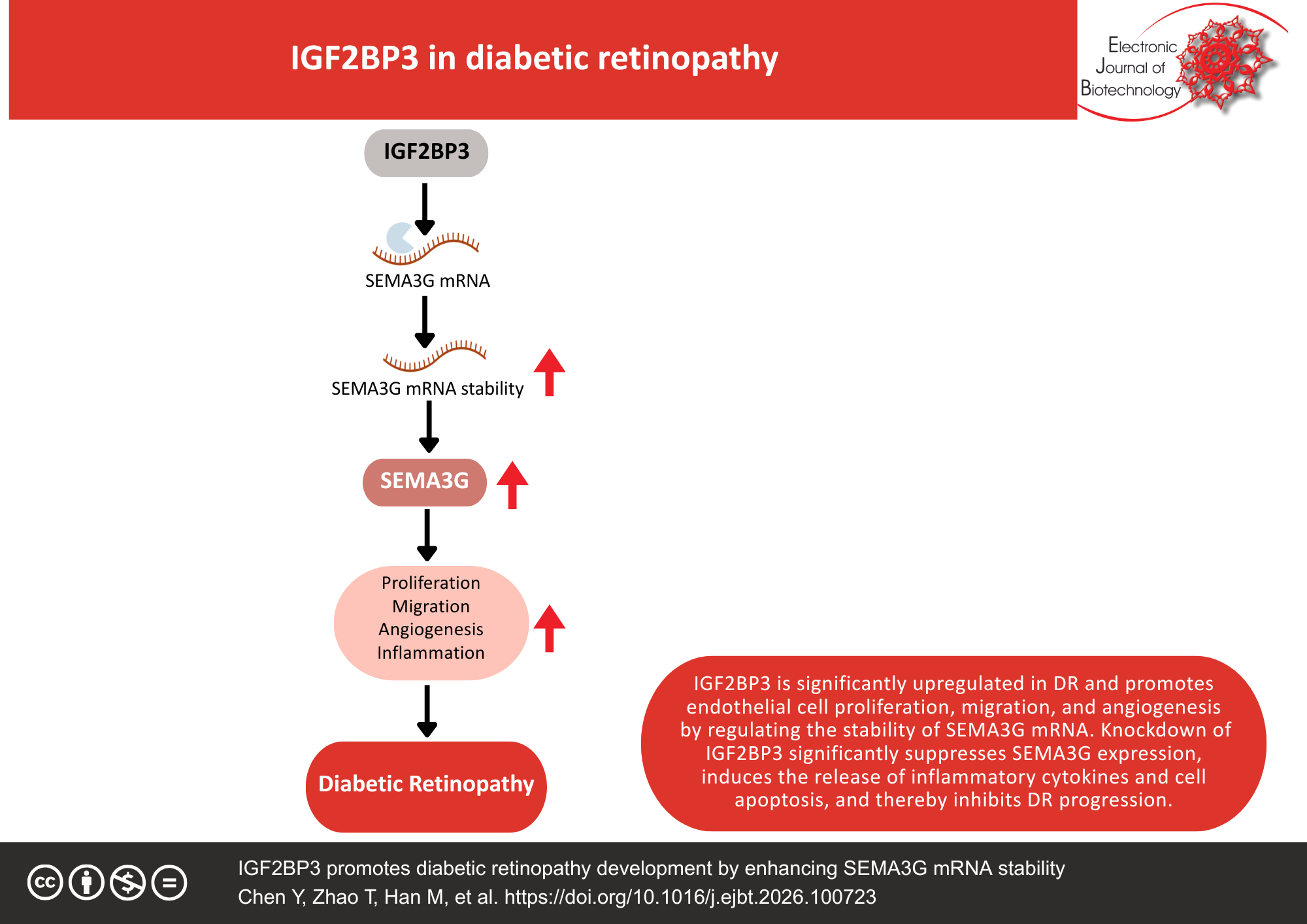
Background: Diabetic retinopathy is characterized by excessive microvascular proliferation that leads to vitreous hemorrhage, retinal traction, and subsequent visual impairment. Aberrant expression of IGF2BP3 is involved in the pathogenesis of multiple diseases. This study aimed to elucidate the mechanism by which IGF2BP3 mediates diabetic retinopathy by regulating semaphorin-3G (SEMA3G) expression.
Results: Elevated IGF2BP3 expression was observed in diabetic retinopathy. In vitro, IGF2BP3 overexpression promoted pathological angiogenesis, whereas its knockdown significantly attenuated wound healing, reduced inflammatory cytokine secretion, and suppressed cellular proliferation. A targeted regulatory relationship between IGF2BP3 and SEMA3G mRNA was identified, with IGF2BP3 enhancing SEMA3G mRNA stability. SEMA3G was upregulated in diabetic retinopathy, and its overexpression partially rescued the diabetic retinopathy progression suppressed by IGF2BP3 silencing. In vivo, IGF2BP3 overexpression aggravated histopathological alterations, thereby accelerating diabetic retinopathy development.
Conclusions: In summary, IGF2BP3 promotes diabetic retinopathy development by enhancing SEMA3G mRNA stability.
References
Genitsaridi I, Salpea P, Salim A, et al. 11th edition of the IDF Diabetes Atlas: global, regional, and national diabetes prevalence estimates for 2024 and projections for 2050. The Lancet Diabetes & Endocrinology 2026;14(2):149-56. http://doi.org/10.1016/s2213-8587(25)00299-2 PMid: 41412135
Guo C, Deshpande M, Niu Y, et al. HIF-1? accumulation in response to transient hypoglycemia may worsen diabetic eye disease. Cell Rep 2023;42(1):111976. http://doi.org/10.1016/j.celrep.2022.111976 PMid: 36640318
Chong DD, Das N, Singh RP. Diabetic retinopathy: Screening, prevention, and treatment. Cleveland Clinic Journal of Medicine 2024;91(8):503-10. http://doi.org/10.3949/ccjm.91a.24028 PMid: 39089852
Zhou Y, Xuan Y, Liu Y, et al. Transcription factor FOXP1 mediates vascular endothelial dysfunction in diabetic retinopathy. Graefe’s Archive for Clinical and Experimental Ophthalmology 2022;260(12):3857-67. http://doi.org/10.1007/s00417-022-05698-3 PMid: 35695913
Wang N, Yao F, Liu D, et al. RNA N6-methyladenosine in nonocular and ocular disease. Journal of Cellular Physiology 2022;237(3):1686-710. http://doi.org/10.1002/jcp.30652 PMid: 34913163
Breier G, Chavakis T, Hirsch E. Angiogenesis in metabolic-vascular disease. Thrombosis and Haemostasis 2017;117(7):1289-95. http://doi.org/10.1160/th17-05-0325 PMid: 28594427
Wang S, Park JK, Duh EJ. Novel targets against retinal angiogenesis in diabetic retinopathy. Current Diabetes Reports 2012;12(4):355-63. http://doi.org/10.1007/s11892-012-0289-0 PMid: 22638940
Huang W, Li Y, Zhang C, et al. IGF2BP3 facilitates cell proliferation and tumorigenesis via modulation of JAK/STAT signalling pathway in human bladder cancer. Journal of Cellular and Molecular Medicine 2020;24(23):13949-60. http://doi.org/10.1111/jcmm.16003 PMid: 33094561
Tian Y, Cheng W, Wang H, et al. Ascorbic acid protects retinal pigment epithelial cells from high glucose by inhibiting the NF??B signal pathway through MALAT1/IGF2BP3 axis. Diabetic Medicine 2023;40(5):e15050. http://doi.org/10.1111/dme.15050 PMid: 36661363
Sakurai A, Doçi CL, Gutkind JS. Semaphorin signaling in angiogenesis, lymphangiogenesis and cancer. Cell Research 2012;22(1):23-32. http://doi.org/10.1038/cr.2011.198 PMid: 22157652
Tan C, Lu NN, Wang CK, et al. Endothelium-derived semaphorin 3G regulates hippocampal synaptic structure and plasticity via Neuropilin-2/PlexinA4. neuron 2019;101(5):920-937.e13. http://doi.org/10.1016/j.neuron.2018.12.036 PMid: 30685224
Chi H, Deng S, Xu K, et al. SEMA3G-NRP1 Signaling functions as an immune checkpoint that enables tumor immune evasion by impairing T-cell cytotoxicity. Cancer Research 2025;85(5):912-924. http://doi.org/10.1158/0008-5472.Can-24-2223 PMid: 39652581
Mirza SL, Upton PD, Hodgson J, et al. SEMA3G regulates BMP9 inhibition of VEGF-mediated migration and network formation in pulmonary endothelial cells. Vascular Pharmacology 2024;155:107381. http://doi.org/10.1016/j.vph.2024.107381 PMid: 38795838
Chen DY, Sun NH, Chen X, et al. Endothelium-derived semaphorin 3G attenuates ischemic retinopathy by coordinating ?-catenin-dependent vascular remodeling. The Journal of Clinical Investigation 2021;131(4):e135296. http://doi.org/10.1172/jci135296 PMid: 33586674
Hyun J, Lee M, Rehman J, et al. Notch1 promotes ordered revascularization through Semaphorin 3g modulation of downstream vascular patterning signalling factors. The Journal of Physiology 2022;600(3):509-30. http://doi.org/10.1113/jp282286 PMid: 34921404
Luo XY, Fu X, Liu F, et al. Sema3G activates YAP and promotes VSMCs proliferation and migration via Nrp2/PlexinA1. Cellular Signalling 2023;105:110613. http://doi.org/10.1016/j.cellsig.2023.110613 PMid: 36720439
Lv L, Wei Q, Zhang J, et al. IGF2BP3 prevent HMGB1 mRNA decay in bladder cancer and development. Cellular & Molecular Biology Letters 2024;29(1):39. http://doi.org/10.1186/s11658-024-00545-1 PMid: 38504159
Wang R, Xue W, Kan F, et al. NSUN2 affects diabetic retinopathy progression by regulating MUC1 expression through RNA m5C methylation. Journal of Translational Medicine 2024;22(1):476. http://doi.org/10.1186/s12967-024-05287-4 PMid: 38764010
Ogurtsova K, da Rocha Fernandes JD, Huang Y, et al. IDF Diabetes Atlas: Global estimates for the prevalence of diabetes for 2015 and 2040. Diabetes Research and Clinical Practice 2017;128:40-50. http://doi.org/10.1016/j.diabres.2017.03.024 PMid: 28437734
Antonetti DA, Silva PS, Stitt AW. Publisher Correction: Current understanding of the molecular and cellular pathology of diabetic retinopathy. Nature Reviews Endocrinology 2025;21(1):62. http://doi.org/10.1038/s41574-024-01053-0 PMid: 39448833
Abu El-Asrar AM, Nawaz MI, Ahmad A, et al. CD40 Ligand-CD40 interaction is an intermediary between inflammation and angiogenesis in proliferative diabetic retinopathy. International Journal of Molecular Sciences 2023;24(21):15582. http://doi.org/10.3390/ijms242115582 PMid: 37958563
Madjedi K, Pereira A, Ballios BG, et al. Switching between anti-VEGF agents in the management of refractory diabetic macular edema: A systematic review. Survey of Ophthalmology 2022;67(5):1364-72. http://doi.org/10.1016/j.survophthal.2022.04.001 PMid: 35452685
Xue L, Hu M, Zhu Q, et al. GRg1 inhibits the TLR4/NF-kB signaling pathway by upregulating miR-216a-5p to reduce growth factors and inflammatory cytokines in DR. Molecular Biology Reports 2023;50(11):9379-94. http://doi.org/10.1007/s11033-023-08895-3 PMid: 37819496
Bell JL, Wächter K, Mühleck B, et al. Insulin-like growth factor 2 mRNA-binding proteins (IGF2BPs): post-transcriptional drivers of cancer progression? Cellular and Molecular Life Sciences 2013;70(15):2657-75. https://doi.org/10.1007/s00018-012-1186-z PMid: 23069990
Mancarella C, Scotlandi K. IGF2BP3 from physiology to cancer: Novel discoveries, unsolved issues, and future perspectives. Front Cell Dev Biol. 2020;7:363. https://doi.org/10.3389/fcell.2019.00363 PMid: 32010687
Rattanapan Y, Nongwa K, Supanpong C, et al. Downregulation of miR-25-3p and its impact on PTAFR and IGF2BP3 expression in type 2 diabetes mellitus: Implications for biomarker discovery and disease pathogenesis. Journal of Clinical Medicine Research 2024;16(11):536-46. https://doi.org/10.14740/jocmr6099 PMid: 39635336
Wan Q, Tang J. Exploration of potential key pathways and genes in multiple ocular cancers through bioinformatics analysis. Graefe's Archive for Clinical and Experimental Ophthalmology 2019;257(10):2329-41. https://doi.org/10.1007/s00417-019-04410-2 PMid: 31309275
Xu X, Wu S, Zhang Y, et al. m6A modification of VEGFA mRNA by RBM15/YTHDF2/IGF2BP3 contributes to angiogenesis of hepatocellular carcinoma. Molecular Carcinogenesis 2024;63(11):2174-89. https://doi.org/10.1002/mc.23802 PMid: 39092767
Huang H, Weng H, Sun W, et al. Recognition of RNA N6-methyladenosine by IGF2BP proteins enhances mRNA stability and translation. Nature Cell Biology 2018;20(3):285-95. https://doi.org/10.1038/s41556-018-0045-zv PMid: 29476152
Tian Y, Cheng W, Wang H, et al. Ascorbic acid protects retinal pigment epithelial cells from high glucose by inhibiting the NF-?B signal pathway through MALAT1/IGF2BP3 axis. Diabetic Medicine 2023;40(5):e15050. https://doi.org/10.1111/dme.15050 PMid: 36661363
Li S, Shen S, Xu H, et al. IGF2BP3 promotes adult myocardial regeneration by stabilizing MMP3 mRNA through interaction with m6A modification. Cell Death & Discovery 2023;9(1):164. http://doi.org/10.1038/s41420-023-01457-3 PMid: 37188676
Qin Y, Liu L, Zhang Y, et al. Citrullinated IGF2BP1 promotes rheumatoid synovial aggression via increasing the mRNA stability of SEMA3D. Communications Biology 2025;8(1):50. http://doi.org/10.1038/s42003-025-07492-3 PMid: 39809921
Zhao H, Wang Y, Liang C, et al. LncRNA FOXD3-AS1/miR-128-3p axis-mediated IGF2BP3 in glioma stimulates cancer angiogenesis and progression. Folia Neuropathologica 2023;61(2):168-84. http://doi.org/10.5114/fn.2023.126862 PMid: 37587892
Hou D, Zhao W, Yang Q, et al. Curcumol promotes immune cell invasion and inhibits angiogenesis in colon cancer by decreasing IGF2BP3 expression. Biochemical and Biophysical Research Communications 2025;750:151394. http://doi.org/10.1016/j.bbrc.2025.151394 PMid: 39899937.
Xu M, Guo Y, Wang F, et al. Enterolactone combined with m6A Reader IGF2BP3 inhibits malignant angiogenesis and disease progression in ovarian cancer. Phytomedicine 2025;136:156343. http://doi.org/10.1016/j.phymed.2024.156343 PMid: 39765033

This work is licensed under a Creative Commons Attribution-ShareAlike 4.0 International License.
Copyright (c) 2026 Electronic Journal of Biotechnology