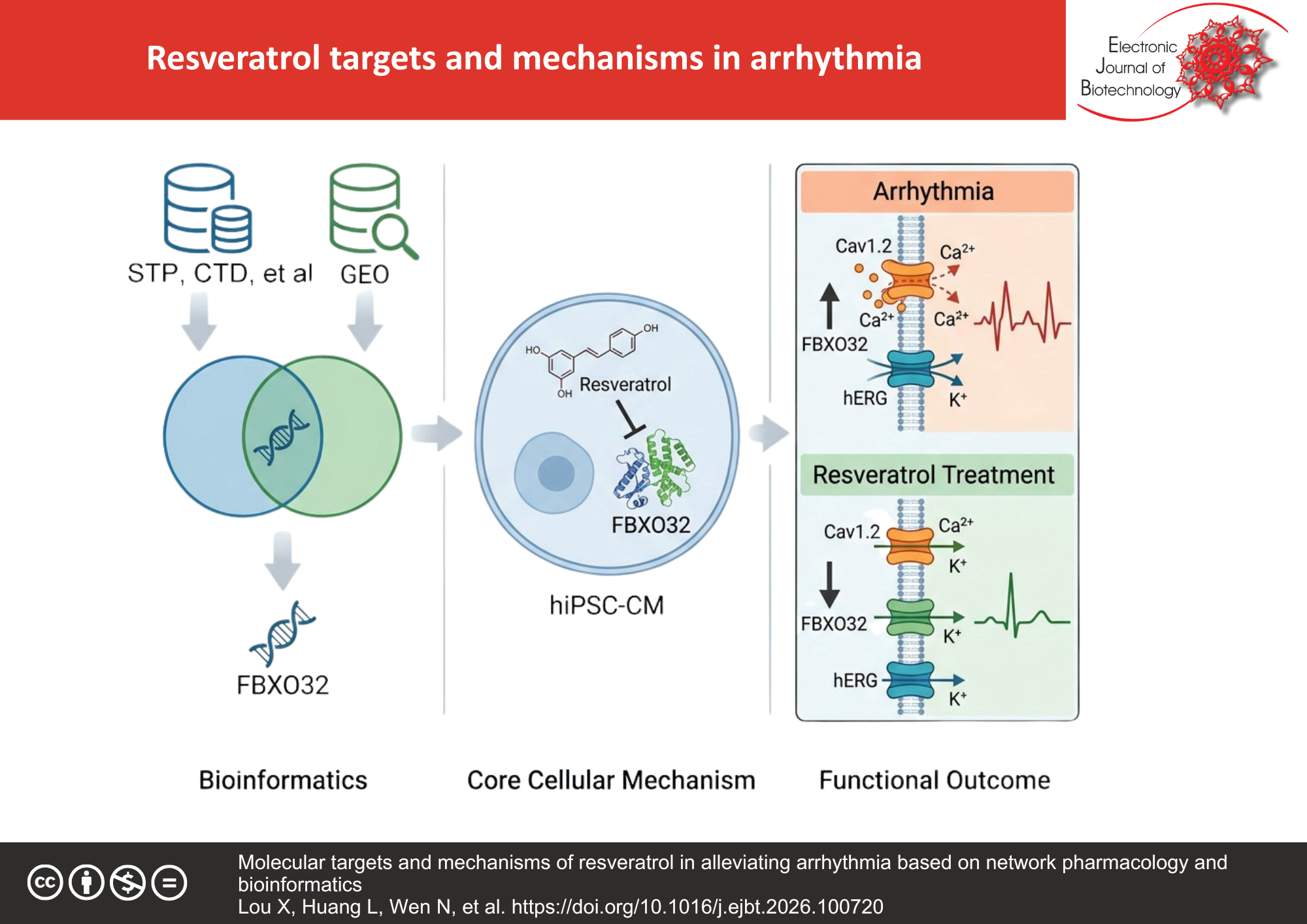
Graphical abstract
Keywords
Categories
How to Cite
Abstract
Background: Arrhythmia refers to a disorder in which abnormal cardiac electrical activity leads to irregular heart rhythm and conduction. Resveratrol (Res), a natural polyphenol compound extracted from medicinal plants, plays an important role in the treatment of arrhythmia, but its precise molecular mechanisms remain unclear.
Results: The intersection of Res targets and arrhythmia yielded 78 common targets, including F-box protein 32 (FBXO32). These targets were significantly enriched in cardiac conduction system development, protein-containing complex, vascular endothelial growth factor (VEGF) signaling pathway, cyclic adenosine monophosphate (cAMP) signaling pathway, and forkhead box O (FoxO) signaling pathway. Molecular docking confirmed that FBXO32 could stably bind to Res. Res treatment increased cell viability in the arrhythmia cell model. FBXO32 was highly expressed in the arrhythmia cell model, but its expression was significantly reduced under Res treatment. Knockdown of FBXO32 increased cell viability, decreased apoptosis, and increased protein levels of calcium voltage-gated channel subunit alpha1 C (CACNA1C) and human ether-à-go-go-related gene (hERG), whereas Res treatment partially modulated these effects.
Conclusions: Res inhibits the expression of FBXO32, thereby suppressing the malignant phenotypes of arrhythmia.
References
Sossalla S, Vollmann D. Arrhythmia-induced cardiomyopathy. Deutsches Ärzteblatt International 2018;115:335-41. https://doi.org/10.3238/arztebl.2018.0335 PMid: 29875055
Fu DG. Cardiac arrhythmias: Diagnosis, symptoms, and treatments. Cell Biochemistry and Biophysics 2015;73(2):291-6. https://doi.org/10.1007/s12013-015-0626-4 PMid: 25737133
Raymond-Paquin A, Nattel S, Wakili R, et al. Mechanisms and clinical significance of arrhythmia-induced cardiomyopathy. Canadian Journal of Cardiology 2018;34(11):1449-60. https://doi.org/10.1016/j.cjca.2018.07.475 PMid: 30404750
Brouwer IA, Geelen A, Katan MB. n-3 Fatty acids, cardiac arrhythmia and fatal coronary heart disease. Progress in Lipid Research 2006;45(4):357-67. https://doi.org/10.1016/j.plipres.2006.02.004 PMid: 16678270
Bounhoure JP, Boveda S, Albenque JP. Cardiomyopathies dilatées d’origine rythmique [Arrhythmia-induced dilated cardiomyopathies]. Bulletin de l’Académie Nationale de Médecine 2006;190:1225-36. https://doi.org/10.1016/S0001-4079(19)33230-3 PMid: 17195405
Zhang Y, Mazgalev TN. Arrhythmias and vagus nerve stimulation. Heart Failure Reviews 2011;16(2):147-61. https://doi.org/10.1007/s10741-010-9178-2 PMid: 20559719
Ski CF, Taylor RS, McGuigan K, et al. Psychological interventions for depression and anxiety in patients with coronary heart disease, heart failure or atrial fibrillation. Cochrane Database of Systematic Reviews 2024;4(4):CD013508. https://doi.org/10.1002/14651858.CD013508.pub3 PMid: 38577875
Turnbull D, Rodricks JV, Mariano GF, et al. Caffeine and cardiovascular health. Regulatory Toxicology and Pharmacology 2017;89:165-85. https://doi.org/10.1016/j.yrtph.2017.07.025 PMid: 28756014
Yuan R, Wang J, Guo L. The effect of sleep deprivation on coronary heart disease. Chinese Medical Sciences Journal 2016;31(4):247-53. https://doi.org/10.1016/S1001-9294(17)30008-1 PMid: 28065222
Barstow C, McDivitt JD. Cardiovascular disease update: Bradyarrhythmias. FP Essentials 2017;454:18-23. PMid: 28266824
Haum M, Kellnar A, Thienel M, et al. Review: Sex-related differences in the treatment of cardiac arrhythmia. Pharmacology & Therapeutics 2023;244:108388. https://doi.org/10.1016/j.pharmthera.2023.108388 PMid: 36940792
Miszczak-Knecht M, Szumowski ?, Posadowska M, et al. Idiopathic ventricular arrhythmia in children and adolescents: early effectiveness of radiofrequency current ablation. Kardiologia Polska 2014;72(11):1148-55. https://doi.org/10.5603/KP.a2014.0132 PMid: 25522755
Bo M, Del Rosso A. Syncope and electrocardiogram. Minerva Medica 2022;113(2):234-42. https://doi.org/10.23736/S0026-4806.21.07531-5 PMid: 33881283
Al-Kaisey AM, Parameswaran R, Bryant C, et al. Atrial fibrillation catheter ablation vs medical therapy and psychological distress: A randomized clinical trial. JAMA 2023;330(10):925-33. https://doi.org/10.1001/jama.2023.14685 PMid: 37698564
Flinders DC, Roberts SD. Ventricular arrhythmias. Primary Care: Clinics in Office Practice 2000;27(3):709-24. https://doi.org/10.1016/S0095-4543(05)70170-6 PMid: 10918676
Xu T, Dong F, Zhang M, et al. Post-stroke arrhythmia could be a potential predictor for post-stroke depression. Scientific Reports 2024;14(1):9093. https://doi.org/10.1038/s41598-024-59789-8 PMid: 38643303
Rauf A, Imran M, Butt MS, et al. Resveratrol as an anti-cancer agent: A review. Critical Reviews in Food Science and Nutrition 2018;58(9):1428-47. https://doi.org/10.1080/10408398.2016.1263597 PMid: 28001084
Zamanian MY, Shahbazi T, Kazmi SW, et al. Effects of Resveratrol on Nonmelanoma Skin Cancer (NMSC): A comprehensive review. Food Science & Nutrition 2024;12(11):8825-45. https://doi.org/10.1002/fsn3.4555 PMid: 39620024
Ratz-?yko A, Arct J. Resveratrol as an active ingredient for cosmetic and dermatological applications: A review. Journal of Cosmetic and Laser Therapy 2019;21(2):84-90. https://doi.org/10.1080/14764172.2018.1469767 PMid: 29737899
Meng T, Xiao D, Muhammed A, et al. Anti-inflammatory action and mechanisms of resveratrol. Molecules 2021;26(1):229. https://doi.org/10.3390/molecules26010229 PMid: 33466247
Chudzi?ska M, Rogowicz D, Wo?owiec ?, et al. Resveratrol and cardiovascular system-the unfulfilled hopes. Irish Journal of Medical Science 2021;190(3):981-6. https://doi.org/10.1007/s11845-020-02441-x PMid: 33219913
Seyedpour N, Motevaseli E, Taeb S, et al. Protective effects of alpha-lipoic acid, resveratrol, and apigenin against oxidative damages, histopathological changes, and mortality induced by lung irradiation in rats. Current Radiopharmaceuticals 2024;17(1):99-110. https://doi.org/10.2174/0118744710244357231018070313 PMid: 37909433
Gao X, Man XJ, He B, et al. Targets and mechanisms of resveratrol against endothelial-mesenchymal transition in atherosclerosis: A network pharmacology analysis combined with in vivo experiments. Letters in Drug Design & Discovery 2024;21(13):2760-70. https://doi.org/10.2174/1570180820666230719121428
Atoosa K, Vahide M, Niloufar M, et al. Regulating miRNAs expression by resveratrol: novel insights based on molecular mechanism and strategies for cancer therapy. Current Molecular Pharmacology 2024;17:e18761429249717. https://doi.org/10.2174/0118761429249717230920113227 PMid: 37904563
Banashree Chetia P, Rubina R, Shuvasish C, et al. Neuroprotective potential of polydatin in combating Parkinson’s disease through the inhibition of monoamine oxidase-B and catechol-o-Methyl Transferase. Letters in Drug Design & Discovery 2024;21(1):180-8. https://doi.org/10.2174/1570180820666230427092537
Baczkó I, Light PE. Resveratrol and derivatives for the treatment of atrial fibrillation. Annals of the New York Academy of Sciences 2015;1348(1):68-74. https://doi.org/10.1111/nyas.12843 PMid: 26205342
Peng Y, Zheng X, Zhang S, et al. Advances in the activity of resveratrol and its derivatives in cardiovascular diseases. Archiv der Pharmazie (Weinheim). 2025;358(2):e2400865. https://doi.org/10.1002/ardp.202400865 PMid: 39956927
Zordoky BN, Robertson IM, Dyck JR. Preclinical and clinical evidence for the role of resveratrol in the treatment of cardiovascular diseases. Biochimica et Biophysica Acta (BBA)- Molecular Basis of Disease 2015;1852(6):1155-77. https://doi.org/10.1016/j.bbadis.2014.10.016 PMid: 25451966
Song J, Wang J, Li BH, et al. A study on anti-arrhythmia mechanisms of resveratrol on ischemia/reperfusion in rats by regulating PI3K/Akt signaling pathway. [Article in Chinese]. Zhongguo Ying Yong Sheng Li Xue Za Zhi. 2017;33:239-43. http://doi.org/10.12047/j.cjap.5516.2017.059 PMid: 29931939
Liu W, Chen P, Deng J, et al. Resveratrol and polydatin as modulators of Ca2+ mobilization in the cardiovascular system. Annals of the New York Academy of Sciences 2017;1403(1):82-91. https://doi.org/10.1111/nyas.13386 PMid: 28665033
Cao Y, Cui L, Tuo S, et al. Resveratrol mediates mitochondrial function through the sirtuin 3 pathway to improve abnormal metabolic remodeling in atrial fibrillation. European Journal of Histochemistry 2024;68(2):4004. https://doi.org/10.4081/ejh.2024.4004 PMid: 38656259
Rao XH, Qiu H, Zhang W, et al. FBXO32 promotes gastric cancer progression by regulating NME1. Translational Cancer Research 2025;14(6):3520-31. https://doi.org/10.21037/tcr-2024-2426 PMid: 40687258
Wu J, Wen T, Marzio A, et al. FBXO32-mediated degradation of PTEN promotes lung adenocarcinoma progression. Cell Death & Disease 2024;15(4):282. https://doi.org/10.1038/s41419-024-06635-4 PMid: 38643215
Xu J, Zhang D, Ma Y, et al. ROS in diabetic atria regulate SK2 degradation by Atrogin-1 through the NF-?B signaling pathway. Journal of Biological Chemistry 2024;300(3):105735. https://doi.org/10.1016/j.jbc.2024.105735 PMid: 38336298
Zhou DD, Luo M, Huang SY, et al. Effects and mechanisms of resveratrol on aging and age-related diseases. Oxidative Medicine and Cellular Longevity 2021;2021:9932218. https://doi.org/10.1155/2021/9932218 PMid: 34336123
Das S, Das DK. Resveratrol: A therapeutic promise for cardiovascular diseases. Recent Patents on Cardiovascular Drug Discovery 2007;2(2):133-8. https://doi.org/10.2174/157489007780832560 PMid: 18221111
Rajkovic J, Djokic V, Gostimirovic M, et al. Potassium channels on smooth muscle as a molecular target for plant-derived Resveratrol. Cellular and Molecular Biology 2020;66(4):133-44. https://doi.org/10.14715/cmb/2020.66.4.18 PMid: 32583792
Chong E, Chang SL, Hsiao YW, et al. Resveratrol, a red wine antioxidant, reduces atrial fibrillation susceptibility in the failing heart by PI3K/AKT/eNOS signaling pathway activation. Heart Rhythm 2015;12(5):1046-56. https://doi.org/10.1016/j.hrthm.2015.01.044 PMid: 25640634
Stephan LS, Almeida ED, Markoski MM, et al. Red wine, resveratrol and atrial fibrillation. Nutrients 2017;9(11):1190. https://doi.org/10.3390/nu9111190 PMid: 29084143
Liu T, Li X, Zhou X, et al. PI3K/AKT signaling and neuroprotection in ischemic stroke: Molecular mechanisms and therapeutic perspectives. Neural Regeneration Research 2025;20(10):2758-75. https://doi.org/10.4103/NRR.NRR-D-24-00568 PMid: 39435629
Wang W, Wang S, Liu T, et al. Resveratrol: Multi-targets mechanism on neurodegenerative diseases based on network pharmacology. Frontiers in Pharmacology 2020;11:694. https://doi.org/10.3389/fphar.2020.00694 PMid: 32477148
Jiang C, Xie N, Sun T, et al. Xanthohumol inhibits TGF-?1-induced cardiac fibroblasts activation via mediating PTEN/Akt/mTOR signaling pathway. Drug Design, Development and Therapy 2020;14:5431-9. https://doi.org/10.2147/DDDT.S282206 PMid: 33324040
Su D, Wang R, Chen G, et al. FBXO32 Stimulates protein synthesis to drive pancreatic cancer progression and metastasis. Cancer Research 2024;84(16):2607-25. https://doi.org/10.1158/0008-5472.CAN-23-3638 PMid: 38775804
Wang S, Peng R, Chen C, et al. FBXO32 ubiquitination of SUFU promotes progression and lenvatinib resistance in hepatocellular carcinoma via hedgehog signaling. Medical Oncology 2025;42(4):98. https://doi.org/10.1007/s12032-025-02644-1 PMid: 40067532
Zhang N, Liao Y, Lv W, et al. FBXO32 targets PHPT1 for ubiquitination to regulate the growth of EGFR mutant lung cancer. Cellular Oncology 2022;45(2):293-307. https://doi.org/10.1007/s13402-022-00669-6 PMid: 35411430
Zhou Y, Sun C, Ma Y, et al. Identification and validation of aging-related genes in atrial fibrillation. PLoS One 2023;18(11):e0294282. https://doi.org/10.1371/journal.pone.0294282 PMid: 37956134
Li B, Feng Q, Yu C, et al. Predictive value of serum HIF-1? and VEGF for arrhythmia in acute coronary syndrome patients. Experimental Biology and Medicine 2023;248:685-90. https://doi.org/10.1177/15353702231171902 PMid: 37350444
Liu S, Yang Y, Hou X, et al. Role for the F-box proteins in heart diseases. Pharmacological Research 2024;210:107514. https://doi.org/10.1016/j.phrs.2024.107514 PMid: 39577754
Abriel H, Rougier JS, Jalife J. Ion channel macromolecular complexes in cardiomyocytes: roles in sudden cardiac death. Circulation Research 2015;116(12):1971-88. https://doi.org/10.1161/CIRCRESAHA.116.305017 PMid: 26044251
?u?an NA, Paunescu A, Topala C, et al. Aconitine in synergistic, additive and antagonistic approaches. Toxins 2024;16(11):460. https://doi.org/10.3390/toxins16110460 PMid: 39591215
Zhou W, Liu H, Qiu LZ, et al. Cardiac efficacy and toxicity of aconitine: A new frontier for the ancient poison. Medicinal Research Reviews 2021;41(3):1798-811. https://doi.org/10.1002/med.21777 PMid: 33512023
Pan MC, Zhou XW, Liu Y, et al. research progress on the molecular mechanisms of toxicology of ethanol-aconitine induced arrhythmia. Journal of Forensic Medicine 020;36(1):115-9. doi.org/10.12116/j.issn.1004-5619.2020.01.022 PMid: 32250090
Napolitano C, Priori SG. CACNA1C-related disorders. In: Adam MP, Bick S, Marzaa GM, et al. editors. GeneReviews. Seattle (WA): University of Washington; 2006. PMid: 20301577
Sanguinetti MC, Mitcheson JS. Predicting drug-hERG channel interactions that cause acquired long QT syndrome. Trends in Pharmacological Sciences 2005;26:119-24. https://doi.org/10.1016/j.tips.2005.01.003 PMid: 15749156

This work is licensed under a Creative Commons Attribution-ShareAlike 4.0 International License.
Copyright (c) 2026 Electronic Journal of Biotechnology