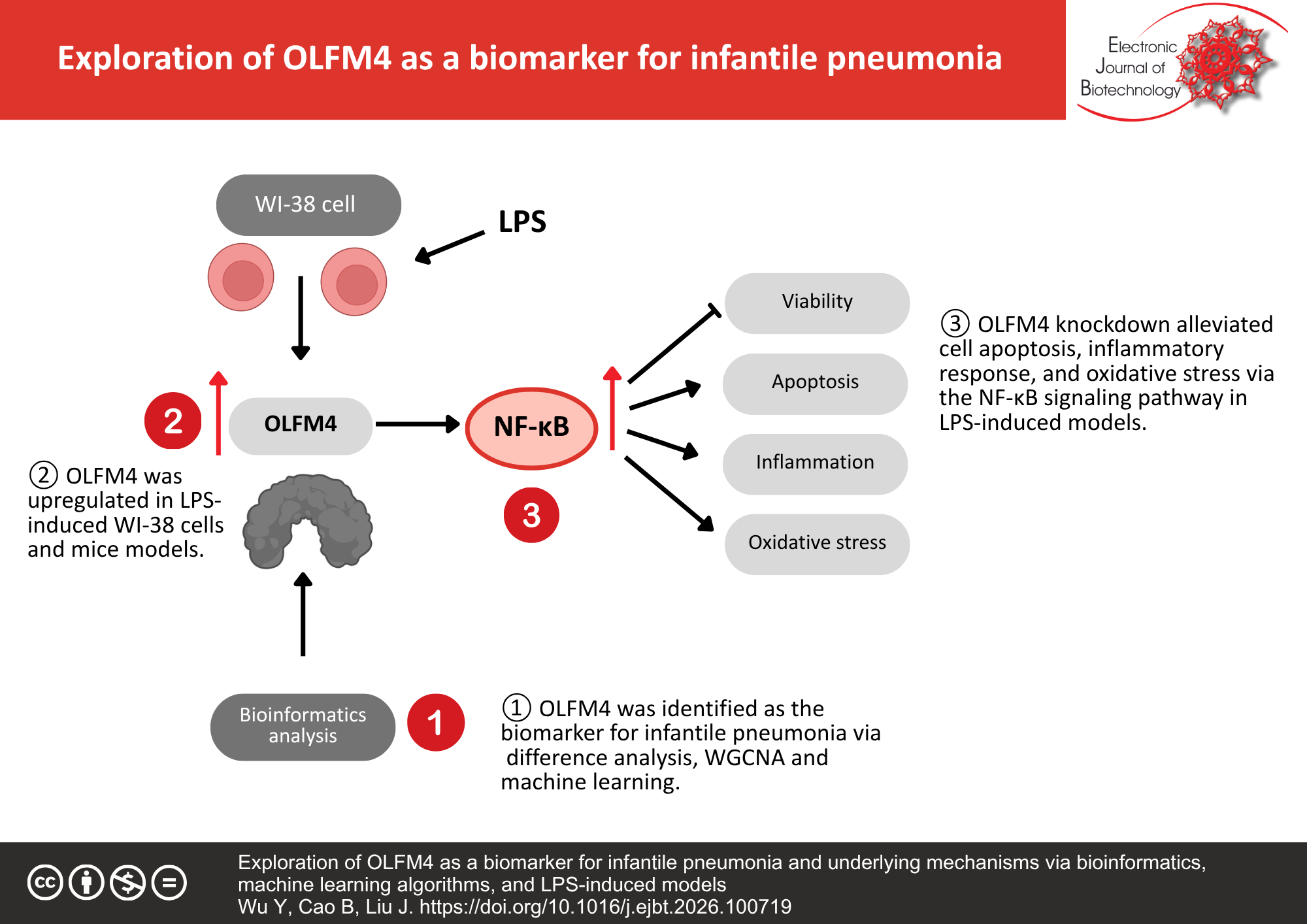
Graphical abstract
Keywords
Categories
How to Cite
Abstract
Background: Infantile pneumonia is a common health concern worldwide, with elevated morbidity and mortality rates among affected children. This study aims to identify key genes associated with infantile pneumonia using bioinformatics and unravel the underlying mechanisms.
Results: OLFM4 was the only biomarker identified for infantile pneumonia. Besides, OLFM4 expression was promoted in the serum of infantile pneumonia patients, and LPS-stimulated cells and mouse models. OLFM4 knockdown repressed cell apoptosis, levels of TNF-α, IL-6, IL-1β, MPO, MDA, ROS, and activation of the NF-κB pathway, and facilitated the SOD level in LPS-induced models. OLFM4 knockdown alleviated the lung injury of the LPS-induced mouse model.
Conclusions: OLFM4 knockdown alleviated cell apoptosis, inflammatory response, and oxidative stress via the NF-κB signaling pathway in LPS-induced WI-38 cells and mouse model. The findings suggest that OLFM4 may pave the way for the treatment of infantile pneumonia.
References
Zhang J, Wang CH, Liu XJ, et al. Efficacy and safety analysis of dopamine combined with creatine phosphate sodium in the treatment of infantile pneumonia combined with heart failure. Journal of Biological Regulators and Homeostatic Agents 2020;34(6):2103-8. https://doi.org/10.23812/20-300-L PMid: 33203205
Ojuawo O, Ojuawo A, Aladesanmi A, et al. Childhood pneumonia diagnostics: A narrative review. Expert Review of Respiratory Medicine 2022;16(7):775-85. https://doi.org/10.1080/17476348.2022.2099842 PMid: 35815336
Yadav KK, Awasthi S. Childhood pneumonia: What's unchanged, and what's new? Indian Journal of Pediatrics 2023;90(7):693-9. https://doi.org/10.1007/s12098-023-04628-3 PMid: 37204597
Meyer Sauteur PM. Childhood community-acquired pneumonia. European Journal of Pediatrics 2024;183(3):1129-36. https://doi.org/10.1007/s00431-023-05366-6 PMid: 38112800
Pratt MTG, Abdalla T, Richmond PC, et al. Prevalence of respiratory viruses in community-acquired pneumonia in children: A systematic review and meta-analysis. The Lancet Child & Adolescent Health. 2022;6(8):555-70. https://doi.org/10.1016/S2352-4642(22)00092-X PMid: 35636455
Li Q, Zhou Q, Florez ID, et al. Short-course vs long-course antibiotic therapy for children with nonsevere community-acquired pneumonia: A systematic review and meta-analysis. JAMA Pediatrics 2022;176(12):1199-207. https://doi.org/10.1001/jamapediatrics.2022.4123 PMid: 36374480
Chee E, Huang K, Haggie S, et al. Systematic review of clinical practice guidelines on the management of community acquired pneumonia in children. Paediatric Respiratory Reviews 2022;42:59-68. https://doi.org/10.1016/j.prrv.2022.01.006 PMid: 35210170
Lyon E, Olarte L. Community-acquired bacterial pneumonia in children: an update on antibiotic duration and immunization strategies. Current Opinion in Pediatrics 2024;36(2):144-9. https://doi.org/10.1097/MOP.0000000000001325 PMid: 38169463
Wang YS, Zhou YL, Bai GN, et al. Expert consensus on the diagnosis and treatment of macrolide-resistant Mycoplasma pneumoniae pneumonia in children. World Journal of Pediatrics 2024;20(9):901-14. https://doi.org/10.1007/s12519-024-00831-0 PMid: 39143259
Chen B, Lin N, Hu Y. Network pharmacology analysis of children pneumonia: Exploration of inflammation-related signaling pathways and potential therapeutic intervention targets. Letters in Drug Design & Discovery 2025;22(11):100220. https://doi.org/10.1016/j.lddd.2025.100220
Reel PS, Reel S, Pearson E, et al. Using machine learning approaches for multi-omics data analysis: A review. Biotechnology Advances 2021;49:107739. https://doi.org/10.1016/j.biotechadv.2021.107739 PMid: 33794304
Morabito A, De Simone G, Pastorelli R, et al. Algorithms and tools for data-driven omics integration to achieve multilayer biological insights: A narrative review. Journal of Translational Medicine 2025;23(1):425. https://doi.org/10.1186/s12967-025-06446-x PMid: 40211300
Sanches PHG, de Melo NC, Porcari AM, et al. Integrating molecular perspectives: strategies for comprehensive multi-omics integrative data analysis and machine learning applications in transcriptomics, proteomics, and metabolomics. Biology 2024;13(11):848. https://doi.org/10.3390/biology13110848 PMid: 39596803
Cheng C, Li B, Li J, et al. Multi-stain deep learning prediction model of treatment response in lupus nephritis based on renal histopathology. Kidney International 2025;107(4):714-27. https://doi.org/10.1016/j.kint.2024.12.007 PMid: 39733792
Wang L, Liu J, Zhang D, et al. Serum proteomics reveals differential proteins between individuals with vestibular migraine and healthy subjects. Current Proteomics 2024;21(6):751-9. https://doi.org/10.2174/0115701646331735241231070050
Smelik M, Zhao Y, Li X, et al. An interactive atlas of genomic, proteomic, and metabolomic biomarkers promotes the potential of proteins to predict complex diseases. Scientific Reports 2024;14(1):12710. https://doi.org/10.1038/s41598-024-63399-9 PMid: 38830935
Sudlow C, Gallacher J, Allen N, et al. UK Biobank: An open access resource for identifying the causes of a wide range of complex diseases of middle and old age. PLoS Medicine 2015;12(3):e1001779. https://doi.org/10.1371/journal.pmed.1001779 PMid: 25826379
Ahsan MA, Liu Y, Feng C, et al. Bioinformatics resources facilitate understanding and harnessing clinical research of SARS-CoV-2. Briefings in Bioinformatics 2021;22(2):714-25. https://doi.org/10.1093/bib/bbaa416 PMid: 33432321
Xia Y, Zhang Z, Liu Q. Screening of immune-related secretory proteins linking primary Sjögren’s syndrome with pulmonary arterial hypertension based on comprehensive bioinformatics analysis and machine learning. Current Proteomics 2025;22(4):100032. https://doi.org/10.1016/j.curpro.2025.100032
O'Sullivan R, Alder MN, Dixon CG, et al. Olfactomedin-4 elevation in pediatric acute respiratory distress syndrome. American Journal of Physiology- Lung Cellular and Molecular Physiology 2025;329(1):L172-L182. https://doi.org/10.1152/ajplung.00040.2025 PMid: 40499529
Kangelaris KN, Clemens R, Fang X, et al. A neutrophil subset defined by intracellular olfactomedin 4 is associated with mortality in sepsis. American Journal of Physiology- Lung Cellular and Molecular Physiology 2021;320(5):L892-L902. https://doi.org/10.1152/ajplung.00090.2020 PMid: 33355521
Gong F, Li R, Zheng X, et al. OLFM4 Regulates lung epithelial cell function in sepsis-associated ARDS/ALI via LDHA-mediated NF-?B signaling. Journal of Inflammation Research 2021;14:7035-51. https://doi.org/10.2147/JIR.S335915 PMid: 34955649
Hasson DC, Krallman K, VanDenHeuvel K, et al. Olfactomedin 4 as a novel loop of Henle-specific acute kidney injury biomarker. Physiological Reports 2022;10(18):e15453. https://doi.org/10.14814/phy2.15453 PMid: 36117416
Kangelaris KN, Prakash A, Liu KD, et al. Increased expression of neutrophil-related genes in patients with early sepsis-induced ARDS. American Journal of Physiology- Lung Cellular and Molecular Physiology 2015;308:L1102-L1113. https://doi.org/10.1152/ajplung.00380.2014 PMid: 25795726
Chen H, Liu S, Fang G. Knockdown of OLFM4 protects cardiomyocytes from sepsis by inhibiting apoptosis and inflammatory responses. Allergologia et Immunopathologia 2024;52(5):15-20. https://doi.org/10.15586/aei.v52i5.1145 PMid: 39278846
Zhang F, Li Y, Xi Y, et al. Qinbaohong Zhike oral liquid attenuates LPS-induced acute lung injury in immature rats by inhibiting OLFM4. Oxidative Medicine and Cellular Longevity 2022;2022:7272371. https://doi.org/10.1155/2022/7272371 PMid: 36035204
Wen F, Han Y, Zhang H, et al. Epstein-Barr virus infection upregulates extracellular OLFM4 to activate YAP signaling during gastric cancer progression. Nature Communications 2024;15(1):10543. https://doi.org/10.1038/s41467-024-54850-6 PMid: 39627192
Li J, Liu C, Li D, et al. OLFM4 inhibits epithelial-mesenchymal transition and metastatic potential of cervical cancer cells. Oncology Research 2019;27(7):763-71. https://doi.org/10.3727/096504018X15399955297355 PMid: 30764901
Chen Z, Zhang X, Xing Z, et al. OLFM4 deficiency delays the progression of colitis to colorectal cancer by abrogating PMN-MDSCs recruitment. Oncogene. 2022;41(22):3131-50. https://doi.org/10.1038/s41388-022-02324-8 PMid: 35487976
Brand HK, Ahout IM, de Ridder D, et al. Olfactomedin 4 serves as a marker for disease severity in pediatric Respiratory Syncytial Virus (RSV) infection. PLoS One 2015;10(7):e0131927. https://doi.org/10.1371/journal.pone.0131927 PMid: 26162090
Zhu-Ge D, Yang YP, Jiang ZJ. Knockdown CRNDE alleviates LPS-induced inflammation injury via FOXM1 in WI-38 cells. Biomedicine & Pharmacotherapy 2018;103:1678-87. https://doi.org/10.1016/j.biopha.2018.04.192 PMid: 29864958
Smith KM, Mrozek JD, Simonton SC, et al. Prolonged partial liquid ventilation using conventional and high-frequency ventilatory techniques: gas exchange and lung pathology in an animal model of respiratory distress syndrome. Critical Care Medicine 1997;25(11):1888-97. https://doi.org/10.1097/00003246-199711000-00030 PMid: 9366775
Yokoyama K, Mitoma H, Kawano S, et al. CEACAM 1, 3, 5 and 6 -positive classical monocytes correlate with interstitial lung disease in early systemic sclerosis. Frontiers in Immunology 2022;13:1016914. https://doi.org/10.3389/fimmu.2022.1016914 PMid: 36341379
Voronko OE, Khotina VA, Kashirskikh DA, et al. Antimicrobial peptides of the cathelicidin family: Focus on LL-37 and its modifications. International Journal of Molecular Sciences 2025;26(16):8103. https://doi.org/10.3390/ijms26168103 PMid: 40869425
Sun Y, Qian Q, Xu L, et al. Mechanical stretch-induced interlayer coordination between MMP2 and COL17A1 exacerbates regenerative exhaustion in skin. Advanced Science 2025;12(41):e11474. https://doi.org/10.1002/advs.202511474 PMid: 40960906
Brooks D, Barr LC, Wiscombe S, et al. Human lipopolysaccharide models provide mechanistic and therapeutic insights into systemic and pulmonary inflammation. European Respiratory Journal 2020;56(1):1901298. https://doi.org/10.1183/13993003.01298-2019 PMid: 32299854
Nova Z, Skovierova H, Calkovska A. Alveolar-capillary membrane-related pulmonary cells as a target in endotoxin-induced acute lung injury. International Journal of Molecular Sciences 2019;20(49):831. https://doi.org/10.3390/ijms20040831 PMid: 30769918
Bai D, Han A, Cong S. The effect of down-regulation of CCL5 on lipopolysaccharide-induced WI-38 fibroblast injury: a potential role for infantile pneumonia. Iranian Journal of Basic Medical Sciences 2018;21(5):449-54. https://doi.org/10.22038/ijbms.2018.27165.6640 PMid: 29922423
Xiao H, Ma W, Zha L, et al. Curcumin alleviates LPS-induced WI-38 cell inflammation injury by regulating PTGS2 expression. Hereditas 2025;162(1):81. https://doi.org/10.1186/s41065-025-00441-4 PMid: 40380246

This work is licensed under a Creative Commons Attribution-ShareAlike 4.0 International License.
Copyright (c) 2026 Electronic Journal of Biotechnology