Graphical abstract
Keywords
Categories
How to Cite
Abstract
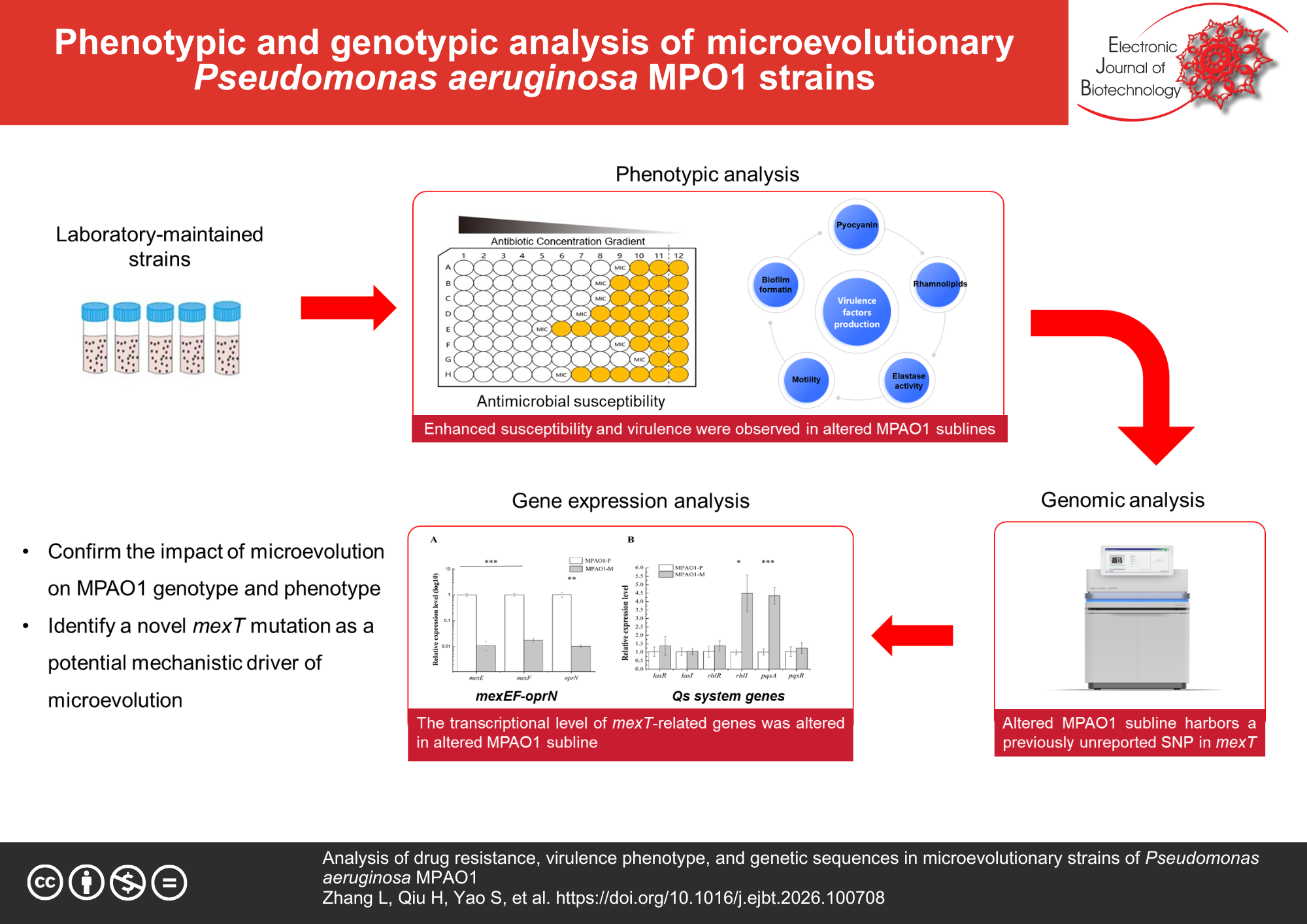
Background: The Pseudomonas aeruginosa PAO1 strain is a foundation of research on bacterial virulence and antibiotic resistance. However, its tendency for microevolution during laboratory culture can lead to genetic and phenotypic divergence, potentially compromising experimental reproducibility. This study aimed to systematically characterize such variations in laboratory-maintained MPAO1 sublines to assess their genetic stability and suitability for research.
Results: We identified two distinct MPAO1 sublines (MPAO1-P and MPAO1-M) with divergent phenotypes. MPAO1-M exhibited markedly increased antimicrobial susceptibility to multiple antibiotics, including ciprofloxacin, imipenem, gentamicin and chloramphenicol, while concurrently displaying enhanced production of key virulence factors, including pyocyanin, rhamnolipids, elastase, and twitching motility. Whole-genome resequencing uncovered a novel missense mutation in the mexT gene of MPAO1-M. Consistent with this finding, quantitative reverse transcription PCR analysis revealed a significant downregulation of the mexEF-oprN efflux pump operon and a marked upregulation of the quorum-sensing genes rhlI and pqsA.
Conclusions: Our findings confirm the critical impact of microevolution on MPAO1 genotype and phenotype, underscoring the necessity of strain verification in experimental design. We further identify a novel mexT mutation as a potential mechanistic driver of these changes, providing new insights into the genetic basis of adaptive evolution in laboratory P. aeruginosa strains.
References
Shao X, Xie Y, Zhang Y, et al. Novel therapeutic strategies for treating Pseudomonas aeruginosa infection. Expert Opin Drug Dis 2020;15(12):1403–1423. https://doi.org/10.1080/17460441.2020.1803274 PMid: 32880507
Abdelaziz AA, Kamer AMA, Al-Monofy KB, et al. Pseudomonas aeruginosa's greenish-blue pigment pyocyanin: its production and biological activities. Microb Cell Fact 2023;8;22(1):110. https://doi.org/10.1186/s12934-023-02122-1 PMid: 37291560
Jurado-Martín I, Sainz-Mejías M, McClean S. Pseudomonas aeruginosa: An audacious pathogen with an adaptable arsenal of virulence factors. Int J Mol Sci 2021;22(6):3128. https://doi.org/10.3390/ijms22063128 PMid: 33803907
Khan F, Pham DTN, Oloketuyi SF, et al. Regulation and controlling the motility properties of Pseudomonas aeruginosa. Appl Microbiol Biotechnol 2020;104(1):33-49. https://doi.org/10.1007/s00253-019-10201-w PMid: 31768614
Ramesh R, Rekha ND, Gopal S. Pseudomonas aeruginosa biofilm: treatment strategies to combat infection. Arch Microbiol. 2025;207(6):141. https://doi.org/10.1007/s00203-025-04346-8 PMid: 40348909
Nickzad A, Déziel E. The involvement of rhamnolipids in microbial cell adhesion and biofilm development - an approach for control? Lett Appl Microbiol 2014;58(5):447–453. https://doi.org/10.1111/lam.12211 PMid: 24372465
Miranda SW, Asfahl KL, Dandekar AA, et al. Pseudomonas aeruginosa quorum sensing. Pseudomonas aeruginosa Quorum Sensing. In: Filloux A, Ramos, JL. (eds) Pseudomonas aeruginosa. Adv Exp Med Biol Springer, Cham 2022;1386:95-115. https://doi.org/10.1007/978-3-031-08491-1_4 PMid: 36258070
Vadakkan K, Ngangbam AK, Sathishkumar K, et al. A review of chemical signaling pathways in the quorum sensing circuit of Pseudomonas aeruginosa. Int J Biol Macromol 2024;254(Pt 2):127861. https://doi.org/10.1016/j.ijbiomac.2023.127861 PMid: 37939761
Raya J, Montagut EJ, Marco MP. Analysing the integrated quorum sensing system its potential role in Pseudomonas aeruginosa pathogenesis. Front Cell Infect Microbiol 2025;15:1575421. https://doi.org/10.3389/fcimb.2025.1575421 PMid: 40438239
Lee J, Zhang L. The hierarchy quorum sensing network in Pseudomonas aeruginosa. Protein Cell 2015;6(1):26–41. https://doi.org/10.1007/s13238-014-0100-x PMid: 25249263
Pang Z, Raudonis R, Glick BR, et al. Antibiotic resistance in Pseudomonas aeruginosa: mechanisms and alternative therapeutic strategies. Biotechnol Adv 2019;37(1):177–192. https://doi.org/10.1016/j.biotechadv.2018.11.013 PMid: 30500353
Reynolds D, Kollef M. The epidemiology and pathogenesis and treatment of Pseudomonas aeruginosa infections: An update. Drugs 2021;81(18):2117-2131. https://doi.org/10.1007/s40265-021-01635-6 PMid: 34743315
Lorusso AB, Carrara JA, Barroso CDN, et al. Role of efflux pumps on antimicrobial resistance in Pseudomonas aeruginosa. Int J Mol Sci 2022;23(24):15779. https://doi.org/10.3390/ijms232415779 PMid: 36555423
Braz VS, Furlan JPR, Fernandes AFT, et al. Mutations in NalC induce MexAB-OprM overexpression resulting in high level of aztreonam resistance in environmental isolates of Pseudomonas aeruginosa. FEMS Microbiol Lett 2016;363(16):fnw166. https://doi.org/10.1093/femsle/fnw166 PMid: 27412168
Pan YP, Xu YH, Wang ZX, et al. Overexpression of MexAB-OprM efflux pump in carbapenem-resistant Pseudomonas aeruginosa. Arch Microbiol 2016;198(6):565–571. https://doi.org/10.1007/s00203-016-1215-7 PMid: 27060003
Suresh M, Nithya N, Jayasree PR, et al. Mutational analyses of regulatory genes, mexR, nalC, nalD and mexZ of mexAB-oprM and mexXY operons, in efflux pump hyperexpressing multidrug-resistant clinical isolates of Pseudomonas aeruginosa. World J Microbiol Biotechnol 2018;34(6):83. https://doi.org/10.1007/s11274-018-2465-0 PMid: 29846800
Juarez P, Broutin I, Bordi C, et al. Constitutive activation of MexT by amino acid substitutions results in MexEF-OprN overproduction in clinical isolates of Pseudomonas aeruginosa. Antimicrob Agents Chemother 2018;62(5):e02445-17. https://doi.org/10.1128/AAC.02445-17 PMid: 29530852
Chandler CE, Horspool AM, Hill PJ, et al. Genomic and phenotypic diversity among ten laboratory isolates of Pseudomonas aeruginosa PAO1. J Bacteriol 2019;201(5):e00595-18. https://doi.org/10.1128/JB.00595-18 PMid: 30530517
Klockgether J, Munder A, Neugebauer J, et al. Genome diversity of Pseudomonas aeruginosa PAO1 laboratory strains. J Bacteriol 2010;192(4):1113-1121. https://doi.org/10.1128/JB.01515-09 PMid: 20023018
Sidorenko J, Jatsenko T, Kivisaar M. Ongoing evolution of Pseudomonas aeruginosa PAO1 sublines complicates studies of DNA damage repair and tolerance. Mutat Res 2017;797–799:26–37. https://doi.org/10.1016/j.mrfmmm.2017.03.005 PMid: 28340408
Liu Y, Ahator SD, Wang H, et al. Microevolution of the mexT and lasR reinforces the bias of quorum sensing system in laboratory strains of Pseudomonas aeruginosa PAO1. Front Microbiol 2022;13:821895. https://doi.org/10.3389/fmicb.2022.821895 PMid: 35495693
Clinical and Laboratory Standards Institute (CLSI). Performance Standards for Antimicrobial Susceptibility Testing; 26th Informational Supplement. CLSI document M100-26. Wayne, PA: Clinical and Laboratory Standards Institute; 2016.
Ji PC, Yin KY, Jiang Y, et al. Sesamol: a novel quorum sensing inhibitor and colistin accelerator against Pseudomonas aeruginosa. Food Science and Human Wellness 2024;14(3):1158-1168. https://doi.org/10.26599/FSHW.2024.9250075
Terzi HA, Kulah C, Ciftci IH. The effects of active efflux pumps on antibiotic resistance in Pseudomonas aeruginosa. World J Microbiol Biotechnol 2014;30(10):2681-2687. https://doi.org/10.1007/s11274-014-1692-2 PMid: 24964907
Horna G, López M, Guerra H, et al. Interplay between MexAB-OprM and MexEF-OprN in clinical isolates of Pseudomonas aeruginosa. Sci Rep 2018;8:16463. https://doi.org/10.1038/s41598-018-34694-z PMid: 30405166
Luong PM, Shogan BD, Zaborin A, et al. Emergence of the P2 phenotype in Pseudomonas aeruginosa PAO1 strains involves various mutations in mexT or mexF. J Bacteriol 2014;196(2):504–513. https://doi.org/10.1128/JB.01050-13 PMid: 24244000
Maseda H, Saito K, Nakajima A, et al. Variation of the mexT gene, a regulator of the MexEF-OprN efflux pump expression in wild-type strains of Pseudomonas aeruginosa. FEMS Microbiol Lett 2000;192(1):107-12. https://doi.org/10.1111/j.1574-6968.2000.tb09367.x PMid: 11040437
De Oliveira DMP, Forde BM, Kidd TJ, et al. Antimicrobial resistance in ESKAPE Pathogens. Clin Microbiol Rev 2020;33(3):e00181-19. https://doi.org/10.1128/CMR.00181-19 PMid: 32404435
Olivas AD, Shogan BD, Valuckaite V, et al. Intestinal tissues induce an SNP mutation in Pseudomonas aeruginosa that enhances its virulence: Possible role in anastomotic leak. PLoS One 2012;7(8):e44326. https://doi.org/10.1371/journal.pone.0044326 PMid: 22952955
Garvey GS, Rocco CJ, Escalante-Semerena JC, et al. The three-dimensional crystal structure of the PrpF protein of Shewanella oneidensis complexed with trans-aconitate: Insights into its biological function. Protein Sci 2007;16(7):1274-1284. https://doi.org/10.1110/ps.072801907 PMid: 17567742
Chang YW, Rettberg LA, Treuner-Lange A, et al. Architecture of the type IVa pilus machine. Science. 2016;351(6278):aad2001. https://doi.org/10.1126/science.aad2001 PMid: 26965631
Buensuceso RNC, Daniel-Ivad M, Kilmury SLN, et al. Cyclic AMP-independent control of twitching motility in Pseudomonas aeruginosa. J Bacteriol 2017;199(16):e00188-17. https://doi.org/10.1128/JB.00188-17 PMid: 28583947
Simm R, Morr M, Kader A, et al. GGDEF and EAL domains inversely regulate cyclic di-GMP levels and transition from sessility to motility. Mol Microbiol 2004;53(4):1123-1134. https://doi.org/10.1111/j.1365-2958.2004.04206.x PMid: 15306016
Ha DG, O'Toole GA. c-di-GMP and its effects on biofilm formation and dispersion: A Pseudomonas aeruginosa Review. Microbiol Spectr 2015;3(2):MB-0003-2014. https://doi.org/10.1128/microbiolspec.MB-0003-2014 PMid: 26104694
Kuchma SL, Delalez NJ, Filkins LM, et al. Cyclic di-GMP-mediated repression of swarming motility by Pseudomonas aeruginosa PA14 requires the MotAB stator. J Bacteriol 2015;197(3):420-430. https://doi.org/10.1128/JB.02130-14 PMid: 25349157
Ankisettypalli K, Cheng JJ, Baker EN, et al. PdxH proteins of mycobacteria are typical members of the classical pyridoxine/pyridoxamine 5'-phosphate oxidase family. FEBS Lett 2016;590(4):453-460. https://doi.org/10.1002/1873-3468.12080 PMid: 26823273
Taha MK, Giorgini D, Nassif X. The pilA regulatory gene modulates the pilus-mediated adhesion of Neisseria meningitidis by controlling the transcription of pilC1. Mol Microbiol 1996;19(5):1073-1084. https://doi.org/10.1046/j.1365-2958.1996.448979.x PMid: 8830264
Pei TT, Wang XY, Zhang YQ, et al. Fha initiates the inside-out assembly of the type VI secretion system. Cell Rep 2025;44(7):115990. https://doi.org/10.1016/j.celrep.2025.115990 PMid: 40650907
Kristensen R, Andersen JB, Rybtke M, et al. Inhibition of Pseudomonas aeruginosa quorum sensing by chemical induction of the MexEF-oprN efflux pump. Antimicrob Agents Chemother 2024;68(2):e0138723. https://doi.org/10.1128/aac.01387-23 PMid: 38189278
Maddocks SE, Oyston PCF. Structure and function of the LysR-type transcriptional regulator (LTTR) family proteins. Microbiology 2008;154(12):3609–3623. https://doi.org/10.1099/mic.0.2008/022772-0 PMid: 19047729

This work is licensed under a Creative Commons Attribution-ShareAlike 4.0 International License.
Copyright (c) 2026 Electronic Journal of Biotechnology