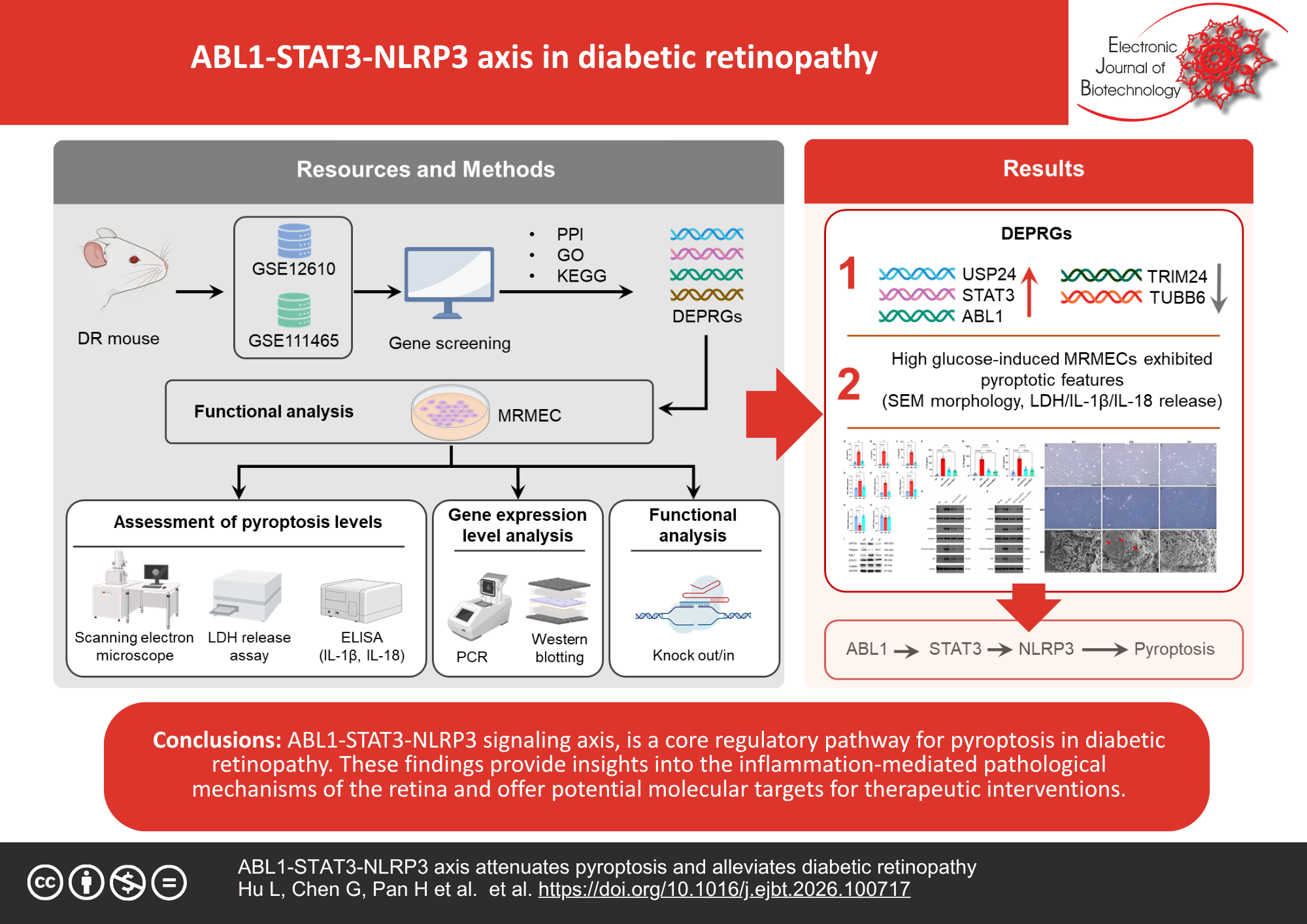
Graphical abstract
Keywords
Categories
How to Cite
Abstract
Background: Diabetic retinopathy is a major microvascular complication of diabetes and a leading cause of vision loss. Persistent low-grade inflammation drives disease progression. Pyroptosis, characterized by its pro-inflammatory nature, is involved in several inflammatory diseases, yet the molecular mechanisms specific to diabetic retinopathy remain largely undefined. This study aimed to identify the key molecular drivers and regulatory pathways of pyroptosis in diabetic retinopathy.
Results: Five key pyroptosis-related genes were identified: ubiquitin-specific peptidase 24, signal transducer and activator of transcription 3, and ABL proto-oncogene 1 were upregulated, while tripartite motif containing 24 and tubulin beta 6 class VI were downregulated in diabetic retinopathy. High glucose exposure induced pyroptotic morphology and increased lactate dehydrogenase, interleukin-1 beta, and interleukin-18 levels. Functional assays demonstrated that ABL proto-oncogene 1 acts upstream of signal transducer and activator of transcription 3 to activate the NOD-like receptor family pyrin domain-containing 3 inflammasome, ultimately leading to pyroptosis. Signal transducer and activator of transcription 3 showed strong diagnostic value with an area under the curve exceeding 0.9.
Conclusions: This study identifies a novel ABL proto-oncogene 1–signal transducer and activator of transcription 3–NOD-like receptor family pyrin domain containing 3 signaling axis as a central regulator of pyroptosis in diabetic retinopathy. These findings provide insights into inflammation-induced retinal pathology and suggest candidate molecular targets for therapeutic intervention.
References
Teo ZL, Tham YC, Yu M, et al. Global prevalence of diabetic retinopathy and projection of burden through 2045: Systematic review and meta-analysis. Ophthalmology 2021;128(11):1580-91. https://doi.org/10.1016/j.ophtha.2021.04.027 PMid: 33940045
Sivaprasad S, Wong TY, Gardner TW, et al. Diabetic retinal disease. Nature Reviews Disease Primers 2025;11(1):62. https://doi.org/10.1038/s41572-025-00646-x PMid: 40877334
Schmidt AM. Highlighting diabetes mellitus: The epidemic continues. Arteriosclererosis, Thrombosis, and Vascular Biology 2018;38(1):e1-e8. https://doi.org/10.1161/ATVBAHA.117.310221 PMid: 29282247
Tan Y, Fukutomi A, Sun MT, et al. Anti-VEGF crunch syndrome in proliferative diabetic retinopathy: A review. Survey of Ophthalmology 2021;66(6):926-32. https://doi.org/10.1016/j.survophthal.2021.03.001 PMid: 33705807
Hu L, Yang H, Ai M, et al. Inhibition of TLR4 alleviates the inflammation and apoptosis of retinal ganglion cells in high glucose. Graefe’s Archive for Clinical and Experimental Ophthalmology 2017;255(11):2199-210. https://doi.org/10.1007/s00417-017-3772-0 PMid: 28808786
Meng C, Gu C, He S, et al. Pyroptosis in the retinal neurovascular unit: New insights into diabetic retinopathy. Frontiers in Immunology 2021;12:763092. https://doi.org/10.3389/fimmu.2021.763092 PMid: 34737754
Wang Y, Kanneganti TD. From pyroptosis, apoptosis and necroptosis to PANoptosis: A mechanistic compendium of programmed cell death pathways. Computational and Structural Biotechnology Journal 2021;19:4641-57. https://doi.org/10.1016/j.csbj.2021.07.038 PMid: 34504660
Liu Y, Pan R, Ouyang Y, et al. Pyroptosis in health and disease: Mechanisms, regulation and clinical perspective. Signal Transduction and Targeted Therapy 2024;9(1):245. https://doi.org/10.1038/s41392-024-01958-2 PMid: 39300122
Zhang Y, Jiao Y, Li X, et al. Pyroptosis: A new insight into eye disease therapy. Frontiers in Pharmacology 2021;12:797110. https://doi.org/10.3389/fphar.2021.797110 PMid: 34925047
Chen M, Rong R, Xia X. Spotlight on pyroptosis: Role in pathogenesis and therapeutic potential of ocular diseases. Journal of Neuroinflammation 2022;19(1):183. https://doi.org/10.1186/s12974-022-02547-2 PMid: 35836195
Al Mamun A, Mimi AA, Zaeem M, et al. Role of pyroptosis in diabetic retinopathy and its therapeutic implications. European Journal of Pharmacology 2021;904:174166. https://doi.org/10.1016/j.ejphar.2021.174166 PMid: 33979651
Roy S, Kern TS, Song B, et al. Mechanistic insights into pathological changes in the diabetic retina: implications for targeting diabetic retinopathy. The American Journal of Pathology 2017;187(1):9-19. https://doi.org/10.1016/j.ajpath.2016.08.022 PMid: 27846381
Gu J, Geng K, Guo M, et al. Targeting pyroptosis: New insights into the treatment of diabetic microvascular complications. Evidence-Based Complementary and Alternative Medicine 2022;2022:5277673. https://doi.org/10.1155/2022/5277673 PMid: 36204129
Samad MA, Ahmad I, Hasan A, et al. STAT3 signaling pathway in health and disease. MedComm 2025;6(4):e70152. https://doi.org/10.1002/mco2.70152 PMid: 40166646
Chen B, Dong X, Zhang JL, et al. Natural compounds target programmed cell death (PCD) signaling mechanism to treat ulcerative colitis: A review. Front Pharmacol. 2024;15:1333657. https://doi.org/10.3389/fphar.2024.1333657 PMid: 38405669
Hong L, Lin Y, Yang X, et al. A narrative review of STAT proteins in diabetic retinopathy: From mechanisms to therapeutic prospects. Ophthalmology and Theraphy 2022;11(6):2005-26. https://doi.org/10.1007/s40123-022-00581-0 PMid: 36208390
Liang GH, Luo YN, Wei RZ, et al. CircZNF532 knockdown protects retinal pigment epithelial cells against high glucose-induced apoptosis and pyroptosis by regulating the miR-20b-5p/STAT3 axis. Journal of Diabetes Investigation 2022;13(5):781-95. https://doi.org/10.1111/jdi.13722 PMid: 34839589
Wang N, Ding L, Liu D, et al. Molecular investigation of candidate genes for pyroptosis-induced inflammation in diabetic retinopathy. Frontiers in Endocrinology 2022;13:918605. https://doi.org/10.3389/fendo.2022.918605 PMid: 35957838
Yang SK, Han DH. The role of TRIM24 in allergic rhinitis. Allergy, Asthma & Immunology Research 2023;15(5):543-4. https://doi.org/10.4168/aair.2023.15.5.543 PMid: 37827975
Hang Y, Tan L, Chen Q, et al. E3 ubiquitin ligase TRIM24 deficiency promotes NLRP3/caspase-1/IL-1?-mediated pyroptosis in endometriosis. Cell Biology International 2021;45(7):1561-70. https://doi.org/10.1002/cbin.11592 PMid: 33724611
Lv D, Li Y, Zhang W, et al. TRIM24 is an oncogenic transcriptional co-activator of STAT3 in glioblastoma. Nature Communications 2017;8(1):1454. https://doi.org/10.1038/s41467-017-01731-w PMid: 29129908
Wang SA, Young MJ, Wang YC, et al. USP24 promotes drug resistance during cancer therapy. Cell Death & Differentiation 2021;28(9):2690-707. https://doi.org/10.1038/s41418-021-00778-z PMid: 33846536
He H, Yi L, Zhang B, et al. USP24-GSDMB complex promotes bladder cancer proliferation via activation of the STAT3 pathway. International Journal of Biological Sciences 2021;17(10):2417-29. https://doi.org/10.7150/ijbs.54442 PMid: 34326684
Maycotte P, Gearheart CM, Barnard R, et al. STAT3-mediated autophagy dependence identifies subtypes of breast cancer where autophagy inhibition can be efficacious. Cancer Research 2014;74(9):2579-90. https://doi.org/10.1158/0008-5472.CAN-13-3470 PMid: 24590058
Bhardwaj A, Panepinto MC, Ueberheide B, et al. A mechanism for hypoxia-induced inflammatory cell death in cancer. Nature 2025;637(8045):470-7. https://doi.org/10.1038/s41586-024-08136-y PMid: 39506105
Salinas RE, Ogohara C, Thomas MI, et al. A cellular genome-wide association study reveals human variation in microtubule stability and a role in inflammatory cell death. Molecular Biology of the Cell 2014;25(1):76-86. https://doi.org/10.1091/mbc.e13-06-0294 PMid: 24173717
Randazzo D, Khalique U, Belanto JJ, et al. Persistent upregulation of the ?-tubulin tubb6, linked to muscle regeneration, is a source of microtubule disorganization in dystrophic muscle. Human Molecular Genetics 2019;28(7):1117-35. https://doi.org/10.1093/hmg/ddy418 PMid: 30535187
Suo L, Liu C, Zhang QY, et al. METTL3-mediated N6 -methyladenosine modification governs pericyte dysfunction during diabetes-induced retinal vascular complication. Theranostics. 2022;12(1):277-89. https://doi.org/10.7150/thno.63441 PMid: 34987645
Zou Z, Wei J, Chen Y, et al. FMRP phosphorylation modulates neuronal translation through YTHDF1. Molecular Cell 2023;83(23):4304-4317.e8. https://doi.org/10.1016/j.molcel.2023.10.028 PMid: 37949069
Hu Z, Chen G, Zhao Y, et al. Exosome-derived circCCAR1 promotes CD8 + T-cell dysfunction and anti-PD1 resistance in hepatocellular carcinoma. Molecular Cancer 2023;22(1):55. https://doi.org/10.1186/s12943-023-01759-1 PMid: 36932387
Chen Y, Peng C, Chen J, et al. WTAP facilitates progression of hepatocellular carcinoma via m6A-HuR-dependent epigenetic silencing of ETS1. Molecular Cancer 2019;18(1):127. https://doi.org/10.1186/s12943-019-1053-8 PMid: 31438961
Liu Y, Yang Z, Lai P, et al. Bcl-6-directed follicular helper T cells promote vascular inflammatory injury in diabetic retinopathy. Theranostics 2020;10(9):4250-64. https://doi.org/10.7150/thno.43731 PMid: 32226551
Meng Z, Chen Y, Wu W, et al. Exploring the immune infiltration landscape and M2 macrophage-related biomarkers of proliferative diabetic retinopathy. Frontiers in Endocrinology 2022;13:841813. https://doi.org/10.3389/fendo.2022.841813 PMid: 35692390
Yu H, Liu B, Wu G, et al. Dysregulation of circulating follicular helper T cells in type 2 diabetic patients with diabetic retinopathy. Immunologic Research 2021;69(2):153-61. https://doi.org/10.1007/s12026-021-09182-8 PMid: 33625683
Yoshida S, Kobayashi Y, Nakama T, et al. Increased expression of M-CSF and IL-13 in vitreous of patients with proliferative diabetic retinopathy: Implications for M2 macrophage-involving fibrovascular membrane formation. British Journal of Ophthalmology 2015;99(5):629-634. https://doi.org/10.1136/bjophthalmol-2014-305860 PMid: 25355804
Wang JH, Kumar S, Liu GS. Bulk Gene Expression Deconvolution Reveals Infiltration of M2 Macrophages in Retinal Neovascularization. Investigative Ophthalmology & Visual Science 2021;62(14):22. https://doi.org/10.1167/iovs.62.14.22 PMid: 34797904

This work is licensed under a Creative Commons Attribution-ShareAlike 4.0 International License.
Copyright (c) 2026 Electronic Journal of Biotechnology