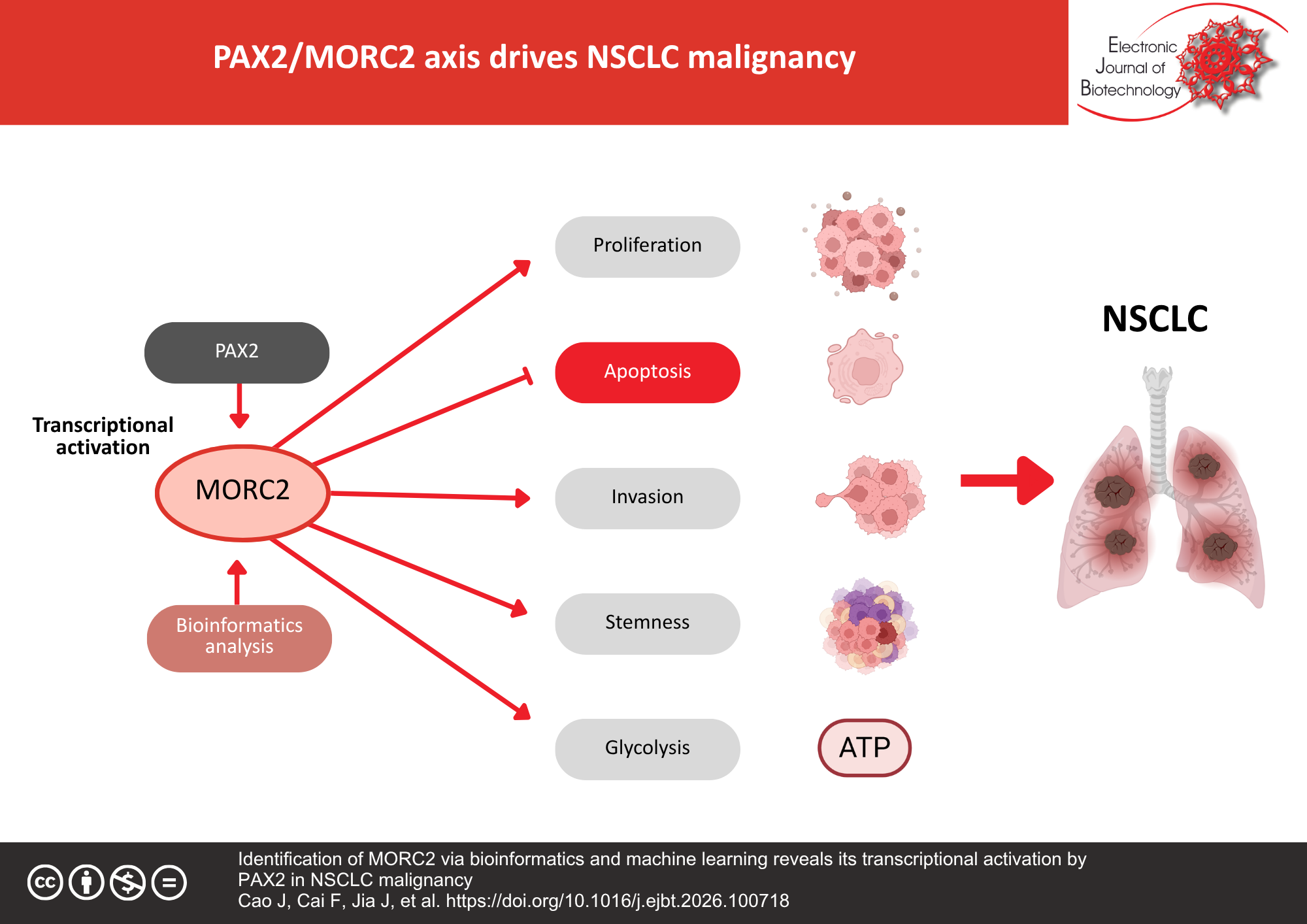
Graphical abstract
Keywords
Categories
How to Cite
Abstract
Background: Non-small cell lung cancer (NSCLC) represents the top contributor to cancer-associated deaths globally, and its suboptimal clinical outcomes are linked to late-stage detection and acquired resistance to existing therapies. Microrchidia family CW-type zinc finger 2 (MORC2) has been found to exhibit oncogenic potential in NSCLC, but its transcriptional regulatory mechanisms and role in glycolytic reprogramming remain unclear.
Results: As a key gene, MORC2 was found to be overexpressed in NSCLC and linked to poor prognosis. MORC2 silencing impaired cell proliferation, stemness, and invasion, diminished glycolysis, and enhanced apoptosis. PAX2 was confirmed to directly transcriptionally activate MORC2; overexpression of MORC2 reversed the defects in malignant phenotypes induced by PAX2 knockdown. In vivo, depletion of PAX2 suppressed tumor growth, which was partially rescued by MORC2 overexpression.
Conclusions: The PAX2/MORC2 axis was demonstrated to drive NSCLC malignancy, supporting MORC2 as a potential prognostic marker and therapeutic target for NSCLC.
References
Bray F, Laversanne M, Sung H, et al. Global cancer statistics 2022: GLOBOCAN estimates of incidence and mortality worldwide for 36 cancers in 185 countries. CA: A Cancer Journal for Clinicians 2024;74(3):229-263. https://doi.org/10.3322/caac.21834 PMid: 38572751
Liu Y, Han Z, Li Y, et al. Global research trends on ALK-TKIs in non-small cell lung cancer: a bibliometric analysis. Frontiers in Pharmacology 2025;16:1665174. https://doi.org/10.3389/fphar.2025.1665174 PMid: 40894217
Travis WD, Brambilla E, Noguchi M, et al. International Association for the Study of Lung Cancer/American Thoracic Society/European Respiratory Society International Multidisciplinary Classification of Lung Adenocarcinoma. Journal of Thoracic Oncology 2011;6(2):244-285. https://doi.org/10.1097/JTO.0b013e318206a221 PMid: 21252716
Molina JR, Yang P, Cassivi SD, et al. Non-small cell lung cancer: Epidemiology, risk factors, treatment, and survivorship. Mayo Clinic Proceedings 2008;83(5):584-594. https://doi.org/10.4065/83.5.584 PMid: 18452692
Relli V, Trerotola M, Guerra E, et al. Abandoning the notion of non-small cell lung cancer. Trends in Molecular Medicine 2019;25(7):585-594. https://doi.org/10.1016/j.molmed.2019.04.012 PMid: 31155338
Li L, Li Y, Ma X, et al. A pomalidomide-based gefitinib PROTAC degrader effectively inhibits lung cancer progression in EGFR-TKIs-acquired resistant models by targeting EGFR degradation and ETFA-mediated ATP generation. Bioorganic Chemistry 2025;164:108864. https://doi.org/10.1016/j.bioorg.2025.108864 PMid: 40815992
Orooji N, Babaei S, Fadaee M, et al. Novel therapeutic approaches for non-small cell lung cancer: an updated view. Journal of Drug Targeting 2025;33(8):1306-1321. https://doi.org/10.1080/1061186x.2025.2489986 PMid: 40186594
Deshpand R, Chandra M, Rauthan A. Evolving trends in lung cancer: Epidemiology, diagnosis, and management. Indian Journal of Cancer 2022;59(Supplement 1):S90-S105. https://doi.org/10.4103/ijc.IJC_52_21 PMid: 35343194
Kandemir O, Demir F. An Investigation of the relationship between 18F-FDG PET/CT parameters of primary tumors and lymph node metastasis in resectable non-small cell lung cancer. Current Radiopharmaceuticals 2024;17(1):111-116. https://doi.org/10.2174/1874471016666230829100703 PMid: 37644744
Jin Y, Wang Z, He D, et al. Identification of novel subtypes based on ssGSEA in immune-related prognostic signature for tongue squamous cell carcinoma. Cancer Medicine 2021;10(23):8693-8707. https://doi.org/10.1002/cam4.4341 PMid: 34668665
Jia ZC, Li YQ, Zhou BW, et al. Transcriptomic profiling of human granulosa cells between women with advanced maternal age with different ovarian reserve. Journal of Assisted Reproduction and Genetics 2023;40(10):2427-2437. https://doi.org/10.1007/s10815-023-02915-8 PMid: 37589858
Herrera LRM. In silico approach in designing a novel multi-epitope vaccine candidate against non-small cell lung cancer with overexpressed G protein-coupled receptor 56. Asian Pacific Journal of Cancer Prevention 2020;21(8):2297-2306. https://doi.org/10.31557/apjcp.2020.21.8.2297 PMid: 32856858
Zhou LX, Zhou Q, Gao TM, et al. Machine learning predicts acute respiratory failure in pancreatitis patients: A retrospective study. International Journal of Medical Informatics 2024;192:105629. https://doi.org/10.1016/j.ijmedinf.2024.105629 PMid: 39321493
Jacquier A, Roubille S, Lomonte P, et al. Microrchidia CW-type zinc finger 2, a chromatin modifier in a spectrum of peripheral neuropathies. Frontiers in Cellular Neuroscience 2022;16:896854. https://doi.org/10.3389/fncel.2022.896854 PMid: 35722617
Zhang J, Yang Y, Dong Y, et al. Microrchidia family CW type zinc finger 2 promotes the proliferation, invasion, migration and epithelial mesenchymal transition of glioma by regulating PTEN/PI3K/AKT signaling via binding to N myc downstream regulated gene 1 promoter. International Journal of Molecular Medicine 2022;49(2):16. https://doi.org/10.3892/ijmm.2021.5071 PMid: 34913078
Liu M, Sun X, Shi S. MORC2 enhances tumor growth by promoting angiogenesis and tumor-associated macrophage recruitment via Wnt/?-catenin in lung cancer. Cellular Physiology and Biochemistry 2018;51(4):1679-1694. https://doi.org/10.1159/000495673 PMid: 30504718
Guddeti RK, Pacharla H, Yellapu NK, et al. MORC2 and MAX contributes to the expression of glycolytic enzymes, breast cancer cell proliferation and migration. Medical Oncology 2023;40(3):102. https://doi.org/10.1007/s12032-023-01974-2 PMid: 36802305
Guddeti RK, Thomas L, Kannan A, et al. The chromatin modifier MORC2 affects glucose metabolism by regulating the expression of lactate dehydrogenase A through a feed forward loop with c-Myc. FEBS Letters 2021;595(9):1289-1302. https://doi.org/10.1002/1873-3468.14062 PMid: 33626175
Cai H, Zhang F, Xu F, et al. Metabolic reprogramming and therapeutic targeting in non-small cell lung cancer: emerging insights beyond the Warburg effect. Frontiers in Oncology 2025;15:1564226. https://doi.org/10.3389/fonc.2025.1564226 PMid: 40469185
Li L, Hossain SM, Eccles MR. The role of the PAX genes in renal cell carcinoma. International Journal of Molecular Sciences 2024;25(12):6730. https://doi.org/10.3390/ijms25126730 PMid: 38928435
Ren Y, Hou J, Xu A, et al. Diagnostic utility of PAX2 and PAX5 in distinguishing non-small cell lung cancer from small cell lung cancer. International Journal of Clinical and Experimental Pathology 2015;8(11):14709-14716. https://pmc.ncbi.nlm.nih.gov/articles/PMC4713581/ PMid: 26823795
Dong N, Lei P, Cai H, et al. The impact of MORC2 on glycolysis and the responsiveness of paclitaxel-resistant ovarian cancer cells. Cytotechnology 2025;77(6):192. https://doi.org/10.1007/s10616-025-00864-x PMid: 41216303
Zhang T, Qiu L, Cao J, et al. ZFP36 loss-mediated BARX1 stabilization promotes malignant phenotypes by transactivating master oncogenes in NSCLC. Cell Death & Disease 2023;14(8):527. https://doi.org/10.1038/s41419-023-06044-z PMid: 37587140
Cantor E, Guauque-Olarte S, León R, et al. Knowledge-slanted random forest method for high-dimensional data and small sample size with a feature selection application for gene expression data. BioData Mining 2024;17(1):34. https://doi.org/10.1186/s13040-024-00388-8 PMid: 39256872
Sun Z, Du T, Yang G, et al. Identification of exosome-related genes in NSCLC via integrated bioinformatics and machine learning analysis. Scientific Reports 2025;15(1):22962. https://doi.org/10.1038/s41598-025-04485-4 PMid: 40595797
Liu J, Shao Y, He Y, et al. MORC2 promotes development of an aggressive colorectal cancer phenotype through inhibition of NDRG1. Cancer Science 2019;110(1):135-146. https://doi.org/10.1111/cas.13863 PMid: 30407715
Liao X, Liu C, Ding Z, et al. High expression of MORC2 predicts worse neoadjuvant chemotherapy efficacy in triple negative breast cancer. Medicine (Baltimore) 2023;102(25):e34164. https://doi.org/10.1097/md.0000000000034164 PMid: 37352040
Zhang FL, Yang SY, Liao L, et al. Dynamic SUMOylation of MORC2 orchestrates chromatin remodelling and DNA repair in response to DNA damage and drives chemoresistance in breast cancer. Theranostics 2023;13(3):973-990. https://doi.org/10.7150/thno.79688 PMid: 36793866
Liao G, Liu X, Wu D, et al. MORC2 promotes cell growth and metastasis in human cholangiocarcinoma and is negatively regulated by miR-186-5p. Aging 2019;11(11):3639-3649. https://doi.org/10.18632/aging.102003 PMid: 31180332
Liu L, Tao T, Liu S, et al. An RFC4/Notch1 signaling feedback loop promotes NSCLC metastasis and stemness. Nature Communications 2021;12(1):2693. https://doi.org/10.1038/s41467-021-22971-x PMid: 33976158
Ahamed F, Van Criekinge M, Wang ZJ, et al. Modeling hyperpolarized lactate signal dynamics in cells, patient-derived tissue slice cultures and murine models. NMR in Medicine 2021;34(3):e4467. https://doi.org/10.1002/nbm.4467 PMid: 33415771
Li Z, Huang M, Wang J, et al. Betulin, an active component from Chinese herb birch bark, suppresses tumor angiogenesis and tumor growth by inhibiting the PAX2/VEGF-A/VEGR2 signaling pathway in non-small cell lung cancer. Phytomedicine 2025;148:157445. https://doi.org/10.1016/j.phymed.2025.157445 PMid: 41166909
Maliszewska-Olejniczak K, Brodaczewska KK, Bielecka ZF, et al. Three-dimensional cell culture model utilization in renal carcinoma cancer stem cell research. In: Barata M, editor. Epithelial Cell Culture: Methods and Protocols. Methods in Molecular Biology, vol 1817 New York: Humana Press, 2018; pp. 47-66. https://doi.org/10.1007/978-1-4939-8600-2_6 PMid: 29959702
Wu Y, Xie J, Wang H, et al. Circular RNA hsa_circ_0011298 enhances Taxol resistance of non-small cell lung cancer by regulating miR-486-3p/CRABP2 axis. Journal of Clinical Laboratory Analysis 2022;36(5):e24408. https://doi.org/10.1002/jcla.24408 PMid: 35396749

This work is licensed under a Creative Commons Attribution-ShareAlike 4.0 International License.
Copyright (c) 2026 Electronic Journal of Biotechnology