Graphical abstract
Keywords
Categories
How to Cite
Abstract
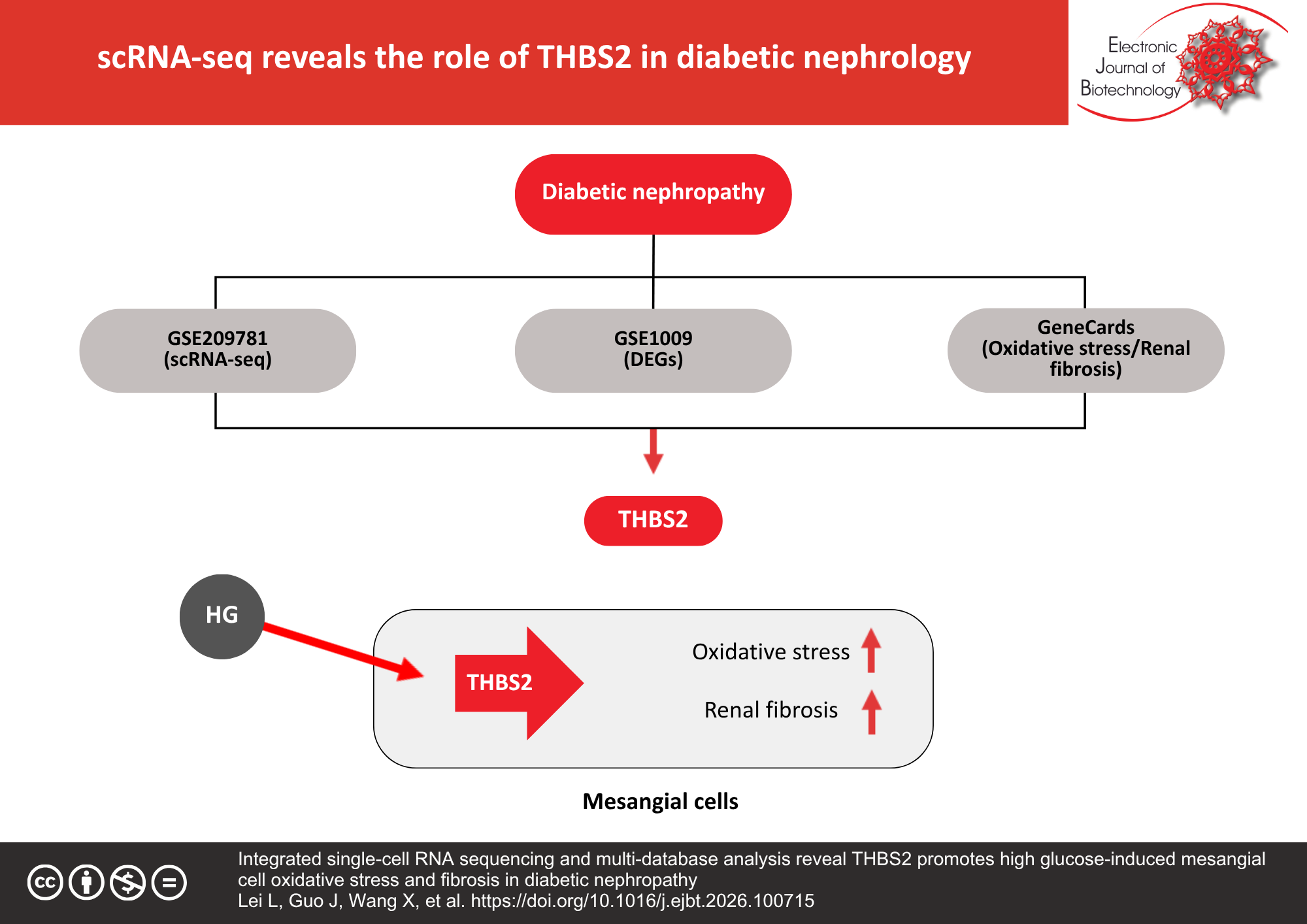
Background: Single-cell RNA sequencing (scRNA-seq) has provided unprecedented resolution for the study of many diseases, including diabetic nephropathy (DN). However, the effective genes regulating oxidative stress and fibrosis in mesangial cells in DN remain to be revealed. In this study, scRNA-seq and multi-database analysis were used to identify thrombospondin 2 (THBS2) as a key gene in regulating DN progression.
Results: The scRNA-seq revealed a total of 6 important cell types in diabetic kidney disease (DKD) from the Gene Expression Omnibus (GEO) database (GSE209781). GO and KEGG analysis showed that the differential genes in mesangial cells of DKD had multi-function and multi-pathway regulation. A total of 4 target genes (ITGB1, THBS2, TIMP1 and COL18A1) were screened by taking the intersection of scRNA-seq (mesangial cells-related genes), GEO database (GSE1009) and GeneCards database (oxidative stress-related genes and renal fibrosis-related genes). THBS2 was overexpressed in high glucose (HG)-induced mesangial cells, and its knockdown inhibited HG-induced mesangial cell oxidative stress and fibrosis.
Conclusions: Based on scRNA-seq, multi-database analysis and experimental verification, this study showed that THBS2 might promote HG-induced mesangial cell oxidative stress and fibrosis in DN.
References
Cleveland KH, Schnellmann RG. Pharmacological targeting of mitochondria in diabetic kidney disease. Pharmacological Reviews 2023;75(2):250-262. https://doi.org/10.1124/pharmrev.122.000560 PMid: 36781216
Fang Y, Xueqing C. Zhenwu decoction modulates PDE3A to alleviate inflammation in diabetic nephropathy. Letters in Drug Design & Discovery 2024;21(19):4743-4755. http://doi.org/10.2174/0115701808339442241223062505
Erekat NS. Programmed cell death in diabetic nephropathy: A review of apoptosis, autophagy, and necroptosis. Medical Science Monitor 2022;28:e937766. https://doi.org/10.12659/MSM.937766 PMid: 35989481
Guo M, Gao J, Jiang L, et al. Astragalus polysaccharide ameliorates renal inflammatory responses in a diabetic nephropathy by suppressing the TLR4/NF-?B Pathway. Drug Design, Development and Therapy 2023;17:2107-2118. https://doi.org/10.2147/DDDT.S411211 PMid: 37489175
Choi S, Hong SP, Bae JH, et al. Hyperactivation of YAP/TAZ drives alterations in mesangial cells through stabilization of N-Myc in diabetic nephropathy. Journal of the American Society of Nephrology 2023;34(5):809-828. https://doi.org/10.1681/ASN.0000000000000075 PMid: 36724799
Sapian S, Budin SB, Taib IS, et al. Role of polyphenol in regulating oxidative stress, inflammation, fibrosis, and apoptosis in diabetic nephropathy. Endocrine, Metabolic & Immune Disorders - Drug Targets 2022;22(5):453-470. https://doi.org/10.2174/1871530321666211119144309 PMid: 34802412
Lv S, Li H, Zhang T, et al. San-Huang-Yi-Shen capsule ameliorates diabetic nephropathy in mice through inhibiting ferroptosis. Biomedicine & Pharmacotherapy 2023;165:115086. https://doi.org/10.1016/j.biopha.2023.115086 PMid: 37418978
Jovic D, Liang X, Zeng H, et al. Single-cell RNA sequencing technologies and applications: A brief overview. Clinical and Translational Medicine 2022;12(3):e694. https://doi.org/10.1002/ctm2.694 PMid: 35352511
Wang S, Sun ST, Zhang XY, et al. The evolution of single-cell RNA sequencing technology and application: progress and perspectives. International Journal of Molecular Science 2023;24(3):2943. https://doi.org/10.3390/ijms24032943 PMid: 36769267
Chen J, Zhang Q, Guo J, et al. Single-cell transcriptomics reveals the ameliorative effect of rosmarinic acid on diabetic nephropathy-induced kidney injury by modulating oxidative stress and inflammation. Acta Pharmaceutical Sinica B 2024;14(4):1661-1676. https://doi.org/10.1016/j.apsb.2024.01.003 PMid: 38572101
Guo Y, Luo J, Zuo J. Depletion of intrinsic renal macrophages with moderate-to-high expression of CD163, MRC1, PTH2R, PDE4D, and CUBN in regulating podocyte injury in diabetic nephropathy: A single-cell RNA sequencing analysis. Translational Andrology and Urology 2024;13(11):2527-2552. https://doi.org/10.21037/tau-24-569 PMid: 39698573
Li K, Tang H, Wang Y, et al. Identification of hub genes involved in the pathogenesis of diabetic nephropathy: A multi-omics study integrating machine learning, mendelian randomization and mediation analysis. Diabetes Obesity and Metabolism 2025;27(9):4927-4941. https://doi.org/10.1111/dom.16536 PMid: 40555691
Wilson PC, Wu H, Kirita Y, et al. The single-cell transcriptomic landscape of early human diabetic nephropathy. Proceedings of the National Academy of Sciences of the United States of America 2019;116(39):19619-19625. https://doi.org/10.1073/pnas.1908706116 PMid: 31506348
Wei Y, Gao X, Li A, et al. Single-nucleus transcriptomic analysis reveals important cell cross-talk in diabetic kidney disease. Frontiers in Medicine 2021;8:657956. https://doi.org/10.3389/fmed.2021.657956 PMid: 33968963
Chen H, Su X, Li Y, et al. Identification of metabolic reprogramming-related genes as potential diagnostic biomarkers for diabetic nephropathy based on bioinformatics. Diabetology & Metabolic Syndrome 2024;16:287. https://doi.org/10.1186/s13098-024-01531-5 PMid: 39609849
Wang Y, Wang Y, Jin J, et al. Identify the co-expressed genes of hypertensive nephropathy and diabetic nephropathy. Scientific reports 2025;15:19418. https://doi.org/10.1038/s41598-025-04679-w PMid: 40461634
Zhong W, Hong C, Dong Y, et al. ASH2L aggravates fibrosis and inflammation through HIPK2 in high glucose-induced glomerular mesangial cells. Genes 2022;13(12):2244. https://doi.org/10.3390/genes13122244 PMid: 36553510
Wen F, Zhang S, Sun L, et al. Salvianolic acid B inhibits oxidative stress in glomerular mesangial cells alleviating diabetic nephropathy by regulating SIRT3/FOXO1 signaling. Kidney and Blood Pressure Research 2023;48(1):738-751. https://doi.org/10.1159/000534832 PMid: 37935137
Bai J, Wang Y, Zhu X, et al. Eriodictyol inhibits high glucose-induced extracellular matrix accumulation, oxidative stress, and inflammation in human glomerular mesangial cells. Phytotherapy Research 2019;33(10):2775-2782. https://doi.org/10.1002/ptr.6463 PMid: 31373419
Cortese R, Adams TS, Cataldo KH, et al. Single-cell RNA-seq uncovers cellular heterogeneity and provides a signature for paediatric sleep apnoea. European Respiratory Journal 2023;61(2):2201465. https://doi.org/10.1183/13993003.01465-2022 PMid: 36356973
Liang L, Yu J, Li J, et al. Integration of scRNA-Seq and bulk RNA-Seq to analyse the heterogeneity of ovarian cancer immune cells and establish a molecular risk model. Frontiers in Oncology 2021;11:711020. https://doi.org/10.3389/fonc.2021.711020 PMid: 34621670
Wang G, Qiu M, Xing X, et al. Lung cancer scRNA-seq and lipidomics reveal aberrant lipid metabolism for early-stage diagnosis. Science Translational Medicine 2022;14(630):eabk2756. https://doi.org/10.1126/scitranslmed.abk2756 PMid: 35108060
Zhang C, Tan G, Zhang Y, et al. Comprehensive analyses of brain cell communications based on multiple scRNA-seq and snRNA-seq datasets for revealing novel mechanism in neurodegenerative diseases. CNS Neuroscience & Therapeutics 2023;29(10):2775-2786. https://doi.org/10.1111/cns.14280 PMid: 37269061
Paik DT, Cho S, Tian L, et al. Single-cell RNA sequencing in cardiovascular development, disease and medicine. Nature Reviews Cardiology 2020;17(8):457-473. https://doi.org/10.1038/s41569-020-0359-y PMid: 32231331
Miao H, Yu G, Minmin Y, et al. Identification of a ubiquitination-related signature for ovarian cancer based on 101 combinations of machine learning methods. Current Proteomics 2024;21(5):543-560. https://doi.org/10.2174/0115701646359714241209075043
Chang Z, Gao Y, Chen P, et al. THBS2 promotes gastric cancer progression and stemness via the Notch signaling pathway. American Journal of Cancer Research 2024;14(7):3433-3450. https://doi.org/10.62347/UXWK4038 PMid: 39113869
Liu Z, Ba Y, Shan D, et al. THBS2-producing matrix CAFs promote colorectal cancer progression and link to poor prognosis via the CD47-MAPK axis. Cell Reports 2025;44(4):115555. https://doi.org/10.1016/j.celrep.2025.115555 PMid: 40222008
Qu HL, Hasen GW, Hou YY, et al. THBS2 promotes cell migration and invasion in colorectal cancer via modulating Wnt/?-catenin signaling pathway. Kaohsiung Journal of Medical Sciences 2022;38(5):469-478. https://doi.org/10.1002/kjm2.12528 PMid: 35315209
Wong YH, Wong SH, Wong XT, et al. Genetic associated complications of type 2 diabetes mellitus. Panminerva Medica 2022;64(2):274-288. https://doi.org/10.23736/S0031-0808.21.04285-3 PMid: 34609116
Jerala M, Hauptman N, Kojc N, et al. Expression of fibrosis-related genes in liver and kidney fibrosis in comparison to inflammatory bowel diseases. Cells 2022;11(3):314. https://doi.org/10.3390/cells11030314 PMid: 35159124
Zhang L, Chen J, Huang X, et al. Berberine ameliorates pulmonary fibrosis by inactivating the thrombospondin 2/Smad homolog 2/3 pathway. Chemical Biology & Drug Design 2025;105(4):e70111. https://doi.org/10.1111/cbdd.70111 PMid: 40247760
Mo T, Fu Q, Hu X, et al. MicroRNA 1228 mediates the viability of high glucose-cultured renal tubule cells through targeting thrombospondin 2 and PI3K/AKT signaling pathway. Kidney and Blood Pressure Research 2022;47(1):1-12. https://doi.org/10.1159/000516791 PMid: 34784607

This work is licensed under a Creative Commons Attribution-ShareAlike 4.0 International License.
Copyright (c) 2026 Electronic Journal of Biotechnology