Graphical abstract
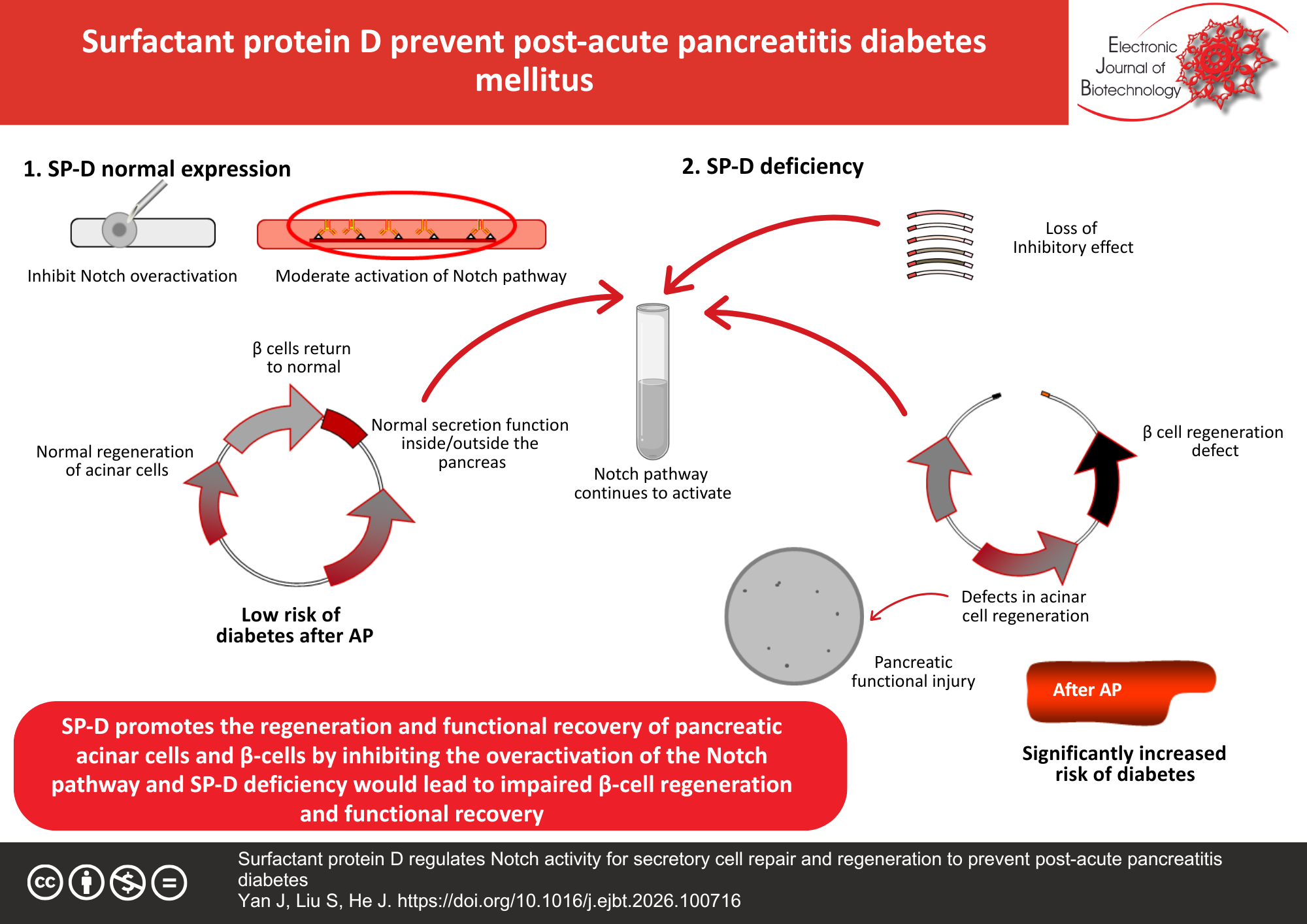
Keywords
Categories
How to Cite
Abstract
Background: Pancreatic endocrine dysfunction following acute pancreatitis (AP) can lead to glucose intolerance and even diabetes. Surfactant protein D (SP-D), as an immune regulatory molecule, has not yet been clarified whether it participates in the regeneration of pancreatic acinar cells and β-cells by modulating the Notch pathway, thereby improving abnormal glucose metabolism. This study aimed to elucidate the role and mechanism of SP-D in promoting the regeneration of pancreatic secretory cells following AP and preventing post-pancreatitis diabetes by regulating the activity of the Notch pathway.
Results: Using wild-type and SP-D gene knockout (SP-D−/−) mice as models, dynamic observations were made after AP induction by Cerulein. Western blot analysis of pancreatic tissue revealed that in the SP-D⁻/⁻-AP group (DG), the key Notch pathway molecules NICD and Hes1 were persistently upregulated; the expression of acinar cell regeneration marker SOX9 and β-cell precursor differentiation marker NGN3 was reduced, and the recovery of the β-cell function marker insulin was delayed. Glucose metabolism testing revealed that the DG had significantly elevated fasting blood glucose (7.6 ± 0.5 mmol/L) at 30 d and an increased area under the curve in the oral glucose tolerance test. Sustained elevation of serum amylase and insufficient insulin secretion were observed, along with a markedly delayed repair process.
Conclusions: SP-D promotes the regeneration and functional recovery of pancreatic acinar cells and β-cells by inhibiting the overactivation of the Notch pathway, thereby improving abnormal glucose metabolism following AP.
References
Hu C, Chen Y, Yin X, et al. Pancreatic endocrine and exocrine signaling and crosstalk in physiological and pathological status. Signal Transduction and Targeted Therapy 2025;10(1):39. https://doi.org/10.1038/s41392-024-02098-3 PMid: 39948335
Pichardo-Lowden A, Goodarzi MO, Trikudanathan G, et al. Risk and factors determining diabetes after mild, nonnecrotizing acute pancreatitis. Current Opinion in Gastroenterology 2024;40(5):396-403. https://doi.org/10.1097/MOG.0000000000001055 PMid: 38935336
Chernysheva ?B, Ruchko ?S, Karimova ?V, et al. Development, regeneration, and physiological expansion of functional ?-cells: Cellular sources and regulators. Frontiers in Cell and Developmental Biology 2024;12:1424278. https://doi.org/10.3389/fcell.2024.1424278 PMid: 39045459
Ward A, Farengo-Clark D, McKenna DB, et al. Clinical management of TP53 mosaic variants found on germline genetic testing. Cancer Genetics 2024;284-285:43-47. https://doi.org/10.1016/j.cancergen.2024.04.002 PMid: 38677009
Swain S, Narayan RK, Mishra PR. Unraveling the interplay: exploring signaling pathways in pancreatic cancer in the context of pancreatic embryogenesis. Frontiers in Cell and Developmental Biology 2024;12:1461278. https://doi.org/10.3389/fcell.2024.1461278 PMid: 39239563
Le N, Vu TD, Palazzo I, et al. Robust reprogramming of glia into neurons by inhibition of Notch signaling and nuclear factor I (NFI) factors in adult mammalian retina. Science Advances 2024;10(28):eadn2091. https://doi.org/10.1126/sciadv.adn2091 PMid: 38996013
Liu H, Tang T. Pan-cancer genetic analysis of disulfidptosis-related gene set. Cancer Genetics 2023;278-279:91-103. https://doi.org/10.1016/j.cancergen.2023.10.001 PMid: 37879141
Mapindra MP, Castillo-Hernandez T, Clark H, et al. Surfactant Protein-A and its immunomodulatory roles in infant respiratory syncytial virus infection: a potential for therapeutic intervention? American Journal of Physiology-Lung Cellular and Molecular Physiology 2025;328(1):L179-L196. https://doi.org/10.1152/ajplung.00199.2024 PMid: 39662519
Lv F, Zhou W, Li K. The roles of collectins in renal diseases and transplantation. Immunology Letters 2025;271:106945. https://doi.org/10.1016/j.imlet.2024.106945 PMid: 39542045
Li X, Zeng Q, Liu C, et al. The immune modulatory role of surfactants in Mycoplasma pneumoniae infection. Journal of Inflammation Research 2025;18:2909-2922. https://doi.org/10.2147/JIR.S507526 PMid: 40034686
Guo J, Wu B, Liu Y, et al. Effect of blood purification combined with antibiotics on CC-16 and SP-D levels and prognosis in patients with severe acute pancreatitis complicated by acute respiratory distress syndrome. American Journal of Translational Research 2025;17(1):429-439. https://doi.org/10.62347/LVRO1003 PMid: 39959207
Mondal S, Ghanta KP, Bandyopadhyay S. Microscopic understanding of the conformational stability of the aggregated nonamyloid ? components of ?-Synuclein. Journal of Chemical Information and Modeling 2023;63(5):1542-1555. https://doi.org/10.1021/acs.jcim.2c01540 PMid: 36866721
Ou L, Zhu Z, Hao Y, et al. 1,3,6-Trigalloylglucose: A novel potent anti-Helicobacter pylori adhesion agent derived from aqueous extracts of Terminalia chebula Retz. Molecules 2024;29(5):1161. https://doi.org/10.3390/molecules29051161 PMid: 38474673
Ahmed I, Mohamed A, Savari O, et al. Expression of DLL3 and SEZ6 in the spectrum of neuroendocrine neoplasia. Endocrine Pathology 2025;36(1):27. https://doi.org/10.1007/s12022-025-09873-0 PMid: 40699376
Liu G, Li Y, Li M, et al. Charting a high-resolution roadmap for regeneration of pancreatic ? cells by in vivo transdifferentiation from adult acinar cells. Science Advances 2023;9(21):eadg2183. https://doi.org/10.1126/sciadv.adg2183 PMid: 37224239
Jiang Y, Yang J, Xia L, et al. Gut microbiota-tryptophan metabolism-GLP-1 axis participates in ?-Cell Regeneration Induced by dapagliflozin. Diabetes 2024;73(6):926-940. https://doi.org/10.2337/db23-0553 PMid: 38471012
Lv B, Liu S, Li Y, et al. Mulberry leaf ameliorate STZ induced diabetic rat by regulating hepatic glycometabolism and fatty acid ?-oxidation. Frontiers in Pharmacology 2024;15:1428604. https://doi.org/10.3389/fphar.2024.1428604 PMid: 39635431
Niu X, Sun W, Tang X, et al. Bufalin alleviates inflammatory response and oxidative stress in experimental severe acute pancreatitis through activating Keap1-Nrf2/HO-1 and inhibiting NF-?B pathways. International Immunopharmacology 2024;142(Part A):113113. https://doi.org/10.1016/j.intimp.2024.113113 PMid: 39276459
Chvanov M, Voronina S, Jefferson M, et al. Deletion of the WD40 domain of ATG16L1 exacerbates acute pancreatitis, abolishes LAP-like non-canonical autophagy and slows trypsin degradation. Autophagy 2025;21(1):210-222. https://doi.org/10.1080/15548627.2024.2392478 PMid: 39216469
Zou J, Du C, Liu S, et al. Notch1 signaling regulates Sox9 and VEGFA expression and governs BMP2-induced endochondral ossification of mesenchymal stem cells. Genes & Diseases 2024;12(3):101336. https://doi.org/10.1016/j.gendis.2024.101336 PMid: 40083323
Sun J, Wang Y, Fu H, et al. Mettl3-Mediated m6A methylation controls pancreatic bipotent progenitor fate and islet formation. Diabetes 2024;73(2):237-249. https://doi.org/10.2337/db23-0360 PMid: 37963393

This work is licensed under a Creative Commons Attribution-ShareAlike 4.0 International License.
Copyright (c) 2026 Electronic Journal of Biotechnology