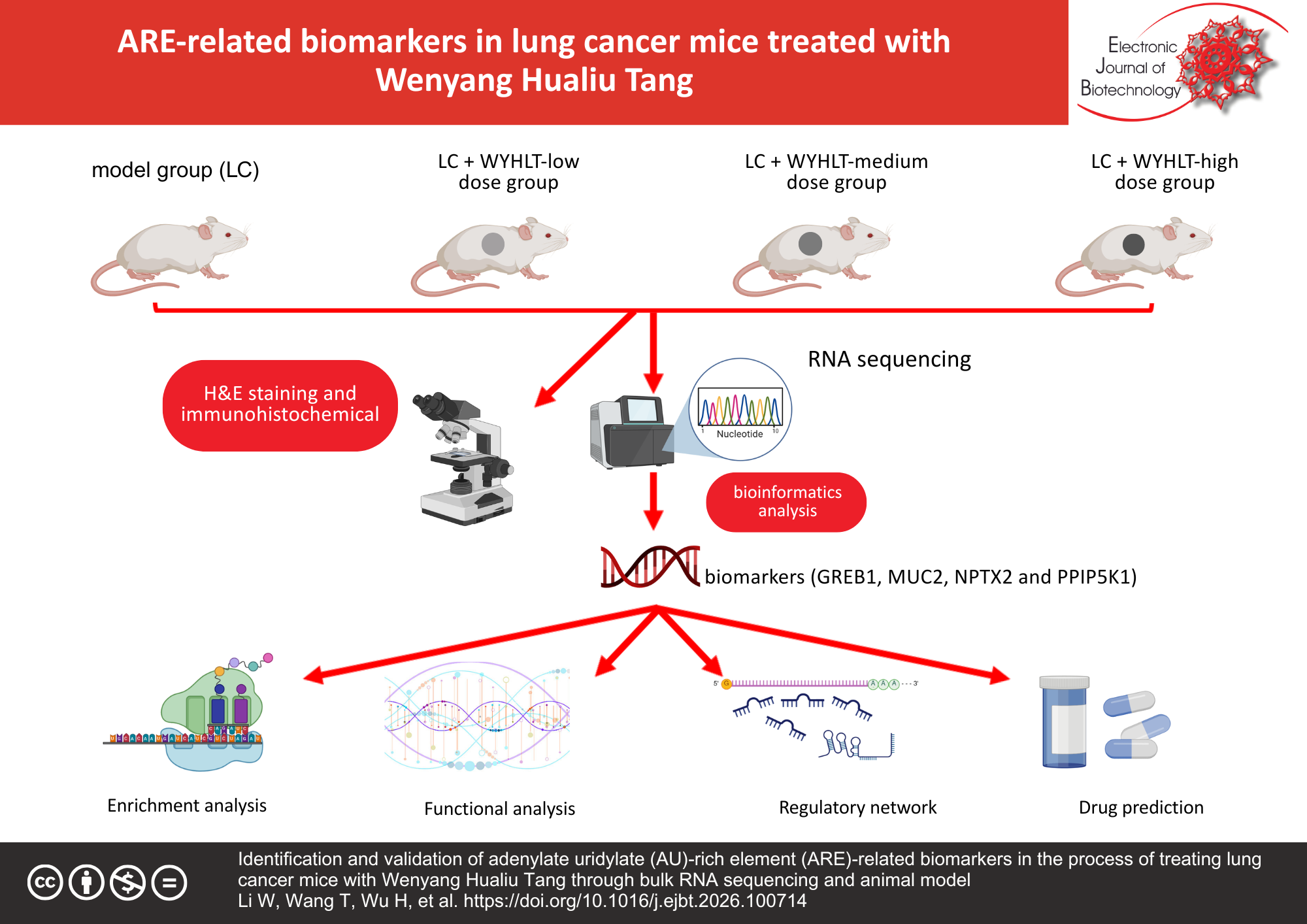
Graphical abstract
Keywords
Categories
How to Cite
Abstract
Background: Lung cancer (LC) remains the leading cause of cancer-related mortality. While the traditional formula Wenyang Hualiu Tang (WYHLT) has shown efficacy against LC, the role of adenylate uridylate (AU)-rich element (ARE)-related genes (AREGs) in this disease and its treatment is unexplored. This study aimed to elucidate the mechanism by which AREGs are involved in WYHLT treatment of LC.
Results: Transcriptome sequencing of a mouse LC model with WYHLT intervention (low, medium, high dose) identified four key biomarkers: GREB1, MUC2, NPTX2, and PPIP5K1. Enrichment analysis linked MUC2, NPTX2, and PPIP5K1 to translation. A constructed regulatory network revealed interactions involving three biomarkers (PPIP5K1, GREB1, NPTX2), 16 long non-coding RNAs (lncRNAs), and 10 circular RNAs (circRNAs), with lncRNA Malat1 targeting four microRNAs (miRNAs). Drug prediction analysis identified seven drugs targeting MUC2 and one targeting NPTX2, with PD-98059 showing the highest binding affinity for MUC2. Reverse transcription quantitative polymerase chain reaction (RT-qPCR) validation confirmed that WYHLT intervention increased PPIP5K1 and MUC2 expression and decreased GREB1 and NPTX2 expression compared to the LC model.
Conclusions: This study identifies GREB1, MUC2, NPTX2, and PPIP5K1 as potential biomarkers involved in WYHLT treatment of LC. The findings provide new insights into the molecular mechanisms of WYHLT and novel directions for LC therapeutic research.
References
Mikaeili Namini A, Jahangir M, Mohseni M, et al. An in silico comparative transcriptome analysis identifying hub lncRNAs and mRNAs in brain metastatic small cell lung cancer (SCLC). Scientific Reports 2022;12:18063. https://doi.org/10.1038/s41598-022-22252-7 PMid: 36302939
Thai AA, Solomon BJ, Sequist LV, et al. Lung cancer. Lancet 2021;398(10299):535-554. https://doi.org/10.1016/s0140-6736(21)00312-3 PMid: 34273294
Zhang C, Jiang M, Zhou N, et al. Use tumor suppressor genes as biomarkers for diagnosis of non-small cell lung cancer. Scientific Reports 2021;11:3596. https://doi.org/10.1038/s41598-020-80735-x PMid: 33580150
Siegel RL, Wagle NS, Cercek A, et al. Colorectal cancer statistics, 2023. CA: A Cancer Journal for Clinicians 2023;73(3):233-254. https://doi.org/10.3322/caac.21772 PMid: 36856579
Zheng X, Song X, Zhu G, et al. Nanomedicine combats drug resistance in lung cancer. Advanced Materials 2024;36(3):e2308977. https://doi.org/10.1002/adma.202308977 PMid: 37968865
Wei Z, Chen J, Zuo F, et al. Traditional Chinese Medicine has great potential as candidate drugs for lung cancer: A review. Journal of Ethnopharmacology 2023;300:115748. https://doi.org/10.1016/j.jep.2022.115748 PMid: 36162545
Dan W, Liu J, Guo X, et al. Study on medication rules of traditional Chinese medicine against antineoplastic drug-induced cardiotoxicity based on network pharmacology and data mining. Evidence-Based Complementary and Alternative Medicine 2020;2020(1):7498525. https://doi.org/10.1155/2020/7498525 PMid: 33281914
Guo M, Fang W, Hu Z. Traditional Chinese medicine and its components effectively reduce resistance mediated by immune checkpoint inhibitors. Frontiers in Immunology 2024;15:1429483. https://doi.org/10.3389/fimmu.2024.1429483 PMid: 39660124
Chen X, Liu T, Luo J, et al. Data for teenagers' stressor, mental health, coping style, social support, parenting style and self-efficacy in South China. Data in Brief 2020;29:105202. https://doi.org/10.1016/j.dib.2020.105202 PMid: 32071981
Shi YH, Zhang XL, Ying PJ, et al. Neuroprotective effect of Astragaloside IV on cerebral ischemia/reperfusion injury rats through Sirt1/Mapt pathway. Frontiers in Pharmacology 2021;12:639898. https://doi.org/10.3389/fphar.2021.639898 PMid: 33841157
Ye F, Xu R, Ge Y, et al. LINC00963 confers oncogenic properties in glioma by regulating the miR-506/BCAT1 axis. Cancer Management Research 2020;12:2339-2351. https://doi.org/10.2147/cmar.S246332 PMid: 32273770
Özdemir-?im?ek Ö, Erfidan G, Arslansoyu-Çamlar S, et al. A rare cause of chronic tubulointerstitial nephritis in childhood: Answers. Pediatric Nephrology 2022;37(3):571-575. https://doi.org/10.1007/s00467-021-05326-y PMid: 34734329
Roberts TJ, Burns AT, MacIsaac RJ, et al. Sildenafil enhances central hemodynamic responses to exercise, but not V?o2peak, in people with diabetes mellitus. Journal of Applied Physiology 2019;127(1):1-10. https://doi.org/10.1152/japplphysiol.00947.2018 PMid: 31046521
Dai J, Xu Y, Wang T, et al. Exploring the relationship between socioeconomic deprivation index and Alzheimer's disease using summary-level data: From genetic correlation to causality. Progress in Neuro-Psychopharmacology and Biological Psychiatry 2023;123:110700. https://doi.org/10.1016/j.pnpbp.2022.110700 PMid: 36566903
Rao Z, Wang Z, Deng H, et al. Role of traditional Chinese medicine in lung cancer management: A Review. The American Journal of Chinese Medicine 2025;53(1):97-117. https://doi.org/10.1142/s0192415x25500053 PMid: 39880665
Huiting W, Chunhong W, Liqin W, et al. Research progress of Warming Yang and dispersing nodules treatment in malignant tumors. Chinese Medicine Modern Distance Education of China 2024;9:166-168. https://doi.org/10.3969/j.issn.1672-2779.2024.09.054
Mingfeng X, Wenxin L, Huiting W, et al. Assessment of the clinical efficacy of Wenyang Hualiu Decoction and chemotherapy in the treatment of non-small cell lung cancer. Chinese Scientific Journal Database- Medicine and Health 2024:0135-0139.
Tian F, Yu CT, Ye WD, et al. Cinnamaldehyde induces cell apoptosis mediated by a novel circular RNA hsa_circ_0043256 in non-small cell lung cancer. Biochemical and Biophysical Research Communications 2017;493(3):1260-1266. https://doi.org/10.1016/j.bbrc.2017.09.136 PMid: 28958934
Xiao Q, Zheng F, Tang Q, et al. Repression of PDK1- and LncRNA HOTAIR-mediated EZH2 gene expression contributes to the enhancement of Atractylenolide 1 and Erlotinib in the inhibition of human lung cancer cells. Cellular Physiology and Biochemistry 2018;49(4):1615-1632. https://doi.org/10.1159/000493497 PMid: 30223276
Zhang J, Liang Y, Lin Y, et al. IRE1?-TRAF2-ASK1 pathway is involved in CSTMP-induced apoptosis and ER stress in human non-small cell lung cancer A549 cells. Biomedicine & Pharmacotherapy 2016;82:281-289. https://doi.org/10.1016/j.biopha.2016.04.050 PMid: 27470364
Bakheet T, Frevel M, Williams BR, et al. ARED: human AU-rich element-containing mRNA database reveals an unexpectedly diverse functional repertoire of encoded proteins. Nucleic Acids Research 2001;29(1):246-254. https://doi.org/10.1093/nar/29.1.246 PMid: 11125104
Zubiaga AM, Belasco JG, Greenberg ME. The nonamer UUAUUUAUU is the key AU-rich sequence motif that mediates mRNA degradation. Molecular and Cell Biology 1995;15(4):2219-2230. https://doi.org/10.1128/mcb.15.4.2219 PMid: 7891716
DeMaria CT, Brewer G. AUF1 Binding affinity to A+U-rich elements correlates with rapid mRNA degradation. The Journal of Biological Chemistry 1996;271(21):12179-12184. https://doi.org/10.1074/jbc.271.21.12179 PMid: 8647811
Khabar KS. Post-transcriptional control during chronic inflammation and cancer: a focus on AU-rich elements. Cellular and Molecular Life Sciences 2010;67(17):2937-2955. https://doi.org/10.1007/s00018-010-0383-x PMid: 20495997
Legrand N, Dixon DA, Sobolewski C. AU-rich element-binding proteins in colorectal cancer. World Journal of Gastrointestinal Oncology 2019;11(2):71-90. https://doi.org/10.4251/wjgo.v11.i2.71 PMid: 30788036
Love MI, Huber W, Anders S. Moderated estimation of fold change and dispersion for RNA-seq data with DESeq2. Genome Biology 2014;15(12):550. https://doi.org/10.1186/s13059-014-0550-8 PMid: 25516281
Gustavsson EK, Zhang D, Reynolds RH, et al. ggtranscript: an R package for the visualization and interpretation of transcript isoforms using ggplot2. Bioinformatics 2022;38(15):3844-3846. https://doi.org/10.1093/bioinformatics/btac409 PMid: 35751589
Gu Z, Hübschmann D. Make interactive complex heatmaps in R. Bioinformatics 2022;38(5):1460-1462. https://doi.org/10.1093/bioinformatics/btab806 PMid: 34864868
Chen H, Boutros PC. VennDiagram: A package for the generation of highly-customizable Venn and Euler diagrams in R. BMC Bioinformatics 2011;12:35. https://doi.org/10.1186/1471-2105-12-35 PMid: 21269502
Wu T, Hu E, Xu S, et al. clusterProfiler 4.0: A universal enrichment tool for interpreting omics data. The Innovation 2021;2(3):100141. https://doi.org/10.1016/j.xinn.2021.100141. PMid: 34557778
Shannon P, Markiel A, Ozier O, et al. Cytoscape: A software environment for integrated models of biomolecular interaction networks. Genome Research 2003;13(11):2498-2504. https://doi.org/10.1101/gr.1239303 PMid: 14597658
Lateef RA. Machine and deep learning techniques in cancer prediction and risk stratification using bioinformatics in Big Data Era: A Review. EDRAAK 2024;2024:118-127. https://doi.org/10.70470/EDRAAK/2024/015
Orifjon S, Jammatov J, Sousa C, et al. Translation and adaptation of the adult developmental coordination disorder/dyspraxia checklist (ADC) into Asian Uzbekistan. Sports 2023;11(7): 135.https://doi.org/10.3390/sports11070135 PMid: 37505622
Hu Y, Yan C, Hsu CH, et al.OmicCircos: A simple-to-use R package for the circular visualization of multidimensional omics data. Cancer Informatics 2014;13:13-20. https://doi.org/10.4137/cin.S13495 PMid: 24526832
Zhang H, Meltzer P, Davis S. RCircos: an R package for Circos 2D track plots. BMC Bioinformatics 2013;14:244. https://doi.org/10.1186/1471-2105-14-244 PMid: 23937229
Ru Y, Kechris KJ, Tabakoff B, et al. The multiMiR R package and database: integration of microRNA-target interactions along with their disease and drug associations. Nucleic Acids Research 2014;42(17):e133. https://doi.org/10.1093/nar/gku631 PMid: 25063298
Livak KJ, Schmittgen TD. Analysis of relative gene expression data using real-time quantitative PCR and the 2???CT method. Methods 2001;25(4):402-408. https://doi.org/10.1006/meth.2001.1262 PMid: 11846609
Al-Rawi NH, Rizvi Z, Mkadmi S, et al. Differential expression profile of salivary oncomiRNAs among smokeless tobacco users. European Journal of Dentistry 2023;17(4):1215-1220. https://doi.org/10.1055/s-0043-1761191 PMid: 36812928
Li R, Liu J, Fang Z, et al. Identification of mutations related to cisplatin-resistance and prognosis of patients with lung adenocarcinoma. Frontiers in Pharmacology 2020;11:572627. https://doi.org/10.3389/fphar.2020.572627 PMid: 33192515
Cox KE, Liu S, Lwin TM, et al. The mucin family of proteins: Candidates as potential biomarkers for colon cancer. Cancers 2023;15(5):1491. https://doi.org/10.3390/cancers15051491 PMid: 36900282
Malmros K, Lindholm A, Vidarsdottir H, et al. Diagnostic gastrointestinal markers in primary lung cancer and pulmonary metastases. Virchows Archiv 2024;485(2):347-357. https://doi.org/10.1007/s00428-023-03583-w PMid: 37349623
Hruska-Plochan M, Wiersma VI, Betz KM, et al. A model of human neural networks reveals NPTX2 pathology in ALS and FTLD. Nature 2024;626:1073-1083. https://doi.org/10.1038/s41586-024-07042-7 PMid: 38355792
García-Ortiz MV, Cano-Ramírez P, Toledano-Fonseca M, et al. Circulating NPTX2 methylation as a non-invasive biomarker for prognosis and monitoring of metastatic pancreatic cancer. Clinical Epigenetics 2023;15(1):118. https://doi.org/10.1186/s13148-023-01535-4 PMid: 37481552
Xu G, Fan L, Zhao S, et al. Neuronal pentraxin II (NPTX2) hypermethylation promotes cell proliferation but inhibits cell cycle arrest and apoptosis in gastric cancer cells by suppressing the p53 signaling pathway. Bioengineered 2021;12(1):1311-1323. https://doi.org/10.1080/21655979.2021.1915658 PMid: 33896384
Machkalyan G, Trieu P, Pétrin D, et al. PPIP5K1 interacts with the exocyst complex through a C-terminal intrinsically disordered domain and regulates cell motility. Cellular Signalling 2016;28(5):401-411. https://doi.org/10.1016/j.cellsig.2016.02.002 PMid: 26854614
Gu C, Nguyen HN, Ganini D, et al. KO of 5-InsP(7) kinase activity transforms the HCT116 colon cancer cell line into a hypermetabolic, growth-inhibited phenotype. Proceedings of the National Academy of Sciences of the United States of America 2017;114(45):11968-11973. https://doi.org/10.1073/pnas.1702370114 PMid: 29078269
Guo F, Yu F, Wang J, et al. Expression of MALAT1 in the peripheral whole blood of patients with lung cancer. Biomedical Reports 2015;3(3):309-312. https://doi.org/10.3892/br.2015.422 PMid: 26137228
Bartel DP. MicroRNAs: Genomics, biogenesis, mechanism, and function. Cell 2004;116(2):281-297. https://doi.org/10.1016/s0092-8674(04)00045-5 PMid: 14744438
Li Z, Liu H, Zhang M, et al. An apoptosis-related specific risk model for breast cancer: From genomic analysis to precision medicine. Frontiers in Bioscience 2024;29(7):239. https://doi.org/10.31083/j.fbl2907239 PMid: 39082332
Zhang X, Zeng Y, Qu Q, et al. PD-L1 induced by IFN-? from tumor-associated macrophages via the JAK/STAT3 and PI3K/AKT signaling pathways promoted progression of lung cancer. International Journal of Clinical Oncology 2017;22(6):1026-1033. https://doi.org/10.1007/s10147-017-1161-7 PMid: 28748356
Ding C, Tang W, Fan X, et al. Overexpression of PEAK1 contributes to epithelial-mesenchymal transition and tumor metastasis in lung cancer through modulating ERK1/2 and JAK2 signaling. Cell Death & Disease 2018;9:802. https://doi.org/10.1038/s41419-018-0817-1 PMid: 30038287

This work is licensed under a Creative Commons Attribution-ShareAlike 4.0 International License.
Copyright (c) 2026 Electronic Journal of Biotechnology