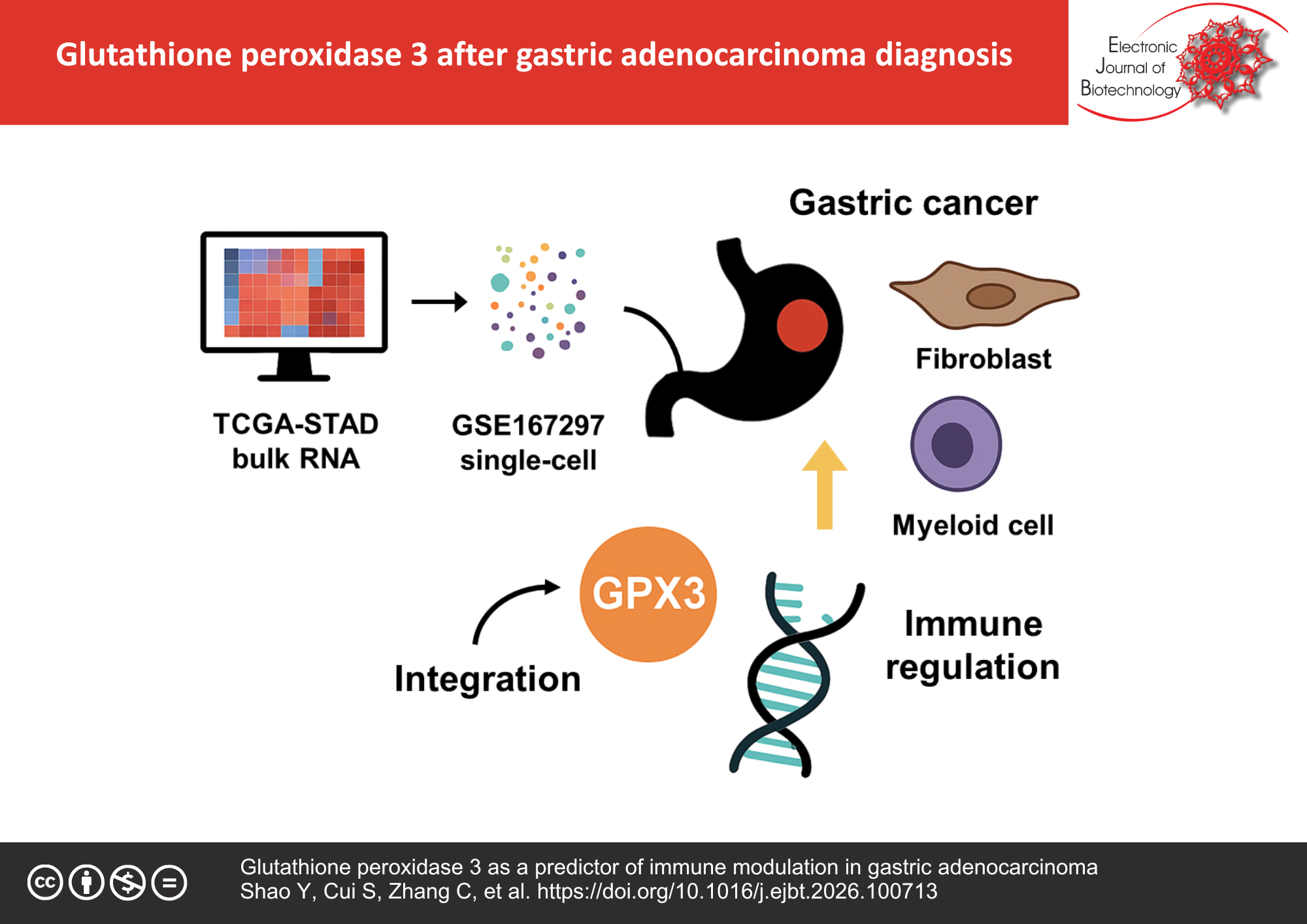
Graphical abstract
Keywords
Categories
How to Cite
Abstract
Background: Gastric cancer is a highly prevalent and lethal malignancy worldwide, with its immune microenvironment playing a crucial role in tumor initiation and progression. Among selenoproteins, glutathione peroxidase 3 (GPX3) is an important antioxidant enzyme that has recently attracted attention for its roles in various cancers. However, the function of GPX3 and its impact on the immune microenvironment in stomach adenocarcinoma (STAD) remain insufficiently explored.
Results: Deep STAD tissues were more enriched in immune cells compared to superficial tumor tissues, particularly myeloid cells and fibroblasts. GPX3 was predominantly expressed in fibroblasts and myeloid cells, while its expression in T cells was relatively low, with no significant differences across different tumor layers. Moreover, GPX3 exhibited weak correlations with PD-1 and CTLA-4, suggesting that GPX3 may not directly mediate immune evasion via immune checkpoint pathways. These findings characterize the cellular distribution of GPX3 within the STAD immune microenvironment and provide initial insights into its potential regulatory function.
Conclusions: Although GPX3 may not directly influence immune checkpoint pathways, its high expression in myeloid cells and fibroblasts suggests that it might indirectly modulate immune responses by regulating the tumor microenvironment. These results lay a theoretical foundation for future research on GPX3 in gastric cancer and its potential as a therapeutic target.
References
Sung H, Ferlay J, Siegel RL, et al. Global cancer statistics 2020: GLOBOCAN estimates of incidence and mortality worldwide for 36 cancers in 185 countries. CA: A Cancer Journal for Clinicians 2021;71(3):209–249. https://doi.org/10.3322/caac.21660 PMid: 33538338
Rugge M, Fassan M, Graham DY. Epidemiology of gastric cancer. In: Strong VE, ed. Gastric Cancer: Principles and Practice. Springer International Publishing; Cham 2015:23–34. https://doi.org/10.1007/978-3-319-15826-6_2
Sexton RE, Al Hallak MN, Diab M, et al. Gastric cancer: A comprehensive review of current and future treatment strategies. Cancer and Metastasis Reviews 2020;39(4):1179–1203. https://doi.org/10.1007/s10555-020-09925-3 PMid: 32894370
Sharma P, Allison JP. The future of immune checkpoint therapy. Science 2015;348(6230):56–61. https://doi.org/10.1126/science.aaa8172 PMid: 25838373
Peng M, Mo Y, Wang Y, et al. Neoantigen vaccine: an emerging tumor immunotherapy. Molecular Cancer 2019;18(1):128. https://doi.org/10.1186/s12943-019-1055-6 PMid: 31443694
Radomska D, Czarnomysy R, Radomski D, et al. Selenium as a bioactive micronutrient in the human diet and its cancer chemopreventive activity. Nutrients 2021;13(5):1649. https://doi.org/10.3390/nu13051649 PMid: 34068374
Ma Y, Zhang L, Gao X, et al. GPX3 represses pancreatic cancer cell proliferation, migration and invasion, and improves their chemo-sensitivity by regulating the JNK/c-Jun signaling pathway. Experimental and Therapeutic Medicine 2024;27(3):118. https://doi.org/10.3892/etm.2024.12407 PMid: 38361519
Chang C, Worley BL, Phaëton R, et al. Extracellular glutathione peroxidase GPx3 and its role in cancer. Cancers 2020;12(8):2197. https://doi.org/10.3390/cancers12082197 PMid: 32781581.
Fujiwara S, Nagai H, Jimbo H, et al. Gene expression and methylation analysis in melanomas and melanocytes from the same patient: Loss of NPM2 expression is a potential immunohistochemical marker for melanoma. Frontiers in Oncology 2019;8:675. https://doi.org/10.3389/fonc.2018.00675 PMid: 30719424
Zhou C, Pan R, Li B, et al. GPX3 hypermethylation in gastric cancer and its prognostic value in patients aged over 60. Future Oncology 2019;15(11):1279–1289. https://doi.org/10.2217/fon-2018-0674 PMid: 30924352
Worley BL, Kim YS, Mardini J, et al. GPx3 supports ovarian cancer progression by manipulating the extracellular redox environment. Redox Biology 2019;25:101051. https://doi.org/10.1016/j.redox.2018.11.009 PMid: 30509602
Hughes DJ, Kunická T, Schomburg L, et al. Expression of selenoprotein genes and association with selenium status in colorectal adenoma and colorectal cancer. Nutrients 2018;10(12):1812. https://doi.org/10.3390/nu10111812 PMid: 30469315
Kalatskaya I. Overview of major molecular alterations during progression from Barrett's esophagus to esophageal adenocarcinoma. Annals of the New York Academy of Sciences 2016;1381(1):74–91. https://doi.org/10.1111/nyas.13134 PMid: 27415609
Gautam PK, Kumar S, Tomar MS, et al. Selenium nanoparticles induce suppressed function of tumor associated macrophages and inhibit Dalton's lymphoma proliferation. Biochemistry and Biophysics Reports 2017;12:172–184. https://doi.org/10.1016/j.bbrep.2017.09.005 PMid: 29090279
Kumar N, Delu V, Nain T, et al. Exploring the therapeutic implications of nanoparticles for liquid tumors: A comprehensive review with special emphasis on green synthesis techniques in the context of Dalton’s lymphoma. The Scientific Temper 2023;14(3):916–926. https://doi.org/10.58414/SCIENTIFICTEMPER.2023.14.3.55
Binnewies M, Roberts EW, Kersten K, et al. Understanding the tumor immune microenvironment (TIME) for effective therapy. Nature Medicine 2018;24:541–550. https://doi.org/10.1038/s41591-018-0014-x PMid: 29686425
Gao X, Liu DD, Liu JZ, et al. TCGA-based analysis of oncogenic signaling pathways underlying oral squamous cell carcinoma. Oncology and Translational Medicine 2024;10(2):87-92. https://doi.org/10.1097/ot9.0000000000000025
Wang Y, Wang J, Zeng T, et al. Data-mining-based biomarker evaluation and experimental validation of SHTN1 for bladder cancer. Cancer Genetics 2024;288-289:43-53. https://doi.org/10.1016/j.cancergen.2024.09.002 PMid: 39260052
Liu H, Guo Z, Wang P. Genetic expression in cancer research: Challenges and complexity. Gene Reports 2024;37:102042. https://doi.org/10.1016/j.genrep.2024.102042
Liu H, Li Y, Karsidag M, et al. Technical and biological biases in bulk transcriptomic data mining for cancer research. Journal of Cancer 2025;16(1):34-43. https://doi.org/10.7150/jca.100922 PMid: 39744578
Ou L, Liu H, Peng C, et al. Helicobacter pylori infection facilitates cell migration and potentially impact clinical outcomes in gastric cancer. Heliyon 2024;10(17):e37046. https://doi.org/10.1016/j.heliyon.2024.e37046 PMid: 39286209
Zhou Q, Wang Q, Duan Y, et al. BRD9-p53-E2F1 circuit orchestrates cell growth and DNA damage repair in gastric cancer. Molecular Cancer 2025;24(1):239. https://doi.org/10.1186/s12943-025-02449-w PMid: 41039535
Ghorbani A, Hosseinie F, Khorshid Sokhangouy S, et al. The prognostic, diagnostic, and therapeutic impact of Long noncoding RNAs in gastric cancer. Cancer Genetics 2024;282-283:14-26. https://doi.org/10.1016/j.cancergen.2023.12.006 PMid: 38157692
Sukumar M, Liu J, Ji Y, et al. Inhibiting glycolytic metabolism enhances CD8+ T cell memory and antitumor function. The Journal of Clinical Investigation 2013;123(10):4479–4488. https://doi.org/10.1172/JCI69589 PMid: 24091329

This work is licensed under a Creative Commons Attribution-ShareAlike 4.0 International License.
Copyright (c) 2026 Electronic Journal of Biotechnology