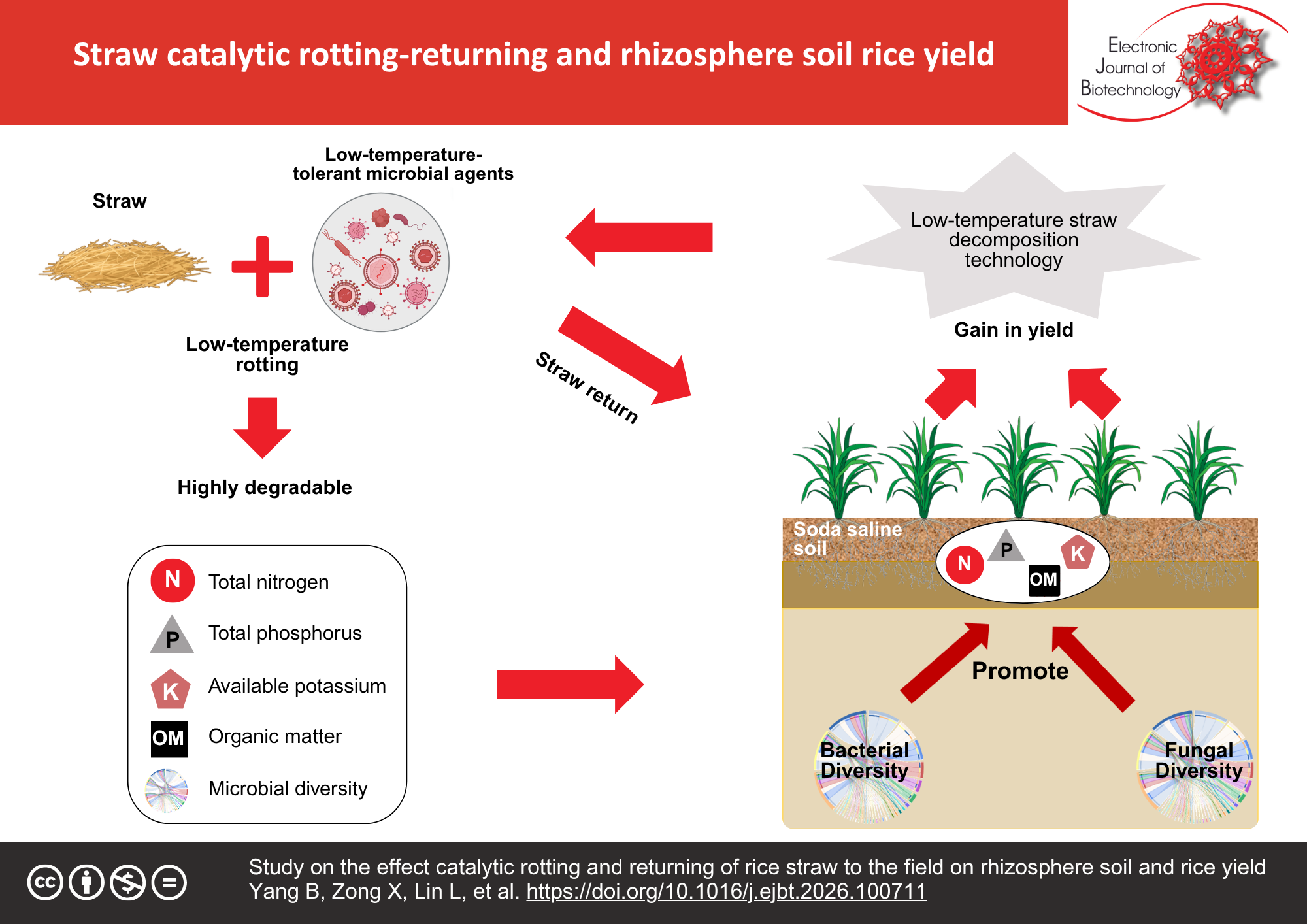
Graphical abstract
Keywords
Categories
How to Cite
Abstract
Background: In-situ straw return is an effective agronomic practice for improving soil quality and increasing crop yields. However, in Northeast China, prolonged seasonal freezing lasting more than 6 months markedly restricts straw decomposition, thereby limiting the benefits of straw return in saline-alkali soils. To overcome this constraint, cold-tolerant bacterial agents were applied to promote the decomposition and in-situ return of rice straw under frozen and low-temperature conditions.
Results: The results demonstrated that under freezing and low-temperature conditions, the application of the microbial agent (CF) increased the rice straw decomposition rate to 51.22%, which was significantly higher than that observed in the control treatment (34.64%). The germination index of seeds exposed to the decomposed straw reached 102.87%, indicating that the decomposition products met safety standards. CF treatment reduced rhizosphere soil pH and salinity, while significantly increasing the diversity and abundance of rhizosphere microorganisms. In particular, it promoted the enrichment of bacterial genera associated with nitrogen fixation and straw decomposition. At the same time, the CF application enhanced rhizosphere soil nutrient levels, which in turn significantly improved rice growth parameters, including tiller number, plant height, and dry weight. Consequently, rice yield increased by 5.84% compared with the control treatment.
Conclusions: In summary, the application of cold-tolerant bacterial agents enables efficient in-situ decomposition and return of rice straw under freezing and low-temperature conditions. This approach effectively enhances rice productivity in saline-alkali farmland and provides a simple, practical, and scalable strategy for overcoming straw decomposition limitations in cold regions worldwide.
References
Zhao W, Zhou Q, Tian Z, et al. Apply biochar to ameliorate soda saline-alkali land, improve soil function and increase corn nutrient availability in the Songnen Plain. Science of The Total Environment 2020;722:137428. https://doi.org/10.1016/j.scitotenv.2020.137428 PMid: 32197168
Yang Y, Mou X, Wen B, et al. Soil carbon, nitrogen and phosphorus concentrations and stoichiometries across a chronosequence of restored inland soda saline-alkali wetlands, western Songnen Plain, northeast China. Chinese Geographical Science 2020;30(5):934-946. https://doi.org/10.1007/s11769-020-1155-7
Chi CM, Zhao CW, Sun XJ, et al. Reclamation of saline-sodic soil properties and improvement of rice (Oriza sativa L.) growth and yield using desulfurized gypsum in the west of Songnen Plain, northeast China. Geoderma 2012;187-188:24-30. https://doi.org/10.1016/j.geoderma.2012.04.005
Chen W, Liu Z. Research progress on improvement of saline alkali soil. Frontiers in Science and Engineering 2023; 3(3): 36-42. https://doi.org/10.54691/fse.v3i3.4503
Mbarki S, Cerdà A, Brestic M, et al. Vineyard compost supplemented with Trichoderma harzianum T78 improve saline soil quality. Land Degradation & Development 2017;28:1028–1037. https://doi.org/10.1002/ldr.2554
Li J. Research status of different improvement measures for saline-alkali land. E3S Web of Conferences 2022;338:01038. https://doi.org/10.1051/e3sconf/202233801038
Daunoras J, Ka?ergius A, Gudiukait? R. Role of soil microbiota enzymes in soil health and activity changes depending on climate change and the type of soil ecosystem. Biology 2024;13(2):85.https://doi.org/10.3390/biology13020085 PMid: 38392304
Li H, Liu Y, Jiao X, et al. Response of soil nutrients retention and rice growth to biochar in straw returning paddy fields. Chemosphere 2023;312(Part 1):137244. https://doi.org/10.1016/j.chemosphere.2022.137244 PMid: 36395890
Li Y, Wang J, Pan F, et al. Soil nitrogen availability alters rhizodeposition carbon flux into the soil microbial community. Journal of Soils and Sediments 2016;16(5):1472-1480. https://doi.org/10.1007/s11368-015-1337-6
Sui N, Zhou Z, Yu C, et al. Yield and potassium use efficiency of cotton with wheat straw incorporation and potassium fertilization on soils with various conditions in the wheat–cotton rotation system. Field Crops Research 2015;172:132-144. https://doi.org/10.1016/j.fcr.2014.11.011
Wang Z, Wang Z, Ma LJ, et al. Combined effects of nitrogen fertilizer and straw application on aggregate distribution and aggregate-associated organic carbon stability in an alkaline sandy loam soil. European Journal of Soil Science 2018;69(6):1105-1116. https://doi.org/10.1111/ejss.12723
Ju X, Xing G, Chen X, et al. Reducing environmental risk by improving N management in intensive Chinese agricultural systems. Proceedings of the National Academy of Sciences of the United States of America 2009;106(9):3041-3046. https://doi.org/10.1073/pnas.0813417106 PMid: 19223587
Zakzeski J, Bruijnincx PCA, Jongerius A, et al. The catalytic valorization of lignin for the production of renewable chemicals. Chemical Reviews 2010;110(6):3552-3599. https://doi.org/10.1021/cr900354u PMid: 20218547
Yang J, Wang S, Bai F, et al. Achieving efficient pretreatment of corn straw at elevated temperatures via constraining cellulose degradation. Chemical Engineering Journal 2023;454(Part 4):140480. https://doi.org/10.1016/j.cej.2022.140480
Fu J, Song S, Guo L, et al. Interprovincial joint prevention and control of open straw burning in northeast China: Implications for atmospheric environment management. Remote Sensing 2022;14(11):2528. https://doi.org/10.3390/rs14112528
Wen X, Chen W, Chen B, et al. Does the prohibition on open burning of straw mitigate air pollution? An empirical study in Jilin Province of China in the post-harvest season. Journal of Environmental Management 2020;264:110451. https://doi.org/10.1016/j.jenvman.2020.110451 PMid: 32217326
Song XW, Zhang BC, Bai Y, et al. Application and review of biotechnology in promoting protective utilization of black soil. Bulletin of Chinese Academy of Sciences (Chinese Version) 2021;36(12):1488-1496. https://doi.org/10.16418/j.issn.1000-3045.20210923001
Gong X, Zou H, Qian C, et al. Construction of in situ degradation bacteria of corn straw and analysis of its degradation efficiency. Annals of Microbiology 2020;70(1):62. https://doi.org/10.1186/s13213-020-01601-9
Wang Y, Wu Y, Cao C, et al. Effects of fertilizer reduction coupled with straw returning on soil fertility, wheat root endophytic bacteria, and the occurrence of wheat crown rot. Frontiers in Microbiology 2023;14:1143480. https://doi.org/10.3389/fmicb.2023.1143480 PMid: 37065114
Su Y, Kwong RWM, Tang W, et al. Straw return enhances the risks of metals in soil? Ecotoxicology and Environmental Safety 2021;207:111201. https://doi.org/https://doi.org/10.1016/j.ecoenv.2020.111201 PMid: 32905933
Guan FC, Liu L, Miao YJ, et al. Effects of psychrophilic bacteria on the fermentation and decomposition characteristics of rice straw in winter. Journal of Southwest Minzu University (Natural Science Edition) 2019;45(4):338-342.
Zhou BY, Luo R, Wang YY, et al. Effect of aerobic aeration of biogas residue from cow manure on seed germination index. Rural Sci. Technol 2023;14(18):96-98. https://doi.org/10.19345/j.cnki.1674-7909.2023.18.043
Jiang H, Zhang Y, Cui R, et al. Effects of two different proportions of microbial formulations on microbial communities in kitchen waste composting. Microorganisms 2023;11(10):2605. https://doi.org/10.3390/microorganisms11102605 PMid: 37894263
Huang H, Liu XY, Shan XY, et al. Dynamic changes of soil organic matter, microbial community and seed germination index after application of hydrothermal carbon liquid nitrogen fertilizer in chicken manure. Journal of the Yan’an University (National Science Edition) 2024;43(4):36-45. https://doi.org/10.13876/J.cnki.ydnse.240073
Li H, Li J, Jiao X, et al. The fate and challenges of the main nutrients in returned straw: A basic review. Agronomy 2024;14(4):698. https://doi.org/10.3390/agronomy14040698
Li J, Gan G, Chen X, et al. Effects of long-term straw management and potassium fertilization on crop yield, soil properties, and microbial community in a rice–oilseed rape rotation. Agriculture 2021;11(12):1233. https://doi.org/10.3390/agriculture11121233
Chen W, Li Y. Fungal pretreatment of lignocellulosic biomass. Biotechnology Advances 2012;30(6):1447-1457. https://doi.org/10.1016/j.biotechadv.2012.03.003 PMid: 22433674
Zheng G, Yin T, Lu Z, et al. Degradation of rice straw at low temperature using a novel microbial consortium ltf-27 with efficient ability. Bioresource Technology 2020;304:123064. https://doi.org/10.1016/j.biortech.2020.123064 PMid: 32115346
Zhao SC, Qiu SJ, Xu XP, et al. Change in straw decomposition rate and soil microbial community composition after straw addition in different long-term fertilization soils. Applied Soil Ecology 2019;138:123–133. https://doi.org/10.1016/j.apsoil.2019.02.018
Mei JF, Shen XB, Gang L, et al. A novel lignin degradation bacteria-Bacillus amyloliquefaciens SL-7 used to degrade straw lignin efficiently. Bioresource Technology 2020;310:123445. https://doi.org/10.1016/j.biortech.2020.123445 PMid: 32361649
Hao XX, Han XZ, Wang SY, et al. Dynamics and composition of soil organic carbon in response to 15 years of straw return in a Mollisol. Soil and Tillage Research 2022;215:105221. https://doi.org/10.1016/j.still.2021.105221
Segata N, Izard J, Waldron L, et al. Metagenomic biomarker discovery and explanation. Genome Biology 2011;12:R60. https://doi.org/10.1186/gb-2011-12-6-r60 PMid: 21702898
Yang SY, Cai JW, Li SP, et al. Decomposition characteristics of pineapple residues under different ditch-burial modes in tropical soil. Journal of Tropical Biology 2024;15(2):133-140. https://doi.org/10.15886/j.cnki.rdswxb.20230054
Olajuyigbe FM, Dele-Joshua MT, Yazdani SS, et al, Consolidated biosaccharification of corn cob by novel lignocellulolytic enzymes from Bacillus subtilis CFB-09. Biofuels Bioproducts & Biorefining 2025;19:1582-1594. https://doi.org/10.1002/bbb.2746
Liu H, Xue Z, Liang F, et al. Enhancement of the wheat straw pretreatment in pulping: The microbial intelligent response. Industrial Crops and Products 2025;223:120109. https://doi.org/10.1016/j.indcrop.2024.120109
Sijinamanoj V, Muthukumar T, Muthuraja R, et al. Ligninolytic valorization of agricultural residues by Aspergillus nomius and Trichoderma harzianum isolated from gut and comb of Odontotermes obesus (Termitidae). Chemosphere 2021;284:131384. https://doi.org/10.1016/j.chemosphere.2021.131384 PMid: 34323800
Ma W, Ma L, Jiao J, et al. Impact of straw incorporation on the physicochemical profile and fungal ecology of saline–alkaline soil. Microorganisms 2024;12(2):277. https://doi.org/10.3390/microorganisms12020277 PMid: 38399680
Wang X, He P, Xu X, et al. Characteristics of rice straw decomposition and bacterial community succession for 2 consecutive years in a paddy field in southeastern China. Scientific Reports 2022;12(1):20893. https://doi.org/10.1038/s41598-022-25229-8 PMid: 36463335
Arunrat N, Sereenonchai S, Sansupa C, et al. Effect of rice straw and stubble burning on soil physicochemical properties and bacterial communities in central Thailand. Biology 2023;12(4):501. https://doi.org/10.3390/biology12040501 PMid: 37106702
Cheng R, Gao D, Liu W, et al. Straw and nitrogen amendments improve soil, rice yield, and roots in a saline sodic soil. Rhizosphere 2022;25:100606. https://doi.org/10.1016/j.rhisph.2022.100606
Nunes MR, Vaz CMP, Denardin JE, et al. Physicochemical and structural properties of an oxisol under the addition of straw and lime. Soil Science Society of America Journal 2017;81(6): 1328-1339. https://doi.org/10.2136/sssaj2017.07.0218
Dang K, Ran C, Tian H, et al. Combined effects of straw return with nitrogen fertilizer on leaf ion balance, photosynthetic capacity, and rice yield in saline-sodic paddy fields. Agronomy 2023;13(9):2274. https://doi.org/10.3390/agronomy13092274
Kaur R, Tiwari SK. Optimization of culture conditions for bacteriocin production by soil isolates Pediococcus pentosaceus LB44 and Weissella confusa LM85. International Journal of Infection 2017;4(3):e15842. https://doi.org/10.5812/iji.15842
Qin DL, Wang SL, Liu YH, et al. Effects of cotton stalk returning on soil physical and chemical properties and cotton yield in coastal saline-alkali soil. Acta Agronomica Sinica 2017;43(7):1030-1042. https://doi.org/10.3724/SP.J.1006.2017.01030
Xie W, Wu L, Wang J, et al. Effect of salinity on the transformation of wheat straw and microbial communities in a saline soil. Communications in Soil Science and Plant Analysis 2017;48(12):1455-1461. https://doi.org/10.1080/00103624.2017.1373787
Loveland, PJ. Is there a critical level of organic matter in the agricultural soils of temperate regions: A review. Soil and Tillage Research 2003;70(1):1-18. https://doi.org/10.1016/s0167-1987(02)00139-3
Sujatha M, Jaidhar CD. Machine learning-based approaches to enhance the soil fertility—A review. Expert Systems with Applications 2024;240:122557. https://doi.org/10.1016/j.eswa.2023.122557
Duan H, Tong H, Liu YQ, et al. Research progress on the effects of high temperature and drought on rice and their mechanisms. Chinese Journal of Rice Science 2019;33(3):206-218. https://doi.org/10.16819/j.1001-7216.2019.8106
Ning C, Chen YG, Liu R, et al. Effects of N fertilizer reduction combined with straw biochar application on the yield, Si, and N nutrition of double-cropping rice. Chinese Journal of Applied Ecology 2023;34(4):993-1001. https://doi.org/10.13287/j.1001-9332.202304.009 PMid: 37078318

This work is licensed under a Creative Commons Attribution-ShareAlike 4.0 International License.
Copyright (c) 2026 Electronic Journal of Biotechnology