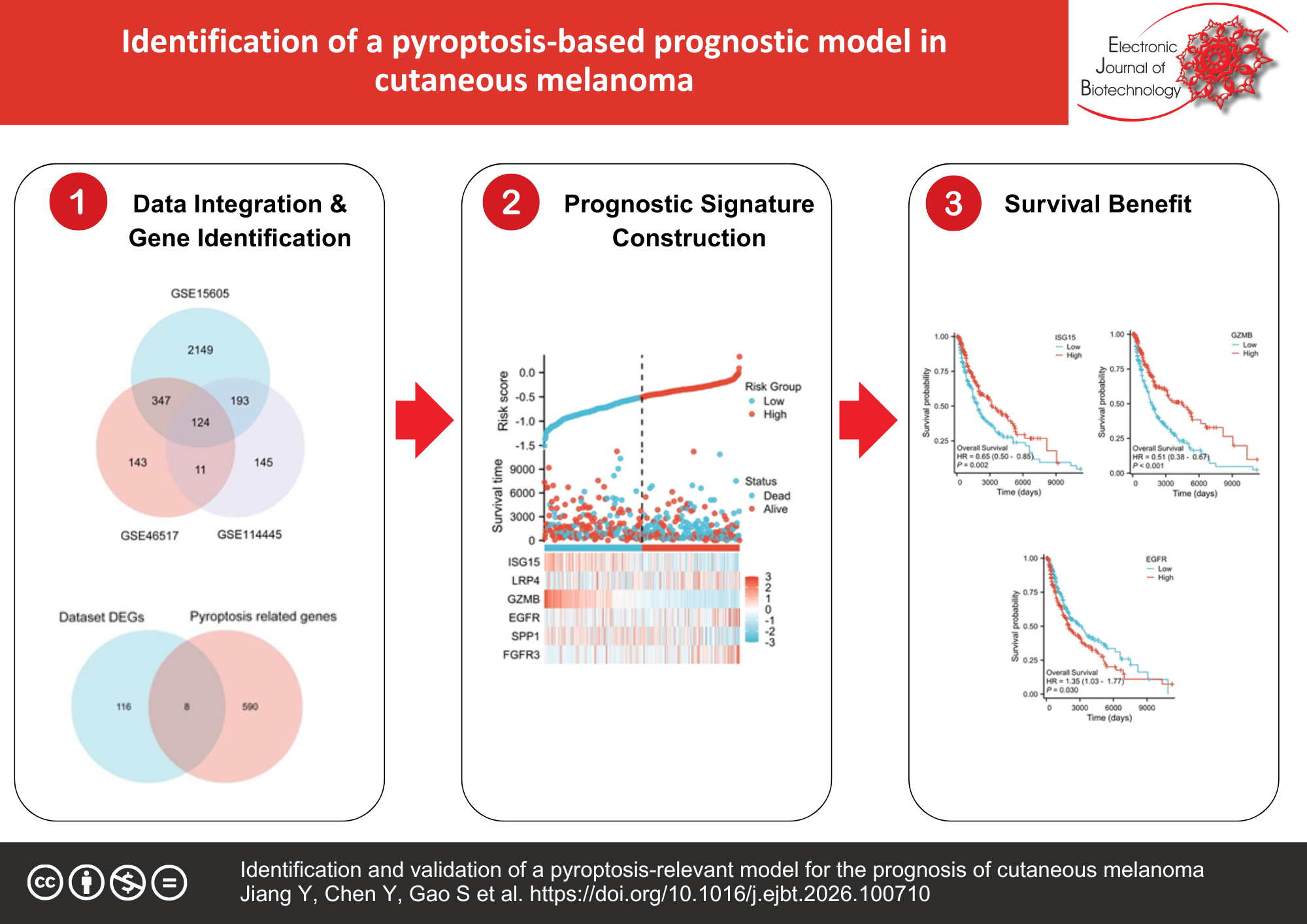
Graphical abstract
Keywords
How to Cite
Abstract
Background: Cutaneous melanoma (CM) is a highly aggressive skin malignancy with marked molecular heterogeneity and poor prognosis. Pyroptosis, an inflammatory form of programmed cell death, has been implicated in tumor progression and immune regulation; however, its prognostic value in CM remains incompletely understood.
Results: Gene expression data from the Gene Expression Omnibus (GEO) and The Cancer Genome Atlas skin cutaneous melanoma (TCGA-SKCM) cohorts were analyzed to identify pyroptosis-related differentially expressed genes (PRGs). Eight CM-associated PRGs were identified through integrated differential expression and intersection analyses. Functional enrichment analyses revealed that these genes were involved in inflammatory responses, immune regulation, and cell cycle-related pathways. A prognostic model was constructed using univariate Cox and least absolute shrinkage and selection operator (LASSO) regression analyses in the TCGA-SKCM cohort. Six PRGs were incorporated into the prognostic signature, of which ISG15, GZMB, and EGFR were independently associated with patient survival. The model demonstrated good predictive performance, as confirmed by receiver operating characteristic curves, Kaplan-Meier survival analysis, calibration plots, and decision curve analysis at 1-, 3-, and 5-year time points. Immune infiltration analysis revealed that ISG15, GZMB, and EGFR expression were positively correlated with the enrichment of multiple immune cell populations. Mutation profiling further supported the clinical relevance of these prognostic genes.
Conclusions: In summary, we developed a pyroptosis-related prognostic model for cutaneous melanoma and identified ISG15, GZMB, and EGFR as clinically relevant prognostic biomarkers. Our findings enhance the understanding of pyroptosis-associated molecular mechanisms in CM and support their potential utility in prognostic stratification.
References
Leonardi GC, Falzone L, Salemi R, et al. Cutaneous melanoma: From pathogenesis to therapy (Review). International Journal of Oncology 2018;52(4):1071–1080. https://doi.org/10.3892/ijo.2018.4287 PMid: 29532857
Davis LE, Shalin SC, Tackett AJ. Current state of melanoma diagnosis and treatment. Cancer Biology & Therapy 2019;20(11):1366–1379. https://doi.org/10.1080/15384047.2019.1640032 PMid: 31366280
Hughes MS, Zager J, Faries M, et al. Results of a randomized controlled multicenter phase III trial of percutaneous hepatic perfusion compared with best available care for patients with melanoma liver metastases. Annals of Surgical Oncology 2016;23(4):1309–1319. https://doi.org/10.1245/s10434-015-4968-3 PMid: 26597368
Zhu Z, Liu W, Gotlieb V. The rapidly evolving therapies for advanced melanoma –Towards immunotherapy, molecular targeted therapy, and beyond. Critical Reviews in Oncology/ Hematology 2016;99:91–99. https://doi.org/10.1016/j.critrevonc.2015.12.002 PMid: 26708040
Roberts P, Fishman GA, Joshi K, et al. Chorioretinal lesions in a case of melanoma-associated retinopathy treated with pembrolizumab. JAMA Ophthalmology 2016;134(10):1184–1188. https://doi.org/10.1001/jamaophthalmol.2016.2944 PMid: 27540851
Queirolo P, Pfeffer U. Metastatic melanoma: How research can modify the course of a disease. Cancer and Metastasis Reviews 2017;36(1):3–5. https://doi.org/10.1007/s10555-017-9664-2 PMid: 28197746
Seftor EA, Seftor REB, Weldon D, et al. Melanoma tumor cell heterogeneity: A molecular approach to study subpopulations expressing the embryonic morphogen nodal. Seminars in Oncology 2014;41(2):259–266. https://doi.org/10.1053/j.seminoncol.2014.02.001 PMid: 24787297
Shannan B, Perego M, Somasundaram R, et al. Heterogeneity in melanoma. In: Kaufman H, Mehnert J (eds) Melanoma. Cancer Treatment and Research, 2016; vol 167:1-15. Springer, Cham. https://doi.org/10.1007/978-3-319-22539-5_1 PMid: 26601857
Zhang Q, Liu W, Zhang HM, et al. hTFtarget: A comprehensive database for regulations of human transcription factors and their targets. Genomics, Proteomics & Bioinformatics 2020;18(2):120–128. https://doi.org/10.1016/j.gpb.2019.09.006 PMid: 32858223
Xue Y, Li J, Lu X. A novel immune-related prognostic signature for thyroid carcinoma. Technology in Cancer Research & Treatment 2020;19:1533033820935860. https://doi.org/10.1177/1533033820935860 PMid: 32588760
Bao M, Zhang L, Hu Y. Novel gene signatures for prognosis prediction in ovarian cancer. Journal of Cellular and Molecular Medicine 2020;24(17):9972–9984.https://doi.org/10.1111/jcmm.15601 PMid: 32666642
Wei Y, Yang L, Pandeya A, et al. Pyroptosis-induced inflammation and tissue damage. Journal of Molecular Biology 2022;434(4):167301.https://doi.org/10.1016/j.jmb.2021.167301 PMid: 34653436
Lu L, Zhang Y, Tan X, et al. Emerging mechanisms of pyroptosis and its therapeutic strategy in cancer. Cell Death Discovery 2022;8(1):338. https://doi.org/10.1038/s41420-022-01101-6 PMid: 35896522
Cao Y, Xie J, Chen L, et al. Construction and validation of a novel pyroptosis-related gene signature to predict the prognosis of uveal melanoma. Frontiers in Cell Developmental Biology 2021;9:761350. https://doi.org/10.3389/fcell.2021.761350 PMid: 34901006
Zhuang Z, Cai H, Lin H, et al. Development and validation of a robust pyroptosis-related signature for predicting prognosis and immune status in patients with colon cancer. Journal of Oncology 2021;2021:5818512. https://doi.org/10.1155/2021/5818512 PMid: 34840571
Colaprico A, Silva TC, Olsen C, et al. TCGAbiolinks: an R/Bioconductor package for integrative analysis of TCGA data. Nucleic Acids Research 2016;44(8):e71. https://doi.org/10.1093/nar/gkv1507 PMid: 26704973
Goldman MJ, Craft B, Hastie M, et al. Visualizing and interpreting cancer genomics data via the Xena platform. Nature Biotechnology 2020;38(6):675–678. https://doi.org/10.1038/s41587-020-0546-8 PMid: 32444850
Ritchie ME, Phipson B, Wu D, et al. limma powers differential expression analyses for RNA-sequencing and microarray studies. Nucleic Acids Research 2015;43(7):e47. https://doi.org/10.1093/nar/gkv007 PMid: 25605792
Stelzer G, Rosen N, Plaschkes I, et al. The GeneCards Suite: From gene data mining to disease genome sequence analyses. Current Protocols in Bioinformatics 2016;54:1.30.1–1.30.33.https://doi.org/10.1002/cpbi.5 PMid: 27322403
Liberzon A, Birger C, Thorvaldsdóttir H, et al. The Molecular Signatures Database Hallmark Gene Set Collection. Cell Systems 2015;1(6):417–425. https://doi.org/10.1016/j.cels.2015.12.004 PMid: 26771021
Yu G. Gene ontology semantic similarity analysis using GOSemSim. In: Kidder B (ed) Stem Cell Transcriptional Networks. Methods in Molecular Biology, 2020;2117:207-215. Humana, New York, NY. https://doi.org/10.1007/978-1-0716-0301-7_11 PMid: 31960380
Yu G, Wang LG, Han Y, et al. clusterProfiler: an R package for comparing biological themes among gene clusters. OMICS: A Journal of Integrative Biology 2012;16(5):284–287. https://doi.org/10.1089/omi.2011.0118 PMid: 22455463
Subramanian A, Tamayo P, Mootha VK, et al. Gene set enrichment analysis: A knowledge-based approach for interpreting genome-wide expression profiles. Proceedings of the National Academy of Sciences of the United States of America 2005;102(43):15545–1550.https://doi.org/10.1073/pnas.0506580102 PMid: 16199517
Hänzelmann S, Castelo R, Guinney J. GSVA: Gene set variation analysis for microarray and RNA-seq data. BMC Bioinformatics 2013;14:7. https://doi.org/10.1186/1471-2105-14-7 PMid: 23323831
Charoentong P, Finotello F, Angelova M, et al. Pan-cancer immunogenomic analyses reveal genotype-immunophenotype relationships and predictors of response to checkpoint blockade. Cell Reports 2017;18(1):248–262. https://doi.org/10.1016/j.celrep.2016.12.019 PMid: 28052254
Barbie DA, Tamayo P, Boehm JS, et al. Systematic RNA interference reveals that oncogenic KRAS-driven cancers require TBK1. Nature 2009;462(7269):108–112. https://doi.org/10.1038/nature08460 PMid: 19847166
Szklarczyk D, Gable AL, Lyon D, et al. STRING v11: protein-protein association networks with increased coverage, supporting functional discovery in genome-wide experimental datasets. Nucleic Acids Research 2019;47(D1):D607–D613. https://doi.org/10.1093/nar/gky1131 PMid: 30476243
Li JH, Liu S, Zhou H, et al. starBase v2.0: decoding miRNA-ceRNA, miRNA-ncRNA and protein-RNA interaction networks from large-scale CLIP-Seq data. Nucleic Acids Research 2014;42(D1):D92–D97. https://doi.org/10.1093/nar/gkt1248 PMid: 24297251
Chen Y, Wang X. miRDB: an online database for prediction of functional microRNA targets. Nucleic Acids Research 2020;48(D1):D127–D131. https://doi.org/10.1093/nar/gkz757 PMid: 31504780
Yang JH, Li JH, Jiang S, et al. ChIPBase: a database for decoding the transcriptional regulation of long non-coding RNA and microRNA genes from ChIP-Seq data. Nucleic Acids Research 2013;41(D1):D177–D187. https://doi.org/10.1093/nar/gks1060 PMid: 23161675
Freshour SL, Kiwala S, Cotto KC, et al. Integration of the Drug-Gene Interaction Database (DGIdb 4.0) with open crowdsource efforts. Nucleic Acids Research 2021;49(D1):D1144–D1151. https://doi.org/10.1093/nar/gkaa1084 PMid: 33237278
Mandrekar JN. Receiver operating characteristic curve in diagnostic test assessment. Journal of Thoracic Oncology 2010;5(9):1315–1316. https://doi.org/10.1097/JTO.0b013e3181ec173d PMid: 20736804
Hajian-Tilaki K. Receiver Operating Characteristic (ROC) curve analysis for medical diagnostic test evaluation. Caspian Journal of Internal Medicine 2013;4(2):627–635. PMid: 24009950
Tataranni T, Piccoli C. Dichloroacetate (DCA) and cancer: An overview towards clinical applications. Oxidative Medicine and Cellular Longevity 2019;2019:8201079. https://doi.org/10.1155/2019/8201079 PMid: 31827705
Thul PJ, Lindskog C. The human protein atlas: A spatial map of the human proteome. Protein Science 2018;27(1):233–244. https://doi.org/10.1002/pro.3307 PMid: 28940711
Hanley JA, McNeil BJ. The meaning and use of the area under a receiver operating characteristic (ROC) curve. Radiology 1982;143(1):29–36. https://doi.org/10.1148/radiology.143.1.7063747 PMid: 7063747
Wang H, Xie X, Zhu J, et al. Comprehensive analysis identifies IFI16 as a novel signature associated with overall survival and immune infiltration of skin cutaneous melanoma. Cancer Cell International 2021;21(1):694. https://doi.org/10.1186/s12935-021-02409-6 PMid: 34930258
Sung H, Ferlay J, Siegel RL, et al. Global Cancer Statistics 2020: GLOBOCAN Estimates of Incidence and Mortality Worldwide for 36 Cancers in 185 Countries. CA: A Cancer Journal for Clinicians 2021;71(3):209–249. https://doi.org/10.3322/caac.21660 PMid: 33538338
Swetter SM, Tsao H, Bichakjian CK, et al. Guidelines of care for the management of primary cutaneous melanoma. Journal of the American Academy of Dermatology 2019;80(1):208–250. https://doi.org/10.1016/j.jaad.2018.08.055 PMid: 30392755
Rebecca VW, Somasundaram R, Herlyn M. Pre-clinical modeling of cutaneous melanoma. Nature Communications 2020;11(1):2858. https://doi.org/10.1038/s41467-020-15546-9 PMid: 32504051
Ping S, Wang S, Zhao Y, et al. Identification and validation of a ferroptosis-related gene signature for predicting survival in skin cutaneous melanoma. Cancer Medicine 2022;11(18):3529–3541. https://doi.org/10.1002/cam4.4706 PMid: 35373463
Ribas A, Lawrence D, Atkinson V, et al. Combined BRAF and MEK inhibition with PD-1 blockade immunotherapy in BRAF-mutant melanoma. Nature Medicine 2019;25(6):936–940. https://doi.org/10.1038/s41591-019-0476-5 PMid: 31171879
Pelster MS, Amaria RN. Combined targeted therapy and immunotherapy in melanoma: a review of the impact on the tumor microenvironment and outcomes of early clinical trials. Therapeutic Advances in Medical Oncology 2019;11:1758835919830826. https://doi.org/10.1177/1758835919830826 PMid: 30815041
Simeone E, Grimaldi AM, Festino L, et al. Correlation between previous treatment with BRAF inhibitors and clinical response to pembrolizumab in patients with advanced melanoma. OncoImmunology 2017;6(3):e1283462. https://doi.org/10.1080/2162402X.2017.1283462 PMid: 28405510
Hassel JC, Lee SB, Meiss F, et al. Vemurafenib and ipilimumab: A promising combination? Results of a case series. OncoImmunology 2016;5(4):e1101207. https://doi.org/10.1080/2162402X.2015.1101207 PMid: 27141385
Xia X, Wang X, Cheng Z, et al. The role of pyroptosis in cancer: pro-cancer or pro-"host"? Cell Death & Disease 2019;10(9):650. https://doi.org/10.1038/s41419-019-1883-8 PMid: 31501419
Hsu SK, Li CY, Lin IL, et al. Inflammation-related pyroptosis, a novel programmed cell death pathway, and its crosstalk with immune therapy in cancer treatment. Theranostics 2021;11(18):8813–8835. https://doi.org/10.7150/thno.62521 PMid: 34522213
Yang Y, Liu PY, Bao W, et al. Hydrogen inhibits endometrial cancer growth via a ROS/NLRP3/caspase-1/GSDMD-mediated pyroptotic pathway. BMC Cancer 2020;20:28. https://doi.org/10.1186/s12885-019-6491-6 PMid: 31924176
Zhang J, Jiang N, Zhang L, et al. NLRP6 expressed in astrocytes aggravates neurons injury after OGD/R through activating the inflammasome and inducing pyroptosis. International Immunopharmacology 2020;80:106183. https://doi.org/10.1016/j.intimp.2019.106183 PMid: 31927506
He X, Fan X, Bai B, et al. Pyroptosis is a critical immune-inflammatory response involved in atherosclerosis. Pharmacological Research 2021;165:105447. https://doi.org/10.1016/j.phrs.2021.105447 PMid: 33516832
Berwick M, Lachiewicz A, Pestak C, et al. Solar UV exposure and mortality from skin tumors. In: Reichrath J (ed) Sunlight, Vitamin D and Skin Cancer. Advances in Experimental Medicine and Biology, 2008;624:117-124. Springer, New York, NY. https://doi.org/10.1007/978-0-387-77574-6_10 PMid: 18348452
Fargnoli MC, Argenziano G, Zalaudek I, et al. High- and low-penetrance cutaneous melanoma susceptibility genes. Expert Review of Anticancer Therapy 2006;6(5):657–670.https://doi.org/10.1586/14737140.6.5.657 PMid: 16759158
Wang LE, Huang YJ, Yin M, et al. Promoter polymorphisms in Matrix metallopeptidase 1 and risk of cutaneous melanoma. European Journal of Cancer 2011;47(1):107–115. https://doi.org/10.1016/j.ejca.2010.06.129 PMid: 20655738
Liu N, Liu G, Ma Q, et al. Chromosome instability-associated prognostic signature and cluster investigation for cutaneous melanoma cases. IET Systems Biology 2023;17(3):121–130. https://doi.org/10.1049/syb2.12064 PMid: 37186446
Ene CD, Tampa M, Nicolae I, et al. Antiganglioside antibodies and inflammatory response in cutaneous melanoma. Journal of Immunology Research 2020;2020:2491265. https://doi.org/10.1155/2020/2491265 PMid: 32855975
Desai SD, Haas AL, Wood LM, et al. Elevated expression of ISG15 in tumor cells interferes with the ubiquitin/26S proteasome pathway. Cancer Research 2006;66(2):921–928. https://doi.org/10.1158/0008-5472.CAN-05-1123 PMid: 16424026
Loeb KR, Haas AL. The interferon-inducible 15-kDa ubiquitin homolog conjugates to intracellular proteins. Journal of Biological Chemistry 1992;267(11):7806–7813. https://doi.org/10.1016/S0021-9258(18)42585-9 PMid: 1373138
Tong HV, Hoan NX, Binh MT, et al. Upregulation of enzymes involved in ISGylation and Ubiquitination in patients with hepatocellular carcinoma. International Journal of Medical Science 2020;17(3):347–353. https://doi.org/10.7150/ijms.39823 PMid: 32132870
Narasimhan J, Potter JL, Haas AL. Conjugation of the 15-kDa interferon-induced ubiquitin homolog is distinct from that of ubiquitin. Journal of Biological Chemistry 1996;271(1):324–330. https://doi.org/10.1074/jbc.271.1.324 PMid: 8550581
Paladino P, Cummings DT, Noyce RS, et al. The IFN-independent response to virus particle entry provides a first line of antiviral defense that is independent of TLRs and retinoic acid-inducible gene I. The Journal of Immunology 2006;177(11):8008–8016. https://doi.org/10.4049/jimmunol.177.11.8008 PMid: 17114474
Desai SD. ISG15: A double edged sword in cancer. OncoImmunology 2015;4(12):e1052935. https://doi.org/10.1080/2162402X.2015.1052935 PMid: 26587329
Buda G, Valdez RM, Biagioli G, et al. Inflammatory cutaneous lesions and pulmonary manifestations in a new patient with autosomal recessive ISG15 deficiency case report. Allergy, Asthma & Clinical Immunology 2020;16:77. https://doi.org/10.1186/s13223-020-00473-7 PMid: 32944031
Malik MNH, Waqas SF, Zeitvogel J, et al. Congenital deficiency reveals critical role of ISG15 in skin homeostasis. The Journal of Clinical Investigation 2022;132(3):e141573. https://doi.org/10.1172/JCI141573 PMid: 34847081
Martin-Fernandez M, Bravo García-Morato M, Gruber C, et al. Systemic type I IFN inflammation in human ISG15 deficiency leads to necrotizing skin lesions. Cell Reports 2020;31(6):107633. https://doi.org/10.1016/j.celrep.2020.107633 PMid: 32402279
Cao X. ISG15 secretion exacerbates inflammation in SARS-CoV-2 infection. Nature Immunology 2021;22(11):1360–1362. https://doi.org/10.1038/s41590-021-01056-3 PMid: 34671145
Liu G, Lee JH, Parker ZM, et al. ISG15-dependent activation of the sensor MDA5 is antagonized by the SARS-CoV-2 papain-like protease to evade host innate immunity. Nature Microbiology 2021;6(4):467–478. https://doi.org/10.1038/s41564-021-00884-1 PMid: 33727702
Hameed A, Lowrey DM, Lichtenheld M, et al. Characterization of three serine esterases isolated from human IL-2 activated killer cells. The Journal of Immunology 1988;141(9):3142–3147. https://doi.org/10.4049/jimmunol.141.9.3142 PMid: 3262682
Krähenbühl O, Rey C, Jenne D, et al. Characterization of granzymes A and B isolated from granules of cloned human cytotoxic T lymphocytes. The Journal of Immunology 1988;141(10):3471–3477. PMid: 3263427
Poe M, Blake JT, Boulton DA, et al. Human cytotoxic lymphocyte granzyme B. Its purification from granules and the characterization of substrate and inhibitor specificity. Journal of Biological Chemistry 1991;266(1):98–103. https://doi.org/10.1016/S0021-9258(18)52407-8 PMid: 1985927
Liang Z, Pan L, Shi J, Zhang L. C1QA, C1QB, and GZMB are novel prognostic biomarkers of skin cutaneous melanoma relating tumor microenvironment. Scientific Report 2022;12(1):20460. https://doi.org/10.1038/s41598-022-24353-9 PMid: 36443341

This work is licensed under a Creative Commons Attribution-ShareAlike 4.0 International License.
Copyright (c) 2026 Electronic Journal of Biotechnology