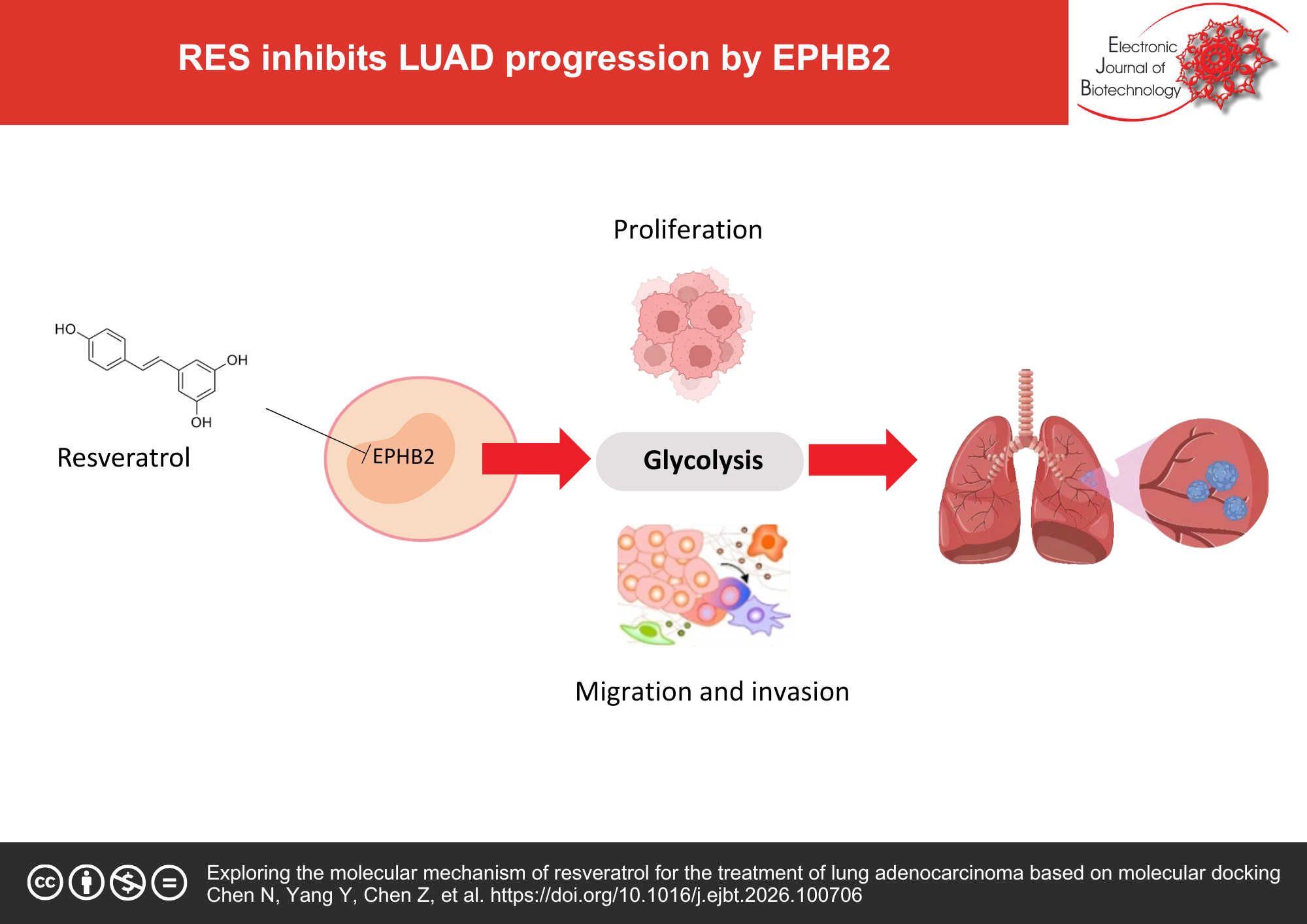
Graphical abstract
Keywords
How to Cite
Abstract
Background: Resveratrol (RES) has been found to inhibit the progression of lung cancer. Our study aims to explore the molecular mechanisms by which RES regulates lung adenocarcinoma (LUAD) progression.
Results: Our study unveils two key novel findings: First, our study demonstrates that EPHB2 is a direct functional target of RES in LUAD. Molecular docking and CETSA confirmed the binding, and crucially, EPHB2 overexpression reversed the anti-tumor effects of RES. Second, our study reveals a previously unrecognized role for EPHB2 in promoting glycolysis in LUAD, which is effectively suppressed by RES. Specifically, RES potently inhibited LUAD tumor growth in vivo and suppressed cell proliferation, migration, invasion, and glycolysis in vitro. These inhibitory effects were consistently abolished upon EPHB2 overexpression.
Conclusions: Collectively, our findings suggest that RES inhibits LUAD cell proliferation, migration, invasion, and glycolysis, with EPHB2 downregulation appearing to contribute to these effects. Further studies are needed to determine whether RES directly targets EPHB2 and to evaluate the translational potential of these findings.
References
Su L, Zhao J, Su H, et al. CircRNAs in lung adenocarcinoma: diagnosis and therapy. Current Gene Therapy 2022;22(1):15-22. https://doi.org/10.2174/1566523221666211202095258 PMid: 34856899
Wei X, Li X, Hu S, et al. Regulation of ferroptosis in lung adenocarcinoma. International Journal of Molecular Sciences 2023;24(19):14614. https://doi.org/10.3390/ijms241914614 PMid: 37834062
Rocco D, Della Gravara L, Battiloro C, et al. The treatment of advanced lung adenocarcinoma with activating EGFR mutations. Expert Opinion on Pharmacotherapy 2021;22(18):2475-2482. https://doi.org/10.1080/14656566.2021.1957096 PMid: 34281457
Myoung Hyoun K, Seul-Gi K, Dae-Weung K. A Novel dual-labeled peptide for multimodal imaging of EGFR with L858R mutation. Current Radiopharmaceuticals 2024;17(2):174-183. https://doi.org/10.2174/0118744710249198231002055810 PMid: 37849228
Subhan I, Siddique YH. Resveratrol: Protective agent against Alzheimer's disease. Central Nervous System Agents in Medicinal Chemistry 2024;24(3):249-263. https://doi.org/10.2174/0118715249287167240222081517 PMid: 38468523
Meyer C, Brockmueller A, Ruiz de Porras V, et al. Microbiota and resveratrol: How are they linked to osteoporosis? Cells 2024;13(13):1145. https://doi.org/10.3390/cells13131145 PMid: 38994996
Xin G, Xiao-Juan M, Bo H, et al. Targets and mechanisms of resveratrol against endothelial-mesenchymal transition in atherosclerosis: A network pharmacology analysis combined with in vivo experiments. Letters in Drug Design & Discovery 2024;21(13):2760-2770. https://doi.org/10.2174/1570180820666230719121428
Nadile M, Retsidou MI, Gioti K, et al. Resveratrol against cervical cancer: Evidence from in vitro and in vivo studies. Nutrients 2022;14(24):5273. https://doi.org/10.3390/nu14245273 PMid: 36558430
Cheuk IW, Chen J, Siu M, et al. Resveratrol enhanced chemosensitivity by reversing macrophage polarization in breast cancer. Clinical and Translational Oncology 2022;24(5):854-863. https://doi.org/10.1007/s12094-021-02731-5 PMid: 34859370
Ahmed MA. Design and synthesis of biodegradable polymeric nanoparticles for targeted delivery of chemotherapeutics in triple-negative breast cancer. SHIFAA 2023;2023:32-40. https://doi.org/10.70470/SHIFAA/2023/004
Pradhan R, Paul S, Acharya SS, et al. Nano formulated resveratrol inhibits PD-L1 in oral cancer cells by deregulating the association between tumor associated macrophages and cancer associated fibroblasts through IL-6/JAK2/STAT3 signaling axis. The Journal of Nutritional Biochemistry 2024;125:109568. https://doi.org/10.1016/j.jnutbio.2024.109568 PMid: 38185347
Xie C, Liang C, Wang R, et al. Resveratrol suppresses lung cancer by targeting cancer stem-like cells and regulating tumor microenvironment. The Journal of Nutritional Biochemistry 2023;112:109211. https://doi.org/10.1016/j.jnutbio.2022.109211 PMid: 36370924
Li J, Fan Y, Zhang Y, et al. Resveratrol induces autophagy and apoptosis in non-small-cell lung cancer cells by activating the NGFR-AMPK-mTOR pathway. Nutrients 2022;14(12):2413. https://doi.org/10.3390/nu14122413 PMid: 35745143
Hamad RH. A systematic review of artificial intelligence's function in the diagnosis of lung cancer (2018–2024). Mesopotamian Journal of Artificial Intelligence in Healthcare 2025;2025:12-25. https://doi.org/10.58496/MJAIH/2025/002
Xin Y, Li X, Zhang M, et al. Fusobacterium nucleatum-induced exosomal HOTTIP promotes gastric cancer progression through the microRNA-885-3p/EphB2 axis. Cancer Science 2023;114:2360-2374. https://doi.org/10.1111/cas.15781 PMid: 36898846
Leung HW, Leung CON, Lau EY, et al. EPHB2 activates ?-catenin to enhance cancer stem cell properties and drive sorafenib resistance in hepatocellular carcinoma. Cancer Research 2021;81(12):3229-3240. https://doi.org/10.1158/0008-5472.CAN-21-0184 PMid: 33903122
Yang Y, Huang JW, Yu WW. Androgen receptor promotes lung cancer metastasis by modifying the miR23a-3p/EPHB2 pathway. Current Medical Science 2024;44(5):954-963. https://doi.org/10.1007/s11596-024-2891-1 PMid: 39390216
Liu J, Shen H, Gu W, et al. Prediction of prognosis, immunogenicity and efficacy of immunotherapy based on glutamine metabolism in lung adenocarcinoma. Frontiers in Immunology 2022;13:960738. https://doi.org/10.3389/fimmu.2022.960738 PMid: 36032135
Torrico Guzmán EA, Gravely M, Meenach SA. Evaluation of the cancer-preventive effect of resveratrol-loaded nanoparticles on the formation and growth of in vitro lung tumor spheroids. Pharmaceutics 2024;16(12):1588. https://doi.org/10.3390/pharmaceutics16121588 PMid: 39771566
Innets B, Thongsom S, Petsri K, et al. Akt/mTOR targeting activity of resveratrol derivatives in non-small lung cancer. Molecules 2022;27(23):8268. https://doi.org/10.3390/molecules27238268 PMid: 36500361
Yin HT, Tian QZ, Guan L, et al. In vitro and in vivo evaluation of the antitumor efficiency of resveratrol against lung cancer. Asian Pacific Journal of Cancer Prevention 2013;14(3):1703-1706. https://doi.org/10.7314/APJCP.2013.14.3.1703 PMid: 23679260
Wu JY, Tsai KW, Shee JJ, et al. 4'-Chloro-3,5-dihydroxystilbene, a resveratrol derivative, induces lung cancer cell death. Acta Pharmacologica Sinica 2010;31(19):81-92. https://doi.org/10.1038/aps.2009.182 PMid: 20048747
Xiao X, Wu X, Li W, et al. Therapeutic effects and safety of resveratrol for lung cancer: An updated preclinical systematic review and meta-analysis. Frontiers in Nutrition 2025;12:1644538. https://doi.org/10.3389/fnut.2025.1644538 PMid: 40948874
Brown VA, Patel KR, Viskaduraki M, et al. Repeat dose study of the cancer chemopreventive agent resveratrol in healthy volunteers: Safety, pharmacokinetics, and effect on the insulin-like growth factor axis. Cancer Research 2010;70(22):9003-9011. https://doi.org/10.1158/0008-5472.CAN-10-2364 PMid: 20935227
Tambe-Jagtap SN, Jaaz ZA. Integrative genomic and proteomic profiling for personalized oncological treatments: Enhancing therapeutic efficacy and reducing adverse effects in breast cancer patients. SHIFAA 2023;2023:1-9.https://doi.org/10.70470/SHIFAA/2023/001
Jiang X, Cao G, Gao G, et al. Triptolide decreases tumor-associated macrophages infiltration and M2 polarization to remodel colon cancer immune microenvironment via inhibiting tumor-derived CXCL12. Journal of Cellular Physiology 2021;236(1):193-204. https://doi.org/10.1002/jcp.29833 PMid: 32495392
Zhang N, Tian H, Huang Q, et al. Investigating the mechanism of curcumin against LUAD malignant progression and macrophage M2 polarization based on network pharmacology, bioinformatics, and molecular docking. Letters in Drug Design & Discovery 2025;22(8):100140. https://doi.org/10.1016/j.lddd.2025.100140
Deswal B, Bagchi U, Kapoor S. Curcumin suppresses M2 macrophage-derived paclitaxel chemoresistance through inhibition of PI3K-AKT/STAT3 signaling. Anti-Cancer Agents in Medicinal Chemistry 2024;24(2):146-156. https://doi.org/10.2174/0118715206275259231105184959 PMid: 37957871
Wang X, Gao S, Song L, et al. Astragaloside IV antagonizes M2 phenotype macrophage polarization-evoked ovarian cancer cell malignant progression by suppressing the HMGB1-TLR4 axis. Molecular Immunology 2021;130:113-121. https://doi.org/10.1016/j.molimm.2020.11.014 PMid: 33308900
Zhang LX, Li CX, Kakar MU, et al. Resveratrol (RV): A pharmacological review and call for further research. Biomedicine & Pharmacotherapy 2021;143:112164. https://doi.org/10.1016/j.biopha.2021.112164 PMid: 34649335
Li T, Tan Y, Ouyang S, et al. Resveratrol protects against myocardial ischemia-reperfusion injury via attenuating ferroptosis. Gene 2022;808:145968. https://doi.org/10.1016/j.gene.2021.145968 PMid: 34530090
Wang Q, Yu Q, Wu M. Antioxidant and neuroprotective actions of resveratrol in cerebrovascular diseases. Frontiers in Pharmacology 2022;13:948889. https://doi.org/10.3389/fphar.2022.948889 PMid: 36133823
Wu H, Chen L, Zhu F, et al. The cytotoxicity effect of resveratrol: Cell cycle arrest and induced apoptosis of breast cancer 4T1 cells. Toxins 2019;11(12):731. https://doi.org/10.3390/toxins11120731 PMid: 31847250
Egal ESA, Kamdem SD, Yoshigi M, et al. EphB2 receptor promotes dermal fibrosis in systemic sclerosis. Arthritis & Rheumatology 2024;76(8):1303-1316. https://doi.org/10.1002/art.42858 PMid: 38589317
Xiao Y, Batmanov K, Hu W, et al. Hepatocytes demarcated by EphB2 contribute to the progression of nonalcoholic steatohepatitis. Science Translational Medicine 2023;15(682):eadc9653. https://doi.org/10.1126/scitranslmed.adc9653 PMid: 36753562
Chen Y, Huang C, Du F, et al. EphB2 promotes enteric nitrergic hyperinnervation and neurogenic inflammation in DSS-induced chronic colitis in mice. International Immunopharmacology 2024;129:111591. https://doi.org/10.1016/j.intimp.2024.111591 PMid: 38295544
Hu Y, Xie Q, Zhao J, et al. Interaction between the EPHB2 receptor and EFNB1 ligand drives gastric cancer invasion and metastasis via the Wnt/?-catenin/FAK pathway. International Journal of Biological Macromolecules 2024;258(Part 1):128848. https://doi.org/10.1016/j.ijbiomac.2023.128848 PMid: 38114003
Yin J, Li Z, Ye L, et al. EphB2 represents an independent prognostic marker in patients with gastric cancer and promotes tumour cell aggressiveness. Journal of Cancer. 2020;11(10):2778-2787. https://doi.org/10.7150/jca.38098 PMid: 32226496
Zhang H, Cui Z, Pan T, et al. RNF186/EPHB2 axis is essential in regulating TNF signaling for colorectal tumorigenesis in colorectal epithelial cells. The Journal of Immunology 2022;209(9):1796-1805. https://doi.org/10.4049/jimmunol.2200229 PMid: 36130827
Yuan L, Zhang Y, Xia J, et al. Resveratrol induces cell cycle arrest via a p53-independent pathway in A549 cells. Molecular Medicine Reports 2015;11(4):2459-2464. https://doi.org/10.3892/mmr.2014.3100 PMid: 25515619
Soonthonsrima T, Putra ID, Phookphan P, et al. A promising resveratrol analogue suppresses CSCs in non-small-cell lung cancer via inhibition of the ErbB2 signaling pathway. Chemical Research in Toxicology 2025;38(3):415-432. https://doi.org/10.1021/acs.chemrestox.4c00436 PMid: 40000408

This work is licensed under a Creative Commons Attribution-ShareAlike 4.0 International License.
Copyright (c) 2026 Electronic Journal of Biotechnology