
Graphical abstract
Categories
How to Cite
Abstract
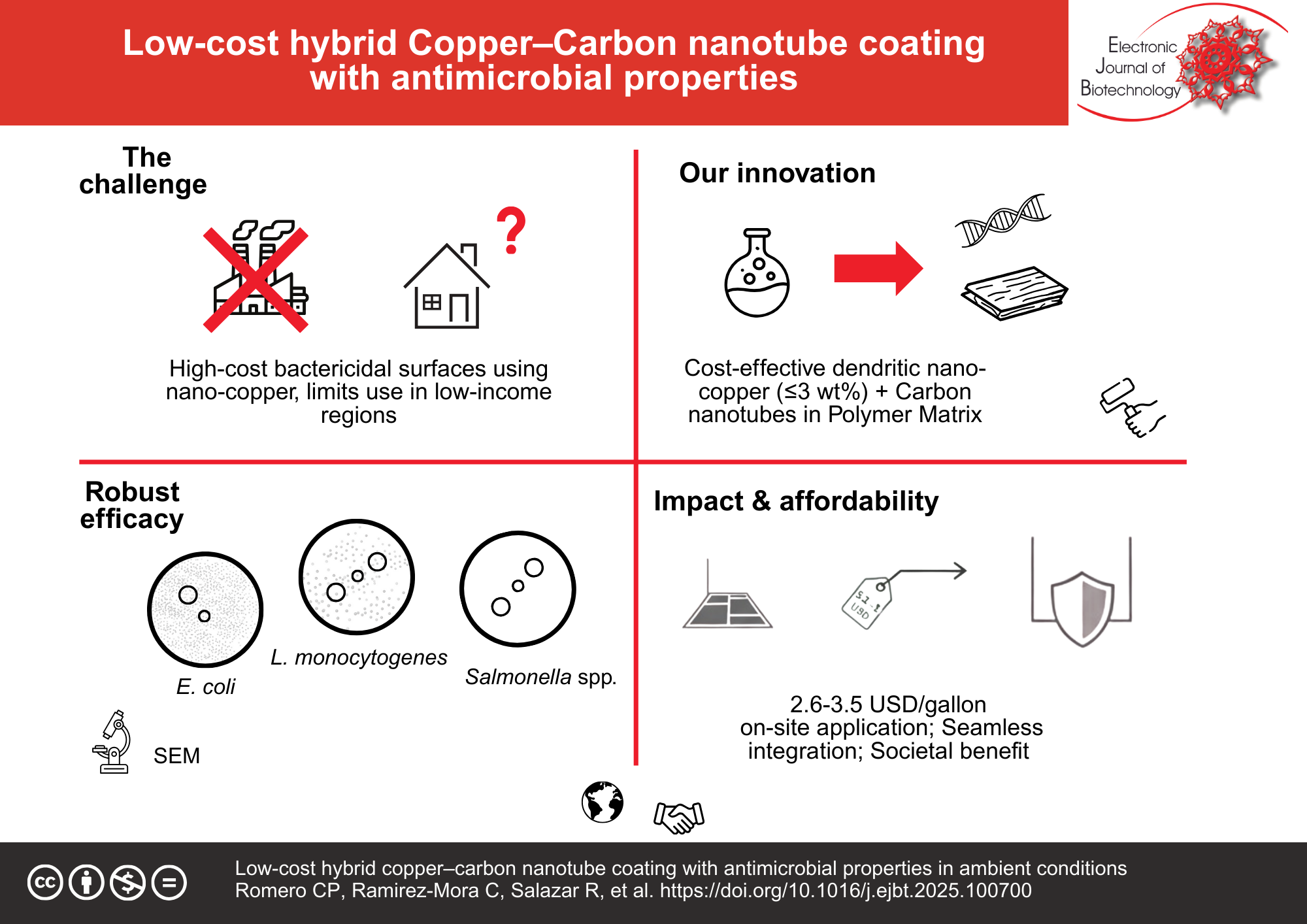
Background: The development of bactericidal surfaces using nanotechnology has gained traction in high-tech sectors due to their effectiveness against pathogens. However, widespread adoption in low-income regions remains limited by the high cost of materials such as copper nanoparticles and the need for specialized application personnel. This study aims to develop a cost-effective bactericidal coating that minimizes nano-copper usage while maintaining strong antimicrobial performance and practical applicability in resource-limited environments.
Results: A polymer-based coating incorporating ≤3 wt% nano-copper and carbon nanotubes was formulated to enhance conductivity and mechanical stability. The fabrication process was optimized for on-site application under ambient conditions. Scanning Electron Microscopy (SEM) revealed a uniform surface distribution of nano-copper particles. Bactericidal activity tests confirmed efficacy against Escherichia coli, Listeria monocytogenes, and Salmonella spp. Techno-economic analysis indicated that the coating could be integrated into existing surface finishing systems at an incremental cost of 2.6–3.5 USD per gallon.
Conclusions: This work demonstrates the feasibility of producing and applying affordable nano-based bactericidal coatings under real-world conditions. The approach provides a practical pathway for implementing antimicrobial surface technologies in low-resource settings. Although the present study focused on wood substrates, future research should assess performance on diverse materials to broaden applicability. The combination of cost-effectiveness, efficacy, and scalability underscores the potential for both commercial adoption and significant public health benefits.
References
Catalan KN, Corrales TP, Forero JC, et al. Glass transition in crosslinked nanocomposite scaffolds of gelatin/chitosan/hydroxyapatite. Polymers 2019;11(4):642. https://doi.org/10.3390/polym11040642 PMid: 30970604
Romero CP, Avila JI, Trabol RA, et al. Pd as a promoter to reduce Co cluster films at room temperature. International Journal of Hydrogen Energy 2010;35(6):2262–2267. https://doi.org/10.1016/j.ijhydene.2010.01.026
Hasan J, Crawford RJ, Ivanova EP. Antibacterial surfaces: The quest for a new generation of biomaterials. Trends in Biotechnology 2019;37(5):295-304. https://doi.org/10.1016/j.tibtech.2013.01.017
Su Q, Xue Y, Wang C, et al. Strategies and applications of antibacterial surface-modified biomaterials. Bioact Mater. 2025;53:114–140. https://doi.org/10.1016/j.bioactmat.2025.07.009 PMid: 40688018
Górny R, Go?ofit-Szymczak M, Pawlak A, et al. Effectiveness of UV-C radiation in inactivation of microorganisms on materials with different surface structures. Annals of Agricultural and Environmental Medicine 2024;31(2):287–293. https://doi.org/10.26444/aaem/189695 PMid: 38940114
Jefferson T, Del Mar C, Dooley L, et al. Physical interventions to interrupt or reduce the spread of respiratory viruses. Cochrane Database Syst Rev. 2020;20;11(11):CD006207. https://doi.org/10.1002/14651858.CD006207.pub5 PMid: 33215698
Vincent M, Hartemann P, Engels-Deutsch M. Antimicrobial applications of copper. International Journal of Hygiene and Environmental Health 2016;219(7):585-591. https://doi.org/10.1016/j.ijheh.2016.06.003 PMid: 27318723
Montero DA, Arellano C, Pardo M, et al. Antimicrobial properties of a novel copper-based composite coating with potential for use in healthcare facilities. Antimicrobial Resistance & Infection Control 2019;8:3. https://doi.org/10.1186/s13756-018-0456-4 PMid: 30627427
Warnes SL, Caves V, Keevil CW. Mechanism of copper surface toxicity in Escherichia coli O157:H7 and Salmonella involves immediate membrane depolarization followed by slower rate of DNA destruction which differs from that observed for Gram-positive bacteria. Environ Microbiol. 2012;14(7):1730-1743. https://doi.org/10.1111/j.1462-2920.2011.02677.x PMid: 22176893
Santo CE, Morais PV, Grass G. Isolation and characterization of bacteria resistant to metallic copper surfaces. Applied and Environmental Microbiology 2010;76(5):1341-1348. https://doi.org/10.1128/AEM.01952-09
Salah I, Parkin IP, Allan E. Copper as an antimicrobial agent: Recent advances. RSC Adv. 2021;11:18179-18186. https://doi.org/10.1039/D1RA02149D PMid: 35480904
Yaqoob AA, Ahmad H, Parveen T, et al. Recent advances in metal decorated nanomaterials and their various biological applications: A Review. Front. Chem. 2020;8:341. https://doi.org/10.3389/fchem.2020.00341 PMid: 32509720
Muñoz-Bonilla A, Fernández-García M. Polymeric materials with antimicrobial activity. Progress in Polymer Science 2012;37(2):281-339. https://doi.org/10.1016/j.progpolymsci.2011.08.005
Ivanova EP, Hasan J, Webb HK, et al. Bactericidal activity of black silicon. Nature Communications 2013;4(1):2838. https://doi.org/10.1038/ncomms3838 PMid: 24281410
Ran B, Ran L, Wang Z, et al. Photocatalytic antimicrobials: Principles, design strategies, and applications. Chem. Rev. 2023;123(22):12371-12430. https://doi.org/10.1021/acs.chemrev.3c00326 PMid: 37615679
Xie M, Gao M, Yun Y, et al. Antibacterial nanomaterials: Mechanisms, impacts on antimicrobial resistance and design principles. Angew. Chem. Int. Ed. 2023;62(17):e202217345. https://doi.org/10.1002/anie.202217345 PMid: 3671800
Linklater DP, Baulin VA, Juodkazis S, et al. Mechano-bactericidal actions of nanostructured surfaces. Nat Rev Microbiol 2021;19:8–22. https://doi.org/10.1038/s41579-020-0414-z PMid: 32807981
Wang X, Shan M, Zhang S, et al. Stimuli-responsive antibacterial materials: Molecular structures, design principles, and biomedical applications. Adv. Sci. 2022;9(13):2104843. https://doi.org/10.1002/advs.202104843 PMid: 35224893
Duan S, Wu R, Xiong Y, et al. Multifunctional antimicrobial materials: From rational design to biomedical applications. Progress in Materials Science, 2022;125:100887. https://doi.org/10.1016/j.pmatsci.2021.100887
Krzy?ewska?Dudek E, Dulipati V., Kapczy?ska K, et al. Lipopolysaccharide with long O?antigen is crucial for Salmonella Enteritidis to evade complement activity and to facilitate bacterial survival in vivo in the Galleria mellonella infection model. Medical Microbiology and Immunology 2024;213:8. https://doi.org/10.1007/s00430-024-00790-3
Bal?k M, Bulut V, Erdogan IY, Optical, structural and phase transition properties of Cu2O, CuO and Cu2O/CuO: Their photoelectrochemical sensor applications. International Journal of Hydrogen Energy 2019;44(34):18744-18755. https://doi.org/10.1016/j.ijhydene.2018.08.159

This work is licensed under a Creative Commons Attribution-ShareAlike 4.0 International License.
Copyright (c) 2026 Electronic Journal of Biotechnology