
Graphical abstract
Keywords
Categories
How to Cite
Abstract
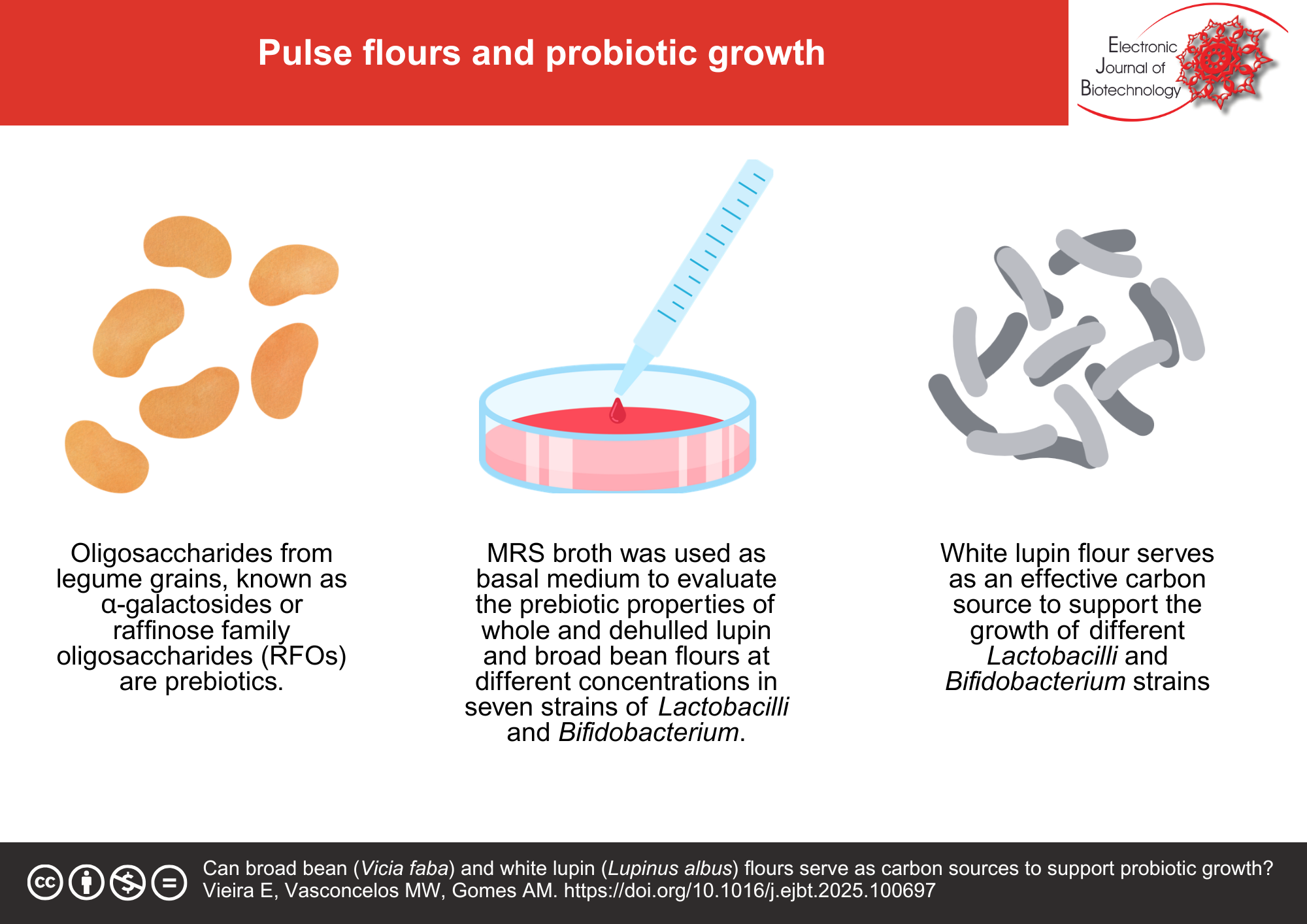
Background: There is growing interest in identifying substrates that support the growth of probiotics in foods. Pulses are an excellent source of nutrients and bioactive compounds, including non-digestible oligosaccharides from the α-galactoside group, which are probiotic growth factors. This study aimed to evaluate the potential of white lupin and broad bean flours to support the growth of seven probiotic strains of Lactobacilli and Bifidobacterium.
Results: Different Man-Rogosa-Sharpe broth media were prepared using whole or dehulled flour as carbon sources at different concentrations (20, 30, 40, and 60 g/L) and inoculated with 2% (w/v) of each probiotic strain. Viable cell numbers and medium acidification were monitored throughout fermentation and compared to negative (MRS without a carbon source) and positive (MRS with 20 g/L glucose) controls. White lupin at 60 g/L concentration proved to be a suitable carbon source for both Lactobacillus acidophilus Ki and Lactobacillus casei ssp. paracasei L26, while concentrations of 40 g/L and 60 g/L supported Bifidobacterium animalis Bb12 growth.
Conclusions: Flour concentration had a greater impact on probiotic growth than composition (hull vs. dehulled). These results suggested that white lupin is a promising ingredient for the development of functional foods.
References
Ji J, Jin W, Liu S, et al. Probiotics, prebiotics, and postbiotics in health and disease. MedComm 2023;4(6):e420. https://doi.org/10.1002/mco2.420 PMid: 37929014
Sharifi-Rad J, Rodrigues CF, Stojanovi?-Radi? Z, et al. Probiotics: Versatile bioactive components in promoting human health. Medicina 2020;56(9):433. https://doi.org/10.3390/medicina56090433 PMid: 32867260
Yadav MK, Kumari I, Singh B, et al. Probiotics, prebiotics and synbiotics: Safe options for next-generation therapeutics. Appl Microbiol Biotechnol 2022;106(2):505–21. https://doi.org/10.1007/s00253-021-11646-8 PMid: 35015145
Markowiak P, ?li?ewska K. Effects of probiotics, prebiotics, and synbiotics on human health. Nutrients. 2017;9(9):1021. https://doi.org/10.3390/nu9091021 PMid: 28914794
Bresciani A, Marti A. Using pulses in baked products: lights, shadows, and potential solutions. Foods. 2019;8(10):451. https://doi.org/10.3390/foods8100451 PMid: 31581614
Cicho?ska P, Ziarno M. Legumes and legume-based beverages fermented with lactic acid bacteria as a potential carrier of probiotics and prebiotics. Microorganisms. 2022;10(1):91. https://doi.org/10.3390/microorganisms10010091 PMid: 35056540
Elango D, Rajendran K, Van der Laan L, et al. Raffinose family oligosaccharides: Friend or foe for human and plant health? Front Plant Sci. 2022;13:829118. https://doi.org/10.3389/fpls.2022.829118 PMid: 35251100
Bryant L, Rangan A, Grafenauer S. Lupins and health outcomes: A systematic literature review. Nutrients. 2022;14(2):327. https://doi.org/10.3390/nu14020327 PMid: 35057507
Caracuta V, Barzilai O, Khalaily H, et al. The onset of faba bean farming in the Southern Levant. Sci Rep. 2015;5(1):14370. https://doi.org/10.1038/srep14370 PMid: 26458981
Verni M, De Mastro G, De Cillis F, et al. Lactic acid bacteria fermentation to exploit the nutritional potential of Mediterranean faba bean local biotypes. Food Res Int. 2019;125:108571. https://doi.org/10.1016/j.foodres.2019.108571 PMid: 31554105
Technavio. Lupin Market - 69% of Growth to Originate from APAC| Animal Feed Segment to be Significant for Revenue Generation (2022, Apr 19). Available from Internet: https://www.prnewswire.com/news-releases/lupin-market---69-of-growth-to-originate-from-apac-animal-feed-segment-to-be-significant-for-revenue-generation-technavio-301527202.html [cited 2022 October 24].
Mordor Intelligence. Fava Bean Market - Growth, Trends, COVID-19 Impact, and Forecasts (2021 - 2026). Available from Internet: https://www.mordorintelligence.com/industry-reports/fava-bean-market [cited 2021 May 4].
Gullón P, Gullón B, Tavaria F, et al. In vitro fermentation of lupin seeds (Lupinus albus) and broad beans (Vicia faba): Dynamic modulation of the intestinal microbiota and metabolomic output. Food Funct. 2015;6(10):3316–22. https://doi.org/10.1039/C5FO00675A PMid: 26252418
Marinangeli CPF, Harding SV, Zafron M, et al. A systematic review of the effect of dietary pulses on microbial populations inhabiting the human gut. Beneficial Microbes. 2020;11(5):457–68. https://doi.org/10.3920/BM2020.0028 PMid: 32865026
Miles AA, Misra SS, Irwin JO. The estimation of the bactericidal power of the blood. Epidemiology and Infection. 1938;38(6):732-749. https://doi.org/10.1017/S002217240001158X PMid: 20475467
Choi YM, Yoon H, Shin MJ, et al. Nutrient levels, bioactive metabolite contents, and antioxidant capacities of faba beans as affected by dehulling. Foods 2023;12(22):4063. https://doi.org/10.3390/foods12224063 PMid: 38002121
Pal RS, Bhartiya A, Yadav P, et al. Effect of dehulling, germination and cooking on nutrients, anti-nutrients, fatty acid composition and antioxidant properties in lentil (Lens culinaris). J Food Sci Technol. 2017;54(4):909–20. https://doi.org/10.1007/s13197-016-2351-4 PMid: 28303042
You S, Ma Y, Yan B, et al. The promotion mechanism of prebiotics for probiotics: A review. Front. Nutr. 2022;9:1000517. https://doi.org/10.3389/fnut.2022.1000517 PMid: 36276830
Dong Y, Han M, Fei T, et al. Utilization of diverse oligosaccharides for growth by Bifidobacterium and Lactobacillus species and their in vitro co-cultivation characteristics. Int Microbiol 2024;27:941-52. https://doi.org/10.1007/s10123-023-00446-x PMid: 37946011
Fritsch C, Vogel RF, Toelstede S. Fermentation performance of lactic acid bacteria in different lupin substrates—influence and degradation ability of antinutritives and secondary plant metabolites. J Appl Microbiol. 2015;119(4):1075–88. https://doi.org/10.1111/jam.12908 PMid: 26189714
Ali SA, Saeed SMG, Ejaz U, et al. A novel approach to improve the nutritional value of black gram (Vigna mungo L.) by the combined effect of pre-gelatinization and fermentation by Lactobacillus sp. E14 and Saccharomyces cerevisiae MK-157: Impact on morphological, thermal, and chemical structural properties. LWT. 2022;172:114216. https://doi.org/10.1016/j.lwt.2022.114216
Martínez-Villaluenga C, Frias J, Vidal-Valverde C. Alpha-galactosides: Antinutritional factors or functional ingredients? Crit Rev Food Sci Nutr. 2008;48(4):301–16. https://doi.org/10.1080/10408390701326243 PMid: 18409113
Martínez-Villaluenga C, Fr??as J, Vidal-Valverde C. Raffinose family oligosaccharides and sucrose contents in 13 Spanish lupin cultivars. Food Chemistry. 2005;91(4):645–9. https://doi.org/10.1016/j.foodchem.2004.06.034
Zartl B, Silberbauer K, Loeppert R, et al. Fermentation of non-digestible raffinose family oligosaccharides and galactomannans by probiotics. Food Funct. 2018;9(3):1638–46. https://doi.org/10.1039/C7FO01887H PMid: 29465736
Thambiraj SR, Phillips M, Koyyalamudi SR, et al. Yellow lupin (Lupinus luteus L.) polysaccharides: Antioxidant, immunomodulatory and prebiotic activities and their structural characterisation. Food Chemistry. 2018;267:319–28. https://doi.org/10.1016/j.foodchem.2018.02.111 PMid: 29934174
Martínez-Villaluenga C, Frías J, Vidal-Valverde C, et al. Raffinose family of oligosaccharides from lupin seeds as prebiotics: Application in dairy products. J Food Prot. 2005;68(6):1246–52. https://doi.org/10.4315/0362-028x-68.6.1246 PMid: 15954717
Palacio MI, Weisstaub AR, Zuleta Á, et al. ?-Galactosides present in lupin flour affect several metabolic parameters in Wistar rats. Food Funct. 2016;7(12):4967–75. https://doi.org/10.1039/C6FO01297C PMid: 27858027
Smith SC, Choy R, Johnson SK, et al. Lupin kernel fiber consumption modifies fecal microbiota in healthy men as determined by rRNA gene fluorescent in situ hybridization. Eur J Nutr. 2006;45(6):335–41. https://doi.org/10.1007/s00394-006-0603-1 PMid: 16763747

This work is licensed under a Creative Commons Attribution-ShareAlike 4.0 International License.
Copyright (c) 2026 Electronic Journal of Biotechnology