
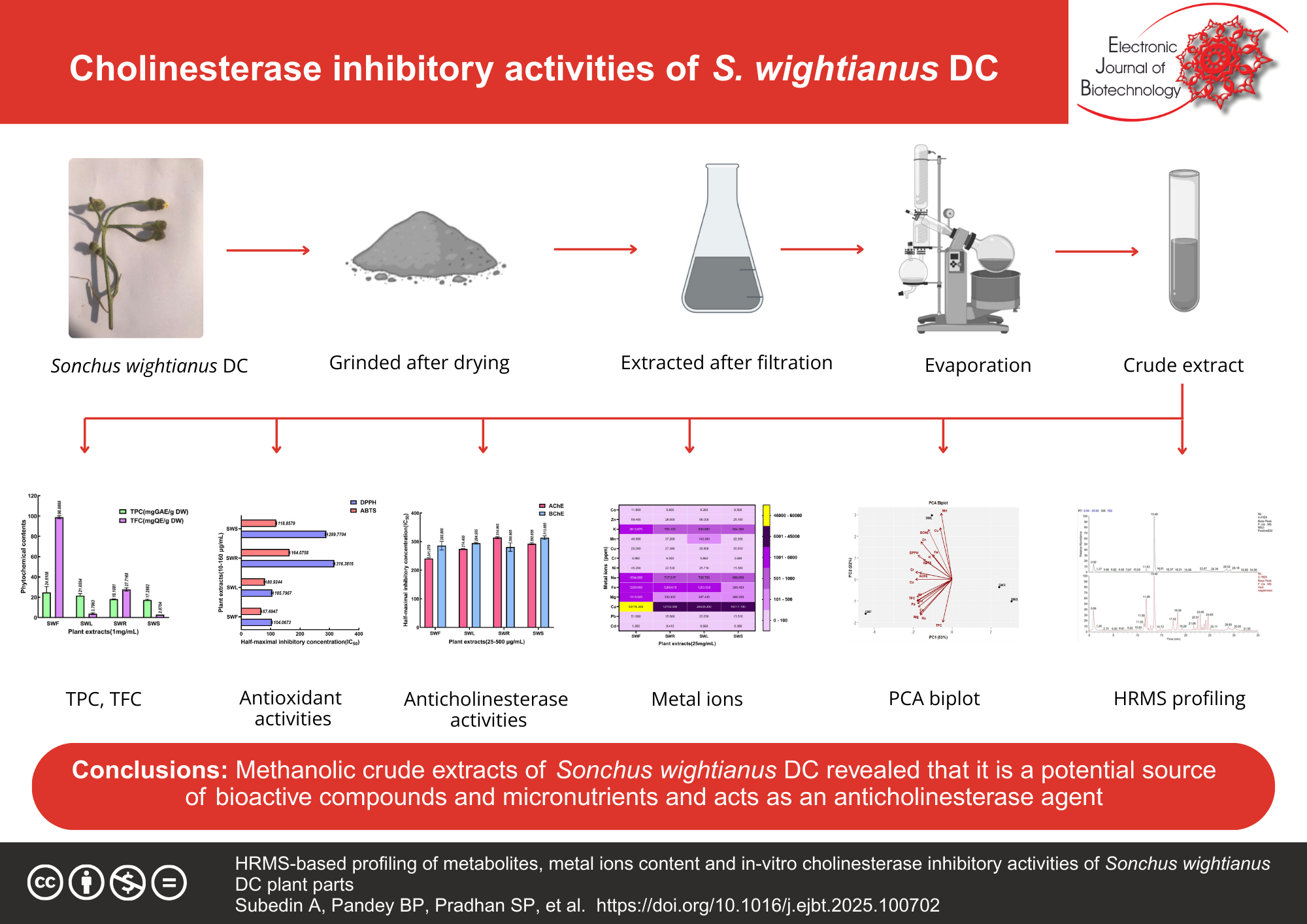
Graphical abstract
Keywords
Categories
How to Cite
Abstract
Background: Sonchus wightianus DC is native to South Asia and has traditionally been known for its wide range of applications for the treatment of several human ailments. However, its application for the treatment of neurodegenerative diseases like Alzheimer’s disease (AD) has not been studied yet. In this present study, comprehensive metabolite profiling of plant parts and in-vitro cholinesterase inhibitory potential was examined to see the efficacy of plant extract against AD.
Results: The potent antioxidant activity was demonstrated by the flower extract in both DPPH and ABTS assays, with IC50 values of 104.06 ± 2.05 µg/mL and 67.69 ± 1.58 µg/mL, respectively. The crude methanol extract of the leaf displayed the highest butyrylcholinesterase (BChE) inhibition potential with IC50 values of 281.09 ± 14.64 µg/mL. In contrast, the flower extract exhibited the strongest acetylcholinesterase (AChE) inhibition with IC50 values of 247.51 ± 11.15 µg/mL. Furthermore, the evaluated plant parts were a rich source of essential macro and micronutrients. Principal component analysis revealed the major contribution of total phenolic content (TPC), and total flavonoid content (TFC) in the plant extracts, which might be the prime reason for strong antioxidant and cholinesterase inhibition. Further, the HRMS profiling analysis revealed the presence of Linoleic acid, gingerol, kaempferol, genistein, daidzein, chlorogenic acid, fisetin and 12-oxo-phytodienoic acid.
Conclusions: The findings of this study suggest that Sonchus wightianus DC is a promising source of bioactive compounds and essential micronutrients, with notable potential as an anticholinesterase agent.
References
. Chaachouay N, Zidane L. Plant-derived natural products. A source for drug discovery and development. Drugs and Drug Candidates, 2024;3(1):184-207. https://doi.org/10.3390/ddc3010011
. Eshete MA, Molla EL. Cultural significance of medicinal plants in healing human ailments among Guji semi-pastoralist people, Suro Barguda District, Ethiopia. J Ethnobiology Ethnomedicine 2021;17:61. https://doi.org/10.1186/s13002-021-00487-4 PMid: 34663365
. Riaz M, Khalid R, Afzal M, et al. Phytobioactive compounds as therapeutic agents for human diseases: A review. Food Sci Nutr. 2023;11(6):2500-2529. https://doi.org/10.1002/fsn3.3308 PMid: 37324906
. Breijyeh Z, Karaman R. Comprehensive review on Alzheimer’s disease: Causes and treatment. Molecules 2020;25(24):5789. https://doi.org/10.3390/molecules25245789 PMid: 33302541
. Nichols E, Steinmetz JD, Vollset SE, et al. Estimation of the global prevalence of dementia in 2019 and forecasted prevalence in 2050: An analysis for the Global Burden of Disease Study 2019. The Lancet Public Health, 2022;7(2):e105-e125. https://doi.org/10.1016/S2468-2667(21)00249-8 PMid: 34998485
. Baral K, Dahal M, Pradhan S. Knowledge regarding Alzheimer’s disease among college students of Kathmandu, Nepal. International Journal of Alzheimer’s Disease, 2020;2020(1):6173217. https://doi.org/10.1155/2020/6173217 PMid: 32494366
. Gao H, Jiang Y, Zhan J, et al. Pharmacophore-based drug design of AChE and BChE dual inhibitors as potential anti-Alzheimer’s disease agents. Bioorganic Chemistry, 2021;114:105149. https://doi.org/10.1016/j.bioorg.2021.105149 PMid: 34252860
. ALNasser MN, Alboraiy GM, Alsowing EM, et al. Cholinesterase inhibitors from plants and their potential in Alzheimer's treatment: Systematic Review. Brain Sciences, 2025;15(2):215. https://doi.org/10.3390/brainsci15020215 PMid: 40002547
. Babashpour-Asl M, Kaboudi PS, Barez SR. Therapeutic and medicinal effects of snowdrop (Galanthus spp.) in Alzheimer’s disease: A review. Journal of Education and Health Promotion 2023;12(1):128. https://doi.org/10.4103/jehp.jehp_451_22 PMid: 37397105
. Nonato IA, Viloria MIV, Carvalho GD, et al. Healing effects of formulations with extract of Sonchus oleraceus. Acta Scientiae Veterinariae, 2018;46(1):7. https://doi.org/10.22456/1679-9216.89177
. Laabar A, Kabach I, El Asri S, et al. Investigation of antioxidant, antidiabetic, and antiglycation properties of Sonchus oleraceus and Lobularia maritima (L.) Desv. extracts from Taza, Morocco. Food Chemistry Advances, 20256:100912. https://doi.org/10.1016/j.focha.2025.100912
. Bhatti MZ, Ismail H, Kayani WK. Plant secondary metabolites: Therapeutic potential and pharmacological properties. In: Vijayakumar R, Raja SSS (editors), Secondary Metabolites - Trends and Reviews. IntechOpen; 2022.
. Lee YH, Choo C, Watawana MI, et al. An appraisal of eighteen commonly consumed edible plants as functional food based on their antioxidant and starch hydrolase inhibitory activities. Journal of the Science of Food and Agriculture 2015;95(14):2956–2964. https://doi.org/10.1002/jsfa.7039 PMid: 25491037
. Aryal S, Baniya MK, Danekhu K, et al. Total phenolic content, flavonoid content and antioxidant potential of wild vegetables from Western Nepal. Plants. 2019;8(4):96. https://doi.org/10.3390/plants8040096 PMid: 30978964
. Rahman MM, Islam MB, Biswas M, et al. In vitro antioxidant and free radical scavenging activity of different parts of Tabebuia pallida growing in Bangladesh. BMC Res Notes 2015;8:621. https://doi.org/10.1186/s13104-015-1618-6 PMid: 26518275
. Ilyasov IR, Beloborodov VL, Selivanova IA, et al. ABTS/PP decolorization assay of antioxidant capacity reaction pathways. Int J Mol Sci, 2020;21(3):1131. https://doi.org/10.3390/ijms21031131 PMid: 32046308
. Pandey BP, Pradhan SP, Adhikari K, et al. Bergenia pacumbis from Nepal, an astonishing enzymes inhibitor. BMC Complement Med Ther. 2020;20(1):198. https://doi.org/10.1186/s12906-020-02989-2 PMid: 32586304
. Yaradua A, Bungudu JI, Shuaibu L, et al. Health risk assessment of heavy metals in vegetable: The contribution of illegal mining and armed banditry to heavy metal pollution in Katsina State, Nigeria. Journal of Scientific Research and Reports, 2025;29(5):19-27. https://doi.org/10.9734/jsrr/2023/v29i51744
. Pradhan SP, Ashok GC, Joshi P, et al. Elemental analysis and enzymes inhibitory potential of the soybean and soy products available in Nepal. Journal of Agriculture and Food Research, 2023;12:100574. https://doi.org/10.1016/j.jafr.2023.100574
. Pradhan SP, Subedi I, Adhikari K, et al. In vitro and in silico approach for the evaluation of enzyme inhibitory potential of Kadipatta (Murraya koenigii) collected from western Nepal. Clinical Traditional Medicine and Pharmacology, 2024;5(3):200161. https://doi.org/10.1016/j.ctmp.2024.200161
. Roy A, Khan A, Ahmad I, et al. Flavonoids a bioactive compound from medicinal plants and its therapeutic applications. Biomed Res Int, 2022;2022(1):5445291. https://doi.org/10.1155/2022/5445291 PMid: 35707379
. Tungmunnithum D, Thongboonyou A, Pholboon A, et al. Flavonoids and other phenolic compounds from medicinal plants for pharmaceutical and medical aspects: An overview. Medicines, 2018;5(3):93. https://doi.org/10.3390/medicines5030093 PMid: 30149600
. Kunnummal SP, Khan M. Diet–gut microbiome interaction and ferulic acid bioavailability: Implications on neurodegenerative disorders. Eur J Nutr, 2024;63:51–66. https://doi.org/10.1007/s00394-023-03247-0 PMid: 37747555
. Rawangkan A, Wongsirisin P, Namiki K, et al. Green tea catechin is an alternative immune checkpoint inhibitor that inhibits PD-L1 expression and lung tumor growth. Molecules, 2018;23(8):2071. https://doi.org/10.3390/molecules23082071 PMid: 30126206
. Enkhbat T, Nishi M, Yoshikawa K, et al. Epigallocatechin-3-gallate enhances radiation sensitivity in colorectal cancer cells through Nrf2 activation and autophagy. Anticancer. Res, 2018;38(11):6247–6252. https://doi.org/10.21873/anticanres.12980 PMid: 30396944
. Intharuksa A, Kuljarusnont S, Sasaki Y, et al. Flavonoids and other polyphenols: Bioactive molecules from traditional medicine recipes/medicinal plants and their potential for phytopharmaceutical and medical application. Molecules, 2024;29(23):5760. https://doi.org/10.3390/molecules29235760 PMid: 39683916
. Danao K, Kodape Y, Mahapatra D, et al. Highlights on synthetic, natural, and hybrid cholinesterase inhibitors for effective treatment of Alzheimer’s disease: A review. International Journal of Current Research and Review, 2021;13(11):27-34. https://doi.org/10.31782/IJCRR.2021.131107
. Garcia-Molina P, Garcia-Molina F, Teruel-Puche JA, et al. The relationship between the IC50 values and the apparent inhibition constant in the study of inhibitors of tyrosinase diphenolase activity helps confirm the mechanism of inhibition. Molecules, 2022;27(10):3141. https://doi.org/10.3390/molecules27103141 PMid: 35630619
. Luo L, Wang B, Jiang J, et al. Heavy metal contaminations in herbal medicines: Determination, comprehensive risk assessments, and solutions. Front Pharmacol, 2021;11:595335. https://doi.org/10.3389/fphar.2020.595335 PMid: 33597875
. Gandhi Y, Prasad SB, Kumar V, et al. Quantification of phytochemicals and metal Ions as well as the determination of volatile compounds, antioxidant, antimicrobial and antacid activities of the Mimosa pudica L. Leaf: Exploration of neglected and under?utilized part. Chemistry & Biodiversity, 2023;20(10):e202301049. https://doi.org/10.1002/cbdv.202301049 PMid: 37728228
. Nuñez MT, Chana-Cuevas P. New perspectives in iron chelation therapy for the treatment of neurodegenerative diseases. Pharmaceuticals, 2018;11(4):109. https://doi.org/10.3390/ph11040109 PMid: 30347635
. Sun L, Sharma AK, Han BH, et al. Amentoflavone: A bifunctional metal chelator that controls the formation of neurotoxic soluble A?42 oligomers. ACS Chem Neurosci, 2020;11(17):2741-2752. https://doi.org/10.1021/acschemneuro.0c00376 PMid: 32786307
. Fukada T, Yamasaki S, Nishida K, et al. Zinc homeostasis and signaling in health and diseases. J Biol Inorg Chem 2011;16:1123–1134. https://doi.org/10.1007/s00775-011-0797-4 PMid: 21660546
. Read AD, Bentley RET, Archer SL, et al. Mitochondrial iron–sulfur clusters: Structure, function, and an emerging role in vascular biology. Redox Biology, 2021;47:102164. https://doi.org/10.1016/j.redox.2021.102164 PMid: 34656823
. Adebamowo SN, Spiegelman D, Willett WC, et al. Association between intakes of magnesium, potassium, and calcium and risk of stroke: 2 cohorts of US women and updated meta-analyses. The American Journal of Clinical Nutrition, 2015;101(6):1269–1277. https://doi.org/10.3945/ajcn.114.100354 PMid: 25948665
. Bost M, Houdart S, Oberli M, et al. Dietary copper and human health: Current evidence and unresolved issues. Journal of Trace Elements in Medicine and Biology, 2016;35:107–115. https://doi.org/10.1016/j.jtemb.2016.02.006 PMid: 27049134
. Kumar S, Islam R, Akash PB, et al. Lead (Pb) contamination in agricultural products and human health risk assessment in Bangladesh. Water Air Soil Pollut 2022;233:257. https://doi.org/10.1007/s11270-022-05711-9
. Suciu NA, De Vivo R, Rizzati N, et al. Cd content in phosphate fertilizer: Which potential risk for the environment and human health? Current Opinion in Environmental Science & Health, 2022;30:100392. https://doi.org/10.1016/j.coesh.2022.100392
. Gasser U, Klier B, Kühn AV, et al. Current findings on the heavy metal content in herbal drugs. Pharmeur Sci Notes, 2009;2009(1):37-50. PMid: 19275871
. Braeken J, van Assen MALM. An Empirical Kaiser criterion. Psychological Methods, 2017;22(3):450-466. https://doi.org/10.1037/met0000074 PMid: 27031883
. Currais A, Farrokhi C, Dargusch R, et al. Fisetin reduces the impact of aging on behavior and physiology in the rapidly aging SAMP8 mouse. The Journals of Gerontology: Series A, 2018;73(3):299–307. https://doi.org/10.1093/gerona/glx104 PMid: 28575152
. Chen Y, Yu Y. Tau and neuroinflammation in Alzheimer’s disease: interplay mechanisms and clinical translation. J Neuroinflammation 2023;20:165. https://doi.org/10.1186/s12974-023-02853-3 PMid: 37452321
. Jin S, Zhang L, Wang L. Kaempferol, a potential neuroprotective agent in neurodegenerative diseases: From chemistry to medicine. Biomedicine & Pharmacotherapy 2023;165:115215. https://doi.org/10.1016/j.biopha.2023.115215 PMid: 37494786
. Fuloria S, Yusri MAA, Sekar M, et al. Genistein: A potential natural lead molecule for new drug design and development for treating memory impairment. Molecules 2022;27(1):265. https://doi.org/10.3390/molecules27010265 PMid: 35011497
. Szulc A, Wi?niewska K, ?abi?ska M, et al. Effectiveness of flavonoid-rich diet in alleviating symptoms of neurodegenerative diseases. Foods, 2024;13(12):1931. https://doi.org/10.3390/foods13121931 PMid: 38928874
. Yan L, Guo MS, Zhang Y, et al. Dietary plant polyphenols as the potential drugs in neurodegenerative diseases: Current evidence, advances, and opportunities. Oxid Med Cell Longev. 2022;21(1):5288698. https://doi.org/10.1155/2022/5288698 PMid: 35237381
. Arcusa R, Villaño D, Marhuenda J, et al. Potential role of ginger (Zingiber officinale Roscoe) in the prevention of neurodegenerative diseases. Front Nutr. 2022;9:809621. https://doi.org/10.3389/fnut.2022.809621 PMid: 35369082
. Zhang YY, Yao YD, Chen F, et al. (9S,13R)-12-oxo-phytodienoic acid attenuates inflammation by inhibiting mPGES-1 and modulating macrophage polarization via NF-?B and Nrf2/HO-1 pathways. Pharmacological Research, 2022;182:106310. https://doi.org/10.1016/j.phrs.2022.106310 PMid: 35714824
. Vieira CP, Lelis CA, Ochioni AC, et al. Estimating the therapeutic potential of NSAIDs and linoleic acid-isomers supplementation against neuroinflammation. Biomedicine & Pharmacotherapy, 2024;177:116884. https://doi.org/10.1016/j.biopha.2024.116884 PMid: 38889635
. Zheng Y, Li L, Chen B, et al. Chlorogenic acid exerts neuroprotective effect against hypoxia-ischemia brain injury in neonatal rats by activating Sirt1 to regulate the Nrf2-NF-?B signaling pathway. Cell Commun Signal, 2022;20(1):84. https://doi.org/10.1186/s12964-022-00860-0 PMid: 35689269
. Nobela O, Ndhlala AR, Tugizimana F, et al. Tapping into the realm of underutilised green leafy vegetables: Using LC-IT-Tof-MS based methods to explore phytochemical richness of Sonchus oleraceus (L.) L. South African Journal of Botany, 2022;145:207-212. https://doi.org/10.1016/j.sajb.2021.03.010
. Fang C, Zhuang X, Li Z, et al. LC-MS/MS-Based determination and optimization of linoleic acid oxides in Baijiu and their variation with storage time. Metabolites, 2025;15(4):246. https://doi.org/10.3390/metabo15040246 PMid: 40278375
. Gonzalez-Gonzalez M, Yerena-Prieto BJ, Carrera C, et al. Determination of gingerols and shogaols content from ginger (Zingiber officinale Rosc.) through microwave-assisted extraction. Agronomy, 2023;13(9):2288. https://doi.org/10.3390/agronomy13092288
. Ersoy E, Boga M, Kaplan A. et al. LC-HRMS profiling of phytochemicals with assessment of antioxidant, anticholinesterase, and antimicrobial potentials of Astragalus brachystachys DC. Chem. Biodiversity, 2025;22(2):e202401853. https://doi.org/10.1002/cbdv.202401853 PMid: 39400994
. Wen J, Kang L, Liu H, et al. A validated UV-HPLC method for determination of chlorogenic acid in Lepidogrammitis drymoglossoides (Baker) Ching, Polypodiaceae. Pharmacognosy Res, 2012;4(3):148-153. https://doi.org/10.4103/0974-8490.99076 PMid: 22923952
. Liang Y, Zhao W, Wang C, et al. A comprehensive screening and identification of genistin metabolites in rats based on multiple metabolite templates combined with UHPLC-HRMS analysis. Molecules, 2018;23(8):1862. https://doi.org/10.3390/molecules23081862 PMid: 30049985
. Nouidha S, Selmi S, Guigonis JM, et al. Metabolomics profiling of Tunisian Sonchus oleraceus L. Extracts and their antioxidant activities. Chem Biodivers. 2023;20(8):e202300290. https://doi.org/10.1002/cbdv.202300290 PMid: 37391386

This work is licensed under a Creative Commons Attribution-ShareAlike 4.0 International License.
Copyright (c) 2026 Electronic Journal of Biotechnology