Graphical abstract
Keywords
How to Cite
Abstract
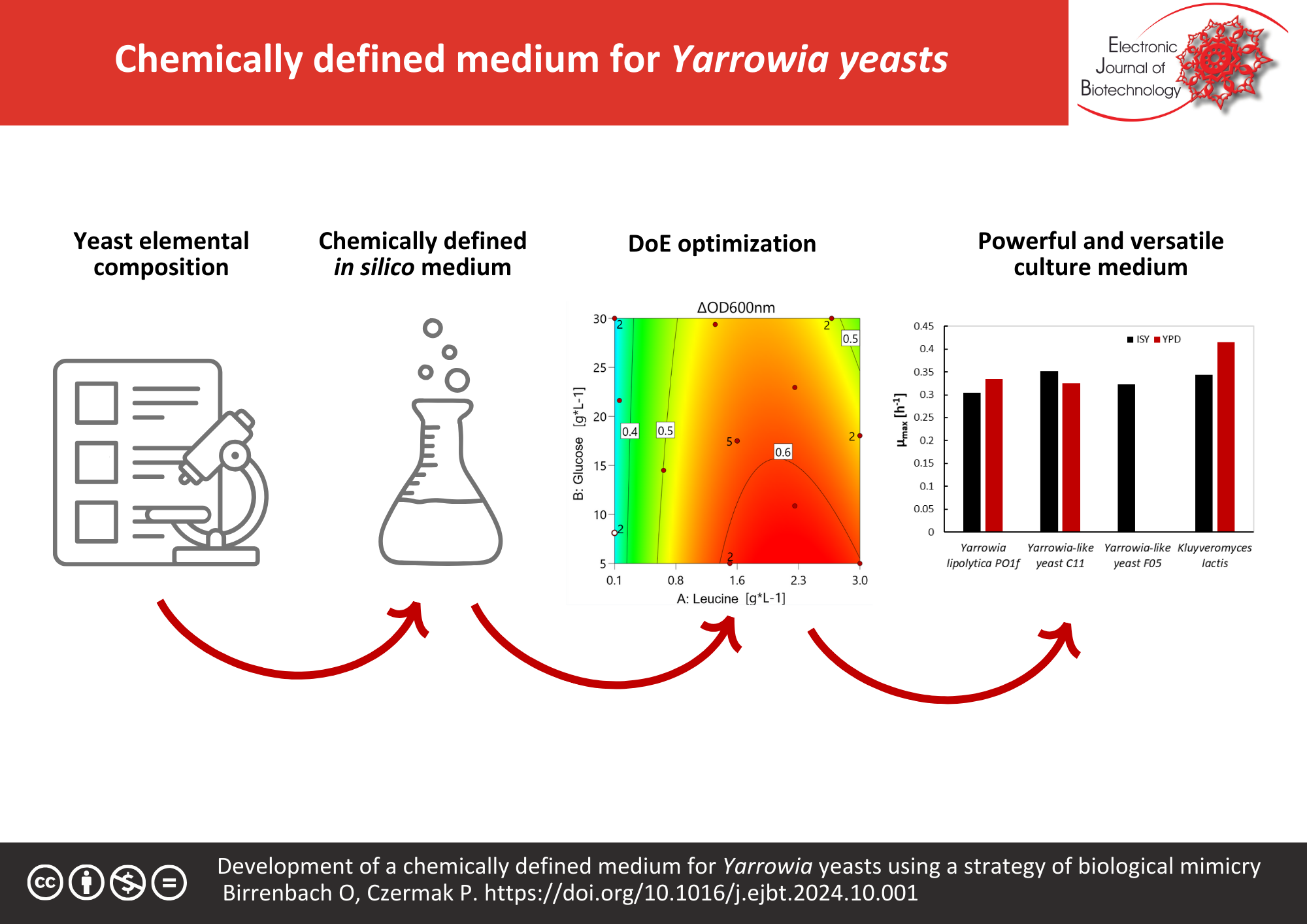
Background: The efficiency of recombinant protein production in Yarrowia lipolytica is strongly influenced by the culture medium. Complex media have limited applications because the composition is undefined and variable, whereas chemically defined media achieve better yields and reproducibility. Defined media also increase selectivity, reduce contamination risks, and enable precise nutrient control, leading to better growth and higher productivity. We used a design of experiments approach based on the elemental composition of yeast for the arithmetic development and optimization of a defined medium for the Y. lipolytica auxotrophic strain PO1f.
Results: Statistically supported optimal concentrations of 10 g*L−1 glucose and 2.29 g*L−1 leucine enabled superior growth in the new in silico yeast (ISY) medium. Specific growth rates of 0.305 h−1 were achieved for the auxotrophic Yarrowia strain. Thiamine hydrochloride was a growth-limiting component, and higher concentrations increased the cell density of Y. lipolytica PO1f cultures by a factor of 30.
Conclusions: ISY medium was suitable not only for the cultivation of Y. lipolytica but also universally applicable for Yarrowia-like and other yeasts, achieving better growth rates and yields compared to existing chemically defined media.
References
Park Y-K, Ledesma-Amaro R. What makes Yarrowia lipolytica well suited for industry? Trends Biotechnol 2023;41(2):242–54. https://doi.org/10.1016/j.tibtech.2022.07.006
Madzak C. Yarrowia lipolytica: Recent achievements in heterologous protein expression and pathway engineering. Applied Microbiology and Biotechnology 2015;99(11):4559–77. https://doi.org/10.1007/s00253-015-6624-z
Yan J, Han B, Gui X, et al. Engineering Yarrowia lipolytica to simultaneously produce lipase and single cell protein from agro-industrial wastes for feed. Sci Rep 2018;8(1):758. https://doi.org/10.1038/s41598-018-19238-9
Gonçalves FAG, Colen G, Takahashi JA. Yarrowia lipolytica and its multiple applications in the biotechnological industry. Scientific World Journal 2014;2014:476207. https://doi.org/10.1155/2014/476207
Kamzolova SV. A review on citric acid production by Yarrowia lipolytica yeast: Past and present challenges and developments. Processes 2023;11(12):3435. https://doi.org/10.3390/pr11123435
Naveira-Pazos C, Robles-Iglesias R, Fernández-Blanco C, et al. State-of-the-art in the accumulation of lipids and other bioproducts from sustainable sources by Yarrowia lipolytica. Rev Environ Sci Biotechnol 2023;22(4):1131–58. https://doi.org/10.1007/s11157-023-09670-3
Madzak C. Yarrowia lipolytica strains and their biotechnological applications: How natural biodiversity and metabolic engineering could contribute to cell factories improvement. J Fungi 2021;7(7). https://doi.org/10.3390/jof7070548
Madzak C. Engineering Yarrowia lipolytica for use in biotechnological applications: A review of major achievements and recent innovations. Mol Biotechnol 2018;60(8):621–35. https://doi.org/10.1007/s12033-018-0093-4
Hahn-Hägerdal B, Karhumaa K, Larsson CU, et al. Role of cultivation media in the development of yeast strains for large scale industrial use. Microb Cell Fact 2005;4:31. https://doi.org/10.1186/1475-2859-4-31
Gasmi N, Ayed A, Nicaud J-M, et al. Design of an efficient medium for heterologous protein production in Yarrowia lipolytica: Case of human interferon alpha 2b. Microb Cell Fact 2011;10:38. https://doi.org/10.1186/1475-2859-10-38
Vandermies M, Fickers P. Bioreactor-scale strategies for the production of recombinant protein in the yeast Yarrowia lipolytica. Microorganisms 2019;7(2). https://doi.org/10.3390/microorganisms7020040
Bonnet M, Lagier JC, Raoult D, et al. Bacterial culture through selective and non-selective conditions: the evolution of culture media in clinical microbiology. New Microbes and New Infections 2020;34:100622. https://doi.org/10.1016/j.nmni.2019.100622
Park M, Safford M, Scheers J, et al. Automation preserves product consistency and quality for the formulation, fill, and finish of T cell-based therapies. Cytotherapy 2024;In press. https://doi.org/10.1016/j.jcyt.2024.07.006
Karnieli O, Friedner OM, Allickson JG, et al. A consensus introduction to serum replacements and serum-free media for cellular therapies. Cytotherapy 2017;19(2):155–69. https://doi.org/10.1016/j.jcyt.2016.11.011
Zhang J, Greasham R. Chemically defined media for commercial fermentations. Appl Microbiol Biotechnol 1999;51(4):407–21. https://doi.org/10.1007/s002530051411
Hong MS, Velez-Suberbie ML, Maloney AJ, et al. Macroscopic modeling of bioreactors for recombinant protein producing Pichia pastoris in defined medium. Biotechnol Bioeng 2021;118(3):1199–212. https://doi.org/10.1002/bit.27643
Vogel H, Shukla SP, Engl T, et al. The digestive and defensive basis of carcass utilization by the burying beetle and its microbiota. Nat Commun 2017;8:15186. https://doi.org/10.1038/ncomms15186
Brinkrolf K, Shukla SP, Griep S, et al. Genomic analysis of novel Yarrowia-like yeast symbionts associated with the carrion-feeding burying beetle Nicrophorus vespilloides. BMC Genomics 2021;22(1):323. https://doi.org/10.1186/s12864-021-07597-z
Kennedy M, Krouse D. Strategies for improving fermentation medium performance: a review. Journal of Industrial Microbiology and Biotechnology 1999;23(6):456–75. https://doi.org/10.1038/sj.jim.2900755
Burghardt JP, Oestreich AM, Weidner T, et al. Development of a chemically defined fermentation medium for the production of a new recombinant fructosyltransferase. IJPMBS 2018;7(4):71–7. https://doi.org/10.18178/ijpmbs.7.4.71-77
Chmiel H (ed.). Bioprozesstechnik. 3rd ed. Heidelberg: Spektrum Akademischer Verlag; 2011. https://doi.org/10.1007/978-3-8274-2477-8
Stanbury PF, Whitaker A, Hall SJ. Principles of fermentation technology. Amsterdam: Elsevier; 2017.
Gordillo MA, Sanz A, Sánchez A, et al. Enhancement of Candida rugosa lipase production by using different control fed-batch operational strategies. Biotechnol. Bioeng. 1998;60(2):156–68. https://doi.org/10.1002/(SICI)1097-0290(19981020)60:2<156::AID-BIT3>3.3.CO;2-Q
Kamzolova SV, Samoilenko VA, Lunina JN, et al. Effects of medium components on isocitric acid production by Yarrowia lipolytica yeast. Fermentation 2020;6(4):112. https://doi.org/10.3390/fermentation6040112
Guillén-Jiménez FM, Morales-Barrera L, Morales-Jiménez J, et al. Modulation of tolerance to Cr(VI) and Cr(VI) reduction by sulfate ion in a Candida yeast strain isolated from tannery wastewater. Journal of Industrial Microbiology and Biotechnology 2008;35(11):1277–87. https://doi.org/10.1007/s10295-008-0425-7
Wilson S, Bird AJ. Zinc sensing and regulation in yeast model systems. Archives of Biochemistry and Biophysics 2016;611:30–6. https://doi.org/10.1016/j.abb.2016.02.031.
Pekarsky A, Mihalyi S, Weiss M, et al. Depletion of boric acid and cobalt from cultivation media: impact on recombinant protein production with Komagataella phaffii. Bioengineering 2020;7(4):161. https://doi.org/10.3390/bioengineering7040161
Tejada-Jimenez M, Leon-Miranda E, Llamas A. Chlamydomonas reinhardtii-A reference microorganism for eukaryotic molybdenum metabolism. Microorganisms 2023;11(7):1671. https://doi.org/10.3390/microorganisms11071671
Kamzolova SV, Morgunov IG. Optimization of medium composition and fermentation conditions for ?-ketoglutaric acid production from biodiesel waste by Yarrowia lipolytica. Appl Microbiol Biotechnol 2020;104(18):7979–89. https://doi.org/10.1007/s00253-020-10805-7
Carvalho A, Ferreira AF, Soares M, et al. Optimization of platelet-rich plasma preparation for regenerative medicine: Comparison of different anticoagulants and resuspension media. Bioengineering 2024;11(3):209. https://doi.org/10.3390/bioengineering11030209
Timoumi A, Cléret M, Bideaux C, et al. Dynamic behavior of Yarrowia lipolytica in response to pH perturbations: dependence of the stress response on the culture mode. Applied Microbiology and Biotechnology 2017;101(1):351–66. https://doi.org/10.1007/s00253-016-7856-2
Santos J, Sousa MJ, Leão C. Ammonium is toxic for aging yeast cells, inducing death and shortening of the chronological lifespan. PLoS ONE 2012;7(5):e37090. https://doi.org/10.1371/journal.pone.0037090
Gasmi N, Ayed A, Ammar BBH, et al. Development of a cultivation process for the enhancement of human interferon alpha 2b production in the oleaginous yeast, Yarrowia lipolytica. Microb Cell Fact 2011;10:90. https://doi.org/10.1186/1475-2859-10-90
Maguire NA, Kuhmann T, Gerlach D, et al. Statistical mixture designs for media development with agro-industrial residues – Supporting the circular bioeconomy. EFB Bioeconomy Journal 2022;2:100023. https://doi.org/10.1016/j.bioeco.2022.100023
Burghardt JP, Fan R, Baas M, et al. Enhancing the heterologous fructosyltransferase activity of Kluyveromyces lactis: Developing a scaled-up process and abolishing invertase by CRISPR/Cas9 genome editing. Front Bioeng Biotechnol 2020;8:607507. https://doi.org/10.3389/fbioe.2020.607507
Gomes AMV, Netto, João HCM, Carvalho LS, et al. Heterologous hyaluronic acid production in Kluyveromyces lactis. Microorganisms 2019;7(9):294. https://doi.org/10.3390/microorganisms7090294
Rothen SA, Sauer M, Sonnleitner B, et al. Growth characteristics of Escherichia coli HB101[pGEc47] on defined medium. Biotechnol. Bioeng. 1998;58(1):92–100. https://doi.org/10.1002/(SICI)1097-0290(19980405)58:1<92::AID-BIT10>3.0.CO;2-7
Beckmann B, Hohmann D, Eickmeyer M, et al. An improved high cell density cultivation-iHCDC-strategy for leucine auxotrophic Escherichia coli K12 ER2507. Eng. Life Sci. 2017;17(8):857–64. https://doi.org/10.1002/elsc.201700054
Walker C, Ryu S, Giannone RJ, et al. Understanding and eliminating the detrimental effect of thiamine deficiency on the oleaginous yeast Yarrowia lipolytica. Appl Environ Microbiol 2020;86(3):e02299-19. https://doi.org/10.1128/AEM.02299-19
Jacobsen IH, Ledesma-Amaro R, Martinez JL. Recombinant ?-carotene production by Yarrowia lipolytica - Assessing the potential of micro-scale fermentation analysis in cell factory design and bioreaction optimization. Front Bioeng Biotechnol 2020;8:29. https://doi.org/10.3389/fbioe.2020.00029

This work is licensed under a Creative Commons Attribution-ShareAlike 4.0 International License.
Copyright (c) 2025 Electronic Journal of Biotechnology